


Review: ELECTRA/PERSONA, Starring Cate Blanchett and Nina Hoss
Cate Blanchett returns to the National
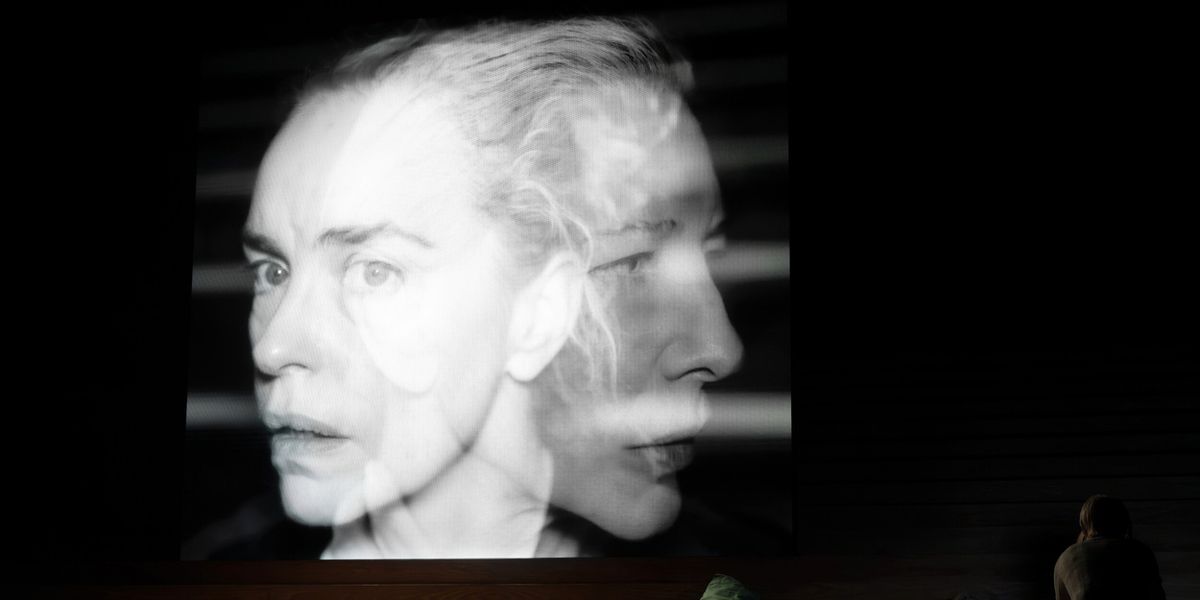

In Ingmar Bergman’s 1966 Modernist classic Persona, an actress named Elisabeth breaks down mid-performance, becomes mute, and goes on to develop a strange codependent relationship with her nurse, Alma. Much ink has been spilled over the film and its varied psychological readings, but Australian writer-director Benedict Andrews takes a new tack – he poses the question of why, of all the plays, Elisabet’s breakdown should happen during Sophocles’ Electra.
A central feature of Andrews’ production is that his stars, Cate Blanchett and Nina Hoss, toss a coin before each show to determine who’ll be playing Electra and Clytemnestra (on press night, Blanchett is Clytemnestra, and Hoss her vengeful daughter). In the second half – there’s no real interval – Electra will become Elisabeth, and whoever played Clytemnestra will morph into Alma.
It’s far from a gimmick. Immediately, we get a sense that the roles these actors are playing are not fixed, but permeable, and will bleed into one another. Our initial impressions of this version of Electra and Clytemnestra are familiarly Sophoclean – the cold, unfeeling mother, and the daughter crippled with rage against her family’s sickness – but we also know that this isn’t set in stone, and a different version of this mother-daughter relationship is lurking somewhere in the text.
Hoss and Blanchett start in all-black ensembles, but open up binbags of costumes (by Merle Hensel) unearthed from the family closet – Agamemnon’s military jacket, Clytemnestra’s furs, Orestes’ tracksuit. The boundaries of reality blur further as they start role-playing episodes from their family’s history (with Ella Lily Hyland supporting as younger sister Chrysothemis), as though stepping outside of themselves will help these characters process their grief. The result is not clarity, though, but confused identities and incestuous overtones.
All this means is that when we get to Persona, we are troubled by the notion of characters losing their sense of self. Blanchett’s version of Alma plays up her innocence, and her optimistic assertion of the healing qualities of the performing arts feels hopelessly naive, especially in front of a woman whose dedication to performance has just driven her to collapse. (Was Elisabeth’s performance as Electra the one we just watched in the first half? Andrews leaves the possibility open.)
%2C%20Nina%20Hoss%20(Clytemnestra)%20and%20Ella%20Lily%20Hyland%20(Chrysothemis)%20in%20Electra%20Persona_%20(c)%20Monika%20Rittershaus%20253.jpg?format=auto&width=800)
Photo credit: Monika Rittershaus
Later on, there is a layer of artifice and insincerity to both Alma and Elisabeth’s behaviour, as though each is constantly aware of the other – Alma with her monologues describing in explicit detail her sexual past and fixation on Elisabeth, and Elisabeth with her bemused microexpressions in response, projected via a handheld camera to a screen onstage.
This exposes that there is vulnerability in the act of confession – of revealing some aspect of oneself – and also in being a captive audience for a confession. Performing is a cathartic practice for performer and audience, and that isn’t necessarily a good thing.
Andrews doesn’t always have total confidence in his vision. Perfunctory nods to social media news fatigue and to the climate crisis lack subtlety, and feel at odds with these characters’ inward-looking self-obsession. The aforementioned onstage camera work serves its thematic purpose, and is a fine showcase for both performers’ skilful facial acting, but often tips into Jamie Lloyd-esque self-indulgence, or mimics memorable shots from the Bergman film without expanding upon them.
But these qualms are problems only when they detract from Blanchett and Hoss’s performances. The actors previously played a troubled married couple in the film Tar, and their chemistry is by turns erotic, maternal and hostile. As Alma and Elisabeth’s lives and psyches merge in increasingly uncomfortable ways, Blanchett and Hoss keep pace, physically melting into one another, parasitically taking on behaviours from each other and from their characters in the first act.
Both Andrews’ sElectra and his Persona could more than stand on their own as imaginative takes on seminal texts that reward those with knowledge of the source material. But the production’s real strength is in the elegant parallels it draws, to form a new whole that enriches and enhances the work of both Sophocles and Bergman.
Electra/Persona plays at The National Theatre until 10 October
Photo credits: Monika Rittershaus

Sign up for all the news on the Fall season, discounts & more...
|
Powered by

|

.png?format=auto&width=365)





Reader Reviews
To post a comment, you must register and login.