On An Ark with McKellen Prime- Holograms Onstage
Are we drawing closer to the day when the analog and digital entwine?
 Click for Tickets!
As I have twice had occasion in real life to sit, essentially, knee to knee with Ian McKellen, my encounter with his digital doppelganger at The Shed was perhaps somewhat less singular than it was for most attendees of An Ark. I have encountered Sir Ian in three palpable dimensions and in those instances he was able to shake my hand and pass me a cup of tea, rather than simply smiling benevolently from across a shallow void. But there was no mistaking the fact that thanks to An Ark, I felt like I’d spent 45 minutes with a very good simulacrum of the acclaimed knight, and presumably the other three actors were equally well rendered, even if I don’t have prior experience in their presence.
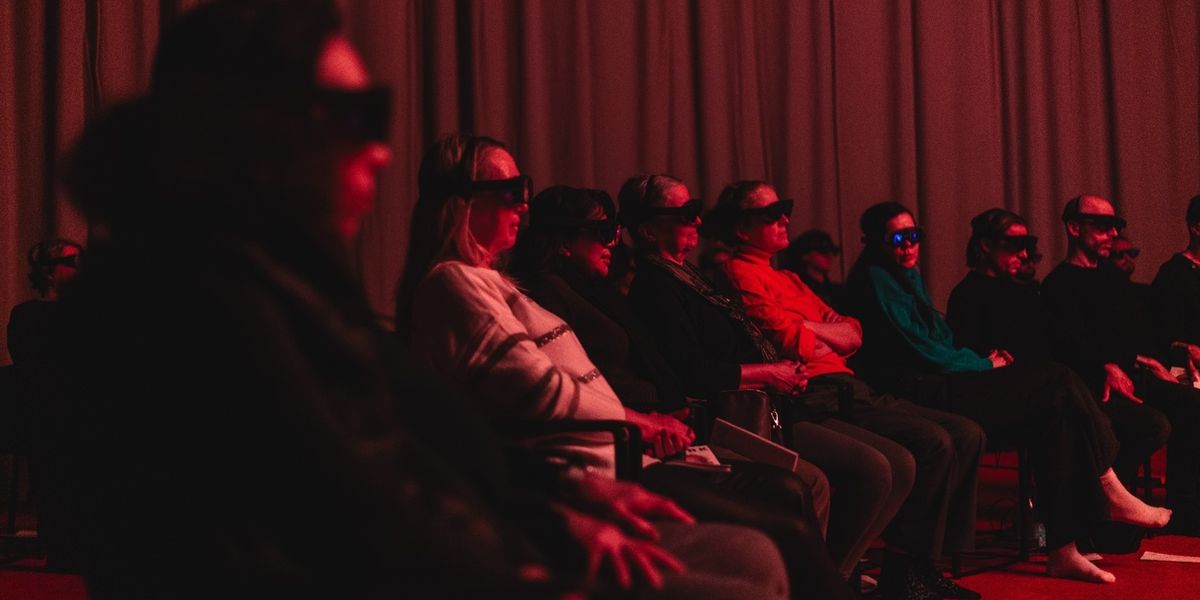
To explain a bit: An Ark is billed as the first mixed reality play and one watches it through high tech headsets which place the show’s four actors in a shallow semi-circle across from each viewer. The field of vision of the electronic glasses is narrow enough that you don’t actually take in all four actors at once, but if you swivel your head slightly from side to side, you can see the two actors on either end, panning and scanning a wider image according to your interest and attention. As the actors intone Simon Stephens’s text, you’re drawn to whomever is speaking, though free to focus on someone else, all with a pivot of the neck to bring the desired figure into the frame.
Do the actors appear corporeal? No, not really, though they seem to have dimension, something like a hologram. Their edges flicker slightly, reminding the viewer that they are a projection of some sort, although not on a screen, but into the empty space before us. It is possible to look through them and beyond, to other audience members in comparable glasses having the same experience, though the electronic interlopers, even just sitting and talking, are more engaging. At a few points, one actor or another stands and leaves the shallow seating array, seemingly walking past you as they exit the field of vision (and on their return) and in those moments, even though there is no whoosh of air as if a body had passed by, there is a true sense of departure, a cue of the eye, a trick of the mind.
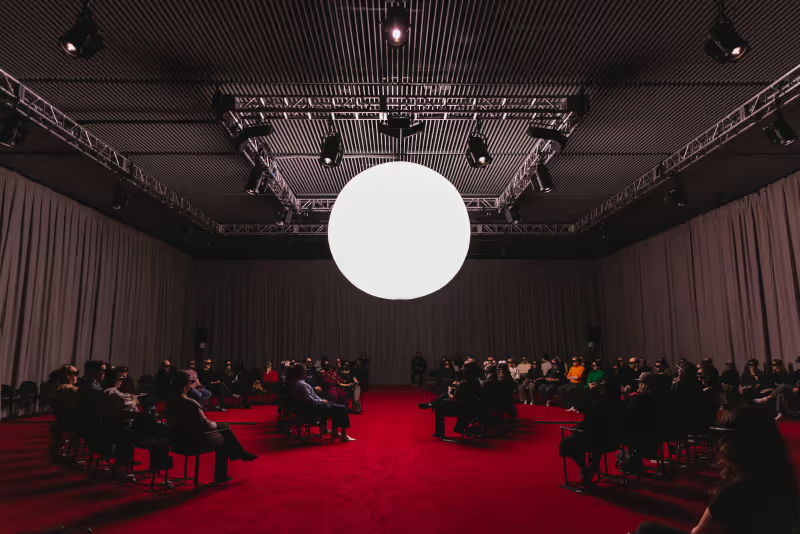
Ultimately, as the novelty of the technology fades over three quarters of an hour, there’s the realization that, despite the billing and the nature of the text, we’re not watching a mixed reality play but rather a mixed reality movie. While the characters exist in isolation as opposed to a setting (they were filmed in front of a green screen), the better to place them seemingly in close proximity to the viewers, this is a recorded experience that will be identical for every viewer, captured once for endless replay and repetition. Nothing that occurs in The Shed’s theatre can act upon the performers and we certainly aren’t sharing breath or space. We’re watching an exhibit, a sophisticated demonstration of digital wizardry dressed up to resemble theatre, but without the spontaneity and palpable humanity that underpins the act of theatregoing and theatrical performance.
That said, the timing of An Ark could not be more felicitous because of its overlap with Second Stage’s Broadway revival of Jordan Harrison’s Marjorie Prime. Why? Because Harrison’s play turns on the concept of Primes, sophisticated holographic recreations of deceased loved ones, to serve as companions and repositories of memories via artificial intelligence for those still alive. While Harrison and director Anne Kauffman free the play’s characters from visual paraphernalia and allow the holograms (played by flesh and blood actors) to appear through advanced projection, the Primes and the characters of An Ark are relatives, perhaps separated by only a few operating system upgrades over a space of years. The Primes can learn, and repeat, and engage in conversation, but much like today’s AI, they are regurgitating what’s been put into them; the passengers on the ark have already been filled with the desired information and intonation, but just imagine if they had a wider repertory or could engage independently.
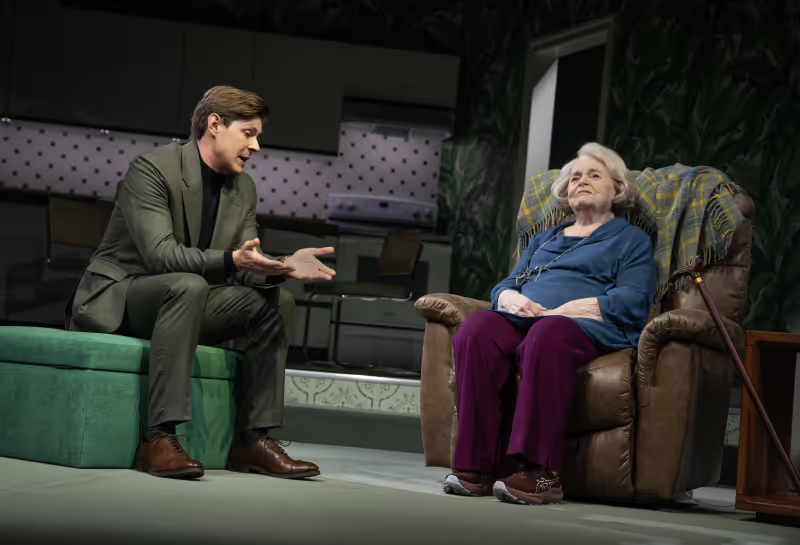
I confess that my mind wandered from An Ark to Marjorie Prime even as I watched the former, because while the latter theorized the technology but represented it with biology, An Ark was showing the way to such a possibility. Even as we excoriated the tone-deaf ads for a virtual friend that blanketed New York ad space a couple of months ago, the amalgam of An Ark and Marjorie Prime put forward more palatable versions, albeit with the countless moral and ethical questions that come with them. Are we so far, one wonders, from a production of Marjorie Prime where the Primes are actual holograms? Is there an iteration of An Ark where the actors can react and interact with the audience, rather than just be displayed in front of them?
For years, when discussing the impact of electronically reproduced entertainment on, and competition with, live performance, I have said that until someone genuinely invents Star Trek’s holodeck, we’ll be OK, because theatre will always be its own distinct form, preserved by its physical reality. The combination of Marjorie Prime and An Ark, imagination and realization, suggest we’re drawing ever closer to the day when we’ll have to grapple with a truly new form of theatre, where the analog and digital entwine.

.jpg?format=auto&width=365)