


Does Broadway Have a Vampire Musical Curse?
The Lost Boys is just the tip of the Vampire musicals iceberg.
Do you have a burning Broadway question? Dying to know more about an obscure Broadway fact? Broadway historian and self-proclaimed theatre nerd Jennifer Ashley Tepper is here to help with Broadway Deep Dive. BroadwayWorld is accepting questions from theatre fans like you. If you're lucky, your question might be selected as the topic of her next column!
Submit your Broadway question here!
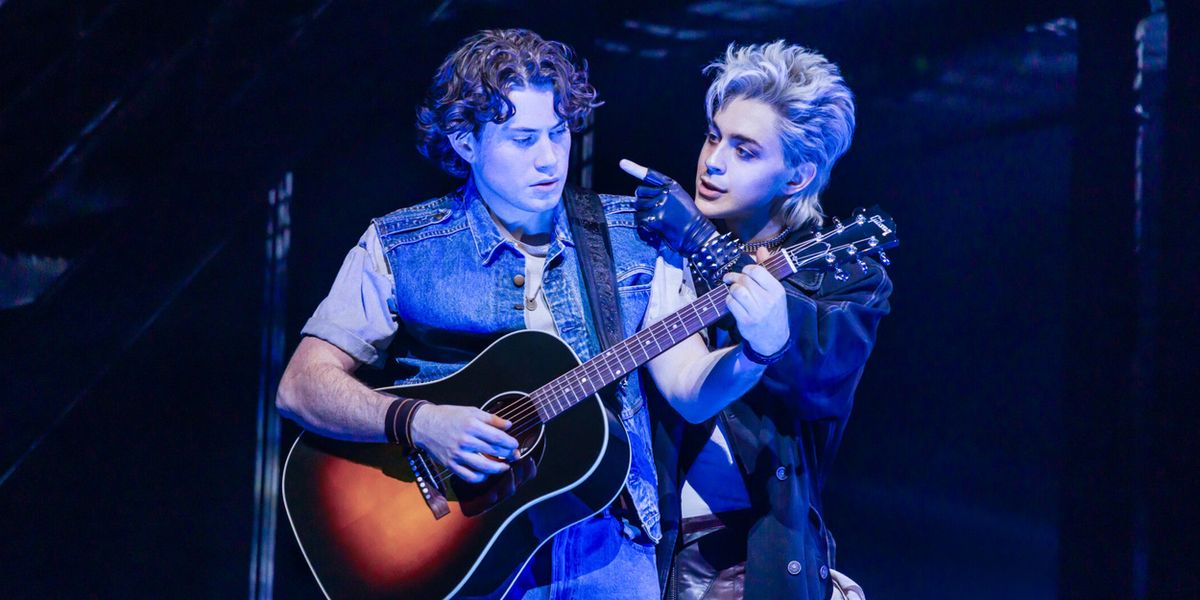
Since The Lost Boys took Broadway by storm this spring, there has been much chatter about the “vampire curse” on Broadway being lifted. In the early 2000s, Broadway received a string of three vampire musicals, which all closed relatively quickly. Dance of the Vampires (2002), Dracula (2004), and Lestat (2006) each received attention in their own right, but they also received attention as a group, since it was remarkable that they came along in such quick succession. But the early 21st century wasn’t the first time vampires thirsted on Broadway. The play adaptation of Dracula was a hit all the way back in 1927 and an even bigger hit in a 1977 revival. And there have been vampires lurking in the theatre district in all sorts of other projects too…
Dance of the Vampires, the second-to-last show to play the Minskoff before The Lion King moved in for the foreseeable future, had issues aligning its campy tone with its initially dramatic branding. The musical, based on a 1967 comedy horror film by Roman Polanski, started out in Vienna as Tanz Der Vampire. The show was a hit overseas, but a Broadway transfer required its sensibilities to be modified for American theatergoers. What had started out as gothic and sexy with some camp elements in Europe attempted to embrace the slapstick musical comedy genre becoming the rage on Broadway in the early 2000s. Zany adlibs were added, multiple creative team members went in and out, and more absurd humor descended upon the Minskoff’s vampires. Broadway audiences weren’t sure whether they were laughing at or with the show, which featured the much-quoted lyric: “Garlic, garlic!/ The secret of staying young/ Garlic, garlic!/ It’s why we’re so well-hung.”
Jim Steinman was behind Dance of the Vampires as composer, lyricist, and co-book writer (alongside David Ives and Michael Kunze). Steinman, the prolific and popular pop-rock writer of radio hits like “I’d Do Anything For Love (But I Won’t Do That)”, had written for the stage before but never on Broadway. A few previous Steinman hits, including “Total Eclipse of the Heart” (credited here as “Vampires in Love (Total Eclipse of the Heart)” were featured in Dance of the Vampires, alongside original numbers written for the score. The grandiose nature of Steinman’s songs combined with the absurd jokery of the English version of the show and the general creative mayhem behind the scenes made for a must-see Broadway event that everyone was talking about for two months in the winter of 2002. (How could one not dish about a Broadway musical with the line “Sucked as dry as a mummy’s scrotum!”) The Minskoff’s ushers were even dressed in vampire capes.
In Variety’s review of Dance of the Vampires, they noted that vampire identity crises should be left to Anne Rice, who had created the Lestat franchise. Little did they know what was coming.
But before Lestat hit the boards, there was Dracula. Two years after Mandy Gonzalez got her blood sucked for the last time, Kelli O’Hara and Melissa Errico had their turns, as the leading ladies in the new adaptation of Bram Stoker’s Dracula, with music by Frank Wildhorn and book and lyrics by Don Black and Christoper Hampton. As the title character, Tom Hewitt struck a foreboding shadow and sang numbers like “Fresh Blood”.
Dracula fit perfectly at the Belasco, the most haunted theater on Broadway. According to Belasco Theatre legend, because a showgirl wearing a blue dress mysteriously died falling down the theater’s elevator shaft, each production must have a character wearing a robin’s egg blue gown or the ghost will appear—and not leave the production alone. Dracula did not have a blue gown (maybe they should have), but it did have aerial work, blood, and nudity—excluding matinees. Both leading ladies, O’Hara and Errico, bared their breasts in the name of art for Dracula, but only at nighttime performances, since matinees were designated as PG-13 student shows.
Dance of the Vampires lasted 56 performances and Dracula lasted 157, but Lestat perished after only 39 shows at the Palace in 2006. Such a high profile effort going down in flames seemed to scare vampire tales off the Broadway stage for two decades. Then, Broadway’s current must-see The Lost Boys moved in exactly where Lestat played (well, a few stories northward, after the Palace’s renovation), and staked its claim.
Lestat had a score by Elton John and Bernie Taupin who had given the world hundreds of defining pop songs, including “Tiny Dancer”, “Your Song”, “Rocket Man”, and “Candle in the Wind”. But they would not give the world the score to Lestat. In a rare move, even though the original Broadway cast recorded a full Lestat cast album, the record has never been released.
It had been Taupin’s dream to bring Anne Rice’s The Vampire Chronicles franchise to the stage for decades. This final happened when director Robert Jess Roth (Beauty and the Beast) became involved. By that point, John had been around the block with The Lion King and Aida, achieving long runs with each. Book writer Linda Woolverton (Beauty and the Beast, Aida) was on board as well. And the show was Warner Bros. Theatre Ventures’ first venture on Broadway.
Lestat didn’t have Dance of the Vampires’ ushers in capes or Dracula’s bare breasts but it did have spectacle in the form of a wall of fire and trapdoors to achieve the effect of vampires disappearing quickly. The plot line was theatrical and queer, with 19th century Frenchman Lestat transforming into a vampire and being forced to determine who to bring along with him for eternal life. His ill mother, actor boyfriend, would-be adopted daughter, and new lover are all potential candidates for the bite that will transform them. Lestat took its vampires seriously, but seeing vampires in typical domestic situations provoked unintentional laughter. Still, Carolee Carmello, Hugh Panaro, Allison Fischer, Jim Stanek, and the rest of the cast gave sweeping, affecting performances. Critics, who had vampire fatigue at this point, took it out on the show, and seemed affronted by its purposeful seriousness.
The one-two-three punch of Dance of the Vampires, Dracula, and Lestat, in a four year period, soured Broadway on vampires until The Lost Boys arrived two decades later and found more success and less unintentional laughter. The Lost Boys is on its way to joining the legacy of the original play version of Dracula, a hit written by Hamilton Deane and John L. Balderston. Bela Lugosi headlined in the 1927 adaptation of Bram Stoker’s novel, which became a Broadway success that led to the 1931 movie version. Stoker himself had initially tried to adapt his novel for the stage, but this stalled. Dracula had very theatrical roots since the novel had been written while Stoker was working as a theatre manager in London.
The Broadway premiere of the play Dracula happened at the Fulton Theatre, later the old Helen Hayes, one of the five theaters demolished to build the Marriott Marquis. Some say that theatre folk from productions at those doomed houses haunt the area that the hotel and its Broadway theater sit on. So if you see Lugosi as Dracula haunting the Marquis breezeway, now you know why.
The play Dracula was briefly revived in 1931 before a 1977 revival at the Martin Beck (now the Al Hirschfeld) became a major hit, running for 925 performances. This time, Frank Langella headlined and the show put the producers Elizabeth I. McCann and Nelle Nugent on the map. A major reason for the production’s success was the vision of artist Edward Gorey who designed its sets, costumes, and show artwork and won a Tony Award. At the Tonys that year, Dracula was nominated in the category of Most Innovative Production of a Revival, a category that existed before musical and play revivals were separated into their own siloes. It won, and the success of this production led to another film adaptation with its Broadway star— Langella this time. One of the show’s Dracula replacements was a then-39-year-old Raul Julia.
Years before Dracula’s first appearance on a Broadway stage, Broadway was graced with a play simply called The Vampire. The 1909 piece was produced by the Shubert brothers at the Hackett Theatre on 42nd Street, which later became a movie house and then was demolished in the 1990s. But nearly a century before, it had held this vampire play by popular vaudeville writer Edgar Allen Woolf and George Sylvester Viereck. The Vampire was the center of some controversy because author Arthur Stringer claimed the playwrights had stolen their show’s plot from his novel. His novel, The Silver Poppy, chronicled the tale of a vampire who leeched off the brain power and thoughts of brilliant men. The Vampire’s playwrights denied Stringer’s accusations wholly. It was an ironic battle, given that the writers were accused of doing just what the central vampire did in their play.
Vampires as we know them today had been gaining steam in the cultural zeitgeist since the 1700s. The short-lived 1909 play The Vampire marked a turning point where vampires began making their way with increasing frequency into commercial storytelling. In the 1910s, Broadway saw seven songs about vampires performed into a variety of Broadway revues. The Ziegfeld Follies led this trend with the 1914 edition of the spectacular revue boasting a song called “The Man Who Wrote 'The Vampire' Must Have Known My Wife”. The song referred not to the previously discussed 1909 play The Vampire but rather to the famous Rudyard Kipling poem of the same name. The comedy number was composed and performed by the legendary Bert Williams, a pillar of The Ziegfeld Follies. Williams was a major star who broke many barriers and overcame countless hurdles as a Black entertainer in the early 20th century. Several critics pointed to “The Man Who Wrote 'The Vampire' Must Have Known My Wife” as the show-stopping highlight of that year’s Ziegfeld Follies.
This was followed by Odds and Ends of 1917, which featured a tune titled “The Vampire Maids” and The Passing Show of 1918, which featured a tune titled “My Vampire Girl”. Both revue series had their own merits but often looked to what the Ziegfeld Follies were doing to capitalize on trends and please their own crowds based on what was working.
In 1919, vampires were definitely the rage in Broadway songbooks, because four new songs about vampires hit the stage in that single year. The same writers who had penned “My Vampire Girl”. Sigmund Romberg, Jean Schwartz, and Harold Atteridge, were back with “Vampire Dance”, this time appearing in their hit book musical Monte Cristo, Jr. The show, which leaned toward opera, was a spectacular at the Winter Garden. Composer Schwartz was also behind “Baby Vampire (Land)” which was featured in Shubert Gaieties of 1919. The revue Toot Sweet featured the similarly titled but completely different “Baby Vampire”. Finally, Fifty-Fifty, Ltd. featured the intriguingly titled “(I’m a) Jazz Vampire”. Like several other vampire songs of the time, this one played on the contrast between vampires and vamps—a then-contemporary term for seductress. Even over a century ago, the sexual elements of vampires were being addressed on Broadway.
Prefer BroadwayWorld in Google Search?
Add us as a preferred source so our stories show up more often in Top Stories and Google’s AI answers — for you.
Sign up for all the news on the Fall season, discounts & more...
.jpg?format=auto&width=300)





Comments
To post a comment, you must register and login.