


A History of Broadway Proshots and Screen Adaptations
Pro-shots of Hadestown and Six will come to the big screen in summer 2026.
Do you have a burning Broadway question? Dying to know more about an obscure Broadway fact? Broadway historian and self-proclaimed theatre nerd Jennifer Ashley Tepper is here to help with Broadway Deep Dive. BroadwayWorld is accepting questions from theatre fans like you. If you're lucky, your question might be selected as the topic of her next column!
Submit your Broadway question here!
In the early days of silent film, there were many screen adaptations of stage pieces. In contrast with today, at the turn of the 20th century, there were many more people working in live entertainment than in film. Their stage work was ripe with potential to be adapted for this new media: movies.
While early silent films like King John (1899) and Romeo and Juliet (1900) did not actually adapt the entire work but rather filmed an excerpt, they could be considered our earliest stage-to-screen adaptations. It wasn’t just Shakespeare that was adapted during the early days of silent movies. From a 1906 short of Kathleen Mavourneen, based on a song that was turned into a Dion Boucicault play, to adaptations of the Alexandre Dumas play The Lady of the Camelias to versions of the Faust legend first adapted for the stage, other stage work was brought to the screen as well, during the earliest days of film. And even before these, there were early film experiments that were a minute long or less that utilized moments originally seen on stage.
Major full-length adaptations of Broadway shows came along pretty much as soon as the technology could sustain them. The first silent full length narrative film appeared in 1906; this was an Australian film called The Story of the Kelly Gang, based not on theatre but on a true story. From here, the world of film exploded. There were several silent Hamlet film adaptations seen during the early years of the 20th century.
What is a pro-shot and how is it different than an adapted film? Pro-shot is an abbreviation for professionally shot, denoting a stage play that was captured in its native habitat: a theatre. In general, a pro-shot seeks to film the exact experience that audience members would have at a live performance of the show, in contrast with a feature film which actually adapts the piece into a new form, including different locations, the removal of theatrical aesthetic, and changes to make the script work as a film as opposed to as a live theatrical show. The first pro-shot may have been L’Enfant prodigue in 1907. This French film was a full length capture of a famous pantomime, left in its original stage format rather than changed to accommodate screen specifics.
Of course, the first full length film with synchronized sound, The Jazz Singer (1927), was based on a play. The screen phenomenon starring Al Jolson started out as a hit 1925 play by Samson Raphaelson. Only two years later, in 1929, came the first full length stage musical with sound: The Broadway Melody, which won the Oscar for Best Picture. The Broadway Melody was not an adaptation of a stage show; it was an original musical created for the screen. But it paved the way for the stage musical-to-screen adaptations that came next. Within the same year, there were screen adaptations of hit stage shows The Desert Song and Little Johnny Jones. The Oscar Hammerstein II-Otto Harbach-Frank Mandel operetta and the George M. Cohan musical comedy both made a splash on screen in the last year of the 1920s. In addition to its 1929 film adaptation, The Desert Song also received a 1955 pro-shot for television.
In the following decade, as the art form of film evolved rapidly, several film adaptations of stage plays became acclaimed Best Pictures at the Oscars, Grand Hotel (1932), Cavalcade (1933), and You Can’t Take It With You (1938), among them. In Germany, 1931 found the landmark musical The Threepenny Opera receiving a full screen adaptation that did make changes to the script for the sake of adapting well to different media.
The major stage musical Show Boat attained an early and significant history of screen adaptions. The show by Oscar Hammerstein II and Jerome Kern premiered on Broadway in 1927. A silent film adaptation came along in 1929 that wound up interpolating a small number songs from the musical. This was quickly followed by a full sound, full-fledged 1936 film adaptation. Like many of the film musical adaptations to follow, the 1936 Show Boat found the creators penning songs exclusively for the screen version in addition to bringing the stage musical’s hit numbers to the screen. Several actors reprised their roles from the stage. Edna Ferber’s famous novel turned stage musical became a film event for a third time in 1951, this time pulling out all of the stops in Technicolor. Show Boat would also receive pro-shots in 1989 and 2015.
The 1930s also gave us screen adaptations of musicals like Anything Goes, No, No, Nanette, On Your Toes, Whoopee!, and Good News. From this decade onward, if a stage musical was a smash, it was fairly likely to be adapted for the screen sooner or later. The majority of the major Golden Age musicals became movies, with many achieving the feat of having their film version become just as beloved as their stage version.
The symbiotic relationship of stage and screen in nurturing the branding of shows like Guys and Dolls, My Fair Lady, West Side Story, Fiddler on the Roof, The Sound of Music and so on became a key element in the longevity of each property. Those who saw the show wanted to see the film when it came out; those who got to know the piece from the movie wanted to experience the story live. That said, most of the film adaptations came out after the shows’ original productions were already closed on Broadway. The way that the stage and film versions fed off each other was long term, inspiring major revivals, licensing, stock productions, and so on—rather than supporting the original production. Would we have had as many productions of Grease without the hit status of the beloved film adaptation?
Following the Golden Age, in the 1970s and 1980s, the perceived relationship between stage and screen versions of the same property changed. Since hit musicals were achieving longer and longer runs on Broadway, screen adaptations sometimes showed up while the original production was still running. In the case of Annie, which opened on Broadway in 1977, the film version showed up in 1982 but did not prevent the show from closing in 1983. Grease’s film showed up six years into its Broadway run; the show ran another two years after the movie came out. Those in charge began asking the question: would a screen version of a show hurt sales for the live version? Would people who could see a piece in their local movie theater still show up to see it on stage? For the next several decades, the general answer was that film adaptations did not appear to be significantly helping original productions stay open or shuttering them. Still, several major hits avoided coming to the screen until many years into their run in fear that a film might hasten the closing of the live production.
In the early 21st century, the massive success of screen adaptations like Chicago and Mamma Mia! undoubtedly enhanced audience interest in seeing the shows live, on Broadway and beyond. Broadway ad campaigns played on this interest, capitalizing on the desire to see a beloved movie live on stage. Soon the prevailing sentiment was that if the film was a hit and the marketing was handled correctly, a screen adaptation could enhance sales for the original Broadway production as well as for the property’s long term life. Some still stalled on screen adaptations of shows until their Broadway production closed, just in case, each property being its own unique entity with unique sales patterns.
For decades, the strategy behind pro-shots was specifically to release them after the live production had already closed. Film adaptations had their own movie studios and teams and were sometimes at the mercy of a variety of powers-that-be to determine a release schedule. But pro-shots were more so under the control of the same folks powering the live production and thus could be timed for release after the live play or musical closed.
While L’Enfant prodigue could technically be considered a very early pro-shot from 1907, pro-shot theatre being brought to screen didn’t begin in earnest until the mid-20th century. Many early pro-shots were shot not for the intention of ending up in movie theaters but rather ending up on the small screen. As the art of television grew, so did the number of theatrical productions that came into the home via pro-shots. The 1960 pro-shot of Peter Pan starring Mary Martin is a well known example of the way that plays and musicals were filmed live and then broadcast.
In 1972, PBS’s Great Performances began. The program featured pro-shots of plays and musicals as well as other live events like operas and concerts. It was not the only television program dedicated to bringing these to the silver screen but it became the longest running. Because non-commercial channels got into the business of airing pro-shots, shows that might not be thought to have as wide appeal as needed for a major motion picture could still be picked up and shot live for the screen. From a 1976 airing of Lanford Wilson’s The Mound Builders to 1978’s version of Uncommon Women and Others by Wendy Wasserstein, the program allowed for worthwhile work by major playwrights to be more widely seen and to be archived for posterity.
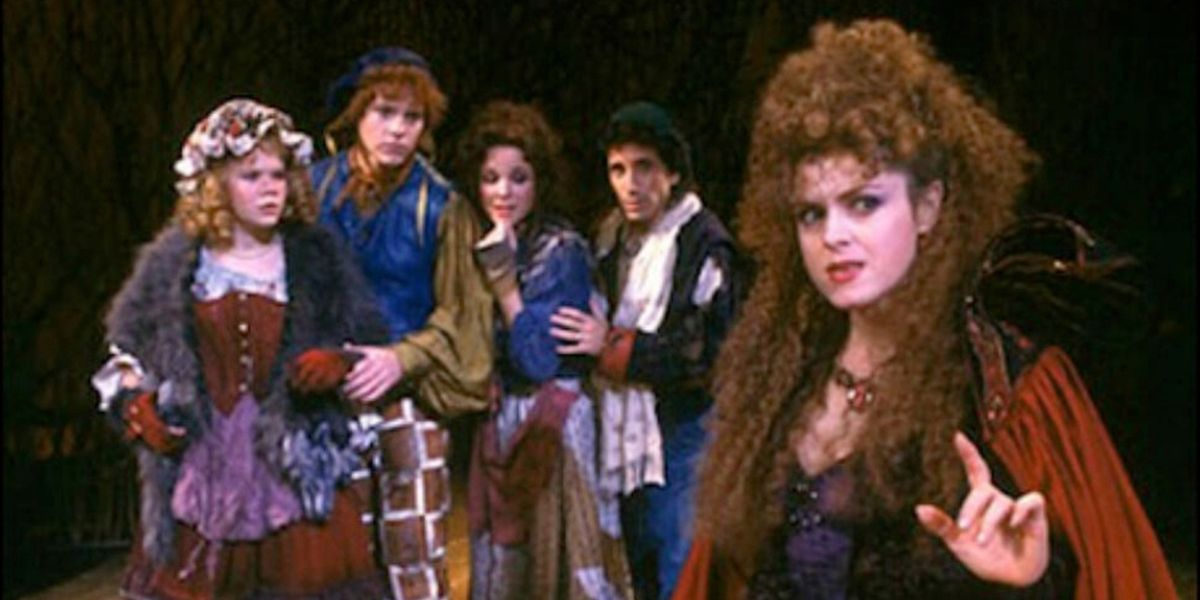
Sondheim musicals like Pacific Overtures, Sunday in the Park with George, and Into the Woods received pro-shots of their original Broadway productions. Thus, these important musicals that were not initially adapted into films gained new fans and ripened for later productions. Even mega-hits like Cats sometimes received a pro-shot before being adapted for the screen in a major motion picture, since the latter could take awhile for all kinds of reasons but the former was somewhat easier to pull the trigger on.
In the 2010s, the pro-shot market heavily expanded, with an increasing number of new shows and revivals being filmed live for release. This coincided with an increase in productions aired live on television as well. Pro-shots like Allegiance and Falsettos introduced new audiences to the pieces who could not have seen them otherwise and pro-shots like Hamilton capitalized on their existing massive fanbase to stoke the flames of would-be ticket buyers and expand the show’s reach. The 2010s was also the decade that saw internet bootlegs become a part of the equation. One of the reasons for releasing official pro-shots was to combat this. In releasing pro-shots, productions could ensure a professional alternative that was created by the production and also financially benefited those who worked on it.
Of course, not just any production could film a pro-shot. The massive funding required to create a pro-shot, including fair compensation for all team members, meant that it wasn’t as easy as just setting up cameras in the theater. But, it was easier and less expensive than making a major motion picture, and provided an entry point of access for those who couldn’t see the actual show. So, pro-shots began to grow in popularity.
Prevailing sentiment also became that pro-shots also did not prevent a major film adaptation from happening later on. Audiences began to enjoy seeing properties they loved in multiple formats and sales proved that something like a pro-shot of Les Miserables would not prevent audience members from also seeing its movie.
As plays and musicals became 365-degree brands, it became clear that most ticket buyers for a live musical would also want to consume the same show’s pro-shot and film adaptation as well as buy its merch, stream its cast recording, and so on. With properties like Chess or Legally Blonde, pro-shots inarguably made it possible for new live productions to happen and succeed that could not have otherwise. Consumers have become increasingly interested in collecting all versions of something they love, which has led to more theatre being transformed into either pro-shots or major motion pictures.
Sign up for all the news on the Fall season, discounts & more...
.jpg?format=auto&width=300)





Comments
To post a comment, you must register and login.