15 Broadway Musicals with Multiple Movie Adaptations
Take a look at our list of musicals that have danced their way to the screen more than once!
In an interview last month, Andrew Lloyd Webber hinted that there may be a new film version of The Phantom of the Opera on the horizon, serving as a remake of the previous 2004 adaptation. This tease follows last year's announcement that Rob Marshall has begun work on a new movie version of Guys and Dolls, which was already adapted in the 1950s.
For years, Broadway musicals have spawned multiple film adaptations, from the early days of cinema to Steven Spielberg's remake of West Side Story in 2021. With more movie musical remakes an inevitability, we have compiled 15 of the most noteworthy examples of musicals that have danced their way to the screen more than once.
For this list, we are only including Broadway musicals adapted as films, whether that be a flashy Hollywood musical or a television adaptation for the small screen. Live recordings, concert versions, or filmed Broadway productions are excluded.
Take a look at the list below to discover how many you have seen!
Show Boat
Show Boat was one of the earliest book musicals as we know them today. The show originally premiered in 1927, with a score by Jerome Kern and book and lyrics by Oscar Hammerstein. Several of its songs, such as Ol' Man River and Can’t Help Lovin’ Dat Man, are now considered classics.
Since its debut, the stage musical has served as inspiration for three feature films. The first, a silent film released in 1929, was mostly based on the novel by Edna Ferber, which inspired the musical. However, scenes from the stage show featuring dialogue and music were later incorporated into the movie, including the two aforementioned songs from the musical.
In 1936, the first major film adaptation of the musical came to the screen, featuring ten numbers from the stage show. Three new songs, written by Kern and Hammerstein, were also incorporated into the film. Helmed by famed Frankenstein director James Whale, several original Broadway cast members reprised their roles for this version, including Charles Winninger, Helen Morgan, and Sammy White.
15 years later, in 1951, a flashy, commercial MGM movie version arrived in theaters, receiving critical and box office success. With a cast that included Kathryn Grayson, Ava Gardner, and Howard Keel, the movie soundtrack includes many of the familiar songs, despite those written for the 1936 movie being omitted. Though the 1951 film was well-received at the time, the 1936 film is generally considered a better, more faithful adaptation of the stage show.
Good News
An old-fashioned musical comedy by Ray Henderson, Buddy DeSylva, and Lew Brown, Good News debuted on Broadway in 1927, the same year as Show Boat. Three years later, the first movie version was released, starring Bessie Love, Cliff Edwards, and Penny Singleton. Though little-seen today, the movie is mostly notable for being released during the pre-Code era when regulations around content were looser. Because the movie featured sexual innuendos, it was not shown during the 1940s, when the Hayes Code was in place.
It was during the 1940s that a new film version of the movie was released. Starring June Allyson, Peter Lawford, and Patricia Marshall, the 1947 film features a screenplay by Betty Comden and Adolph Green, who contributed the book and/or lyrics to numerous musicals such as On the Town, Peter Pan, Applause, and more. Though the film contained an adjusted lineup of songs, some originals remained, including "The Best Things in Life Are Free" and "The Varsity Drag."
Anything Goes
Anything Goes, the popular stage show with songs by Cole Porter, has been made into two major films. The first was released in 1936 and starred Bing Crosby and Ethel Merman, who reprised her breakout role as Reno Sweeney. The soundtrack was heavily altered for this version, with only four of the original songs remaining in the film. Four new songs were written for the film by Richard A. Whiting, Hoagy Carmichael, Leo Robin, Edward Heyman, and Friedrich Hollander.
Crosby himself returned for the second adaptation in 1956. However, other than utilizing the familiar title, it has very little in common with the original musical. The character of Reno Sweeney doesn’t appear in this version, with the film following two Broadway entertainers played by Crosby and Donald O’Connor. The song listing was again changed, with a mix of numbers from the stage show and newly written ones.
Kiss Me, Kate
The only feature film adaptation of the Tony Award-winning musical Kiss Me Kate was released to theaters in 1953, led by Kathryn Grayson, Howard Keel, and Ann Miller. The movie used many of the familiar songs, including So In Love and Always True to You in My Fashion.
One of the more notable aspects of the film was its use of 3D. During a period in which 3D technology was becoming more widely used in Hollywood, MGM filmed Kiss Me Kate in both a 3D and a “flat” version. In the years of home video, the 3D version of the movie became available, and, in 2023, a restored 3D version screened at Film Forum.
Several television versions of the musical were released in the twentieth century. First, a 1958 Hallmark Hall of Fame production with stars Alfred Drake and Patricia Morrison reprising the roles they originated on Broadway in 1948. In 1964 and 1968, two more versions were shown on television on BBC2 and ABC, respectively.
State Fair
This one may be a bit of a cheat, as the stage musical itself didn't make its way to the stage until several years later. Still, there have been two movie versions of Rodgers and Hammerstein's State Fair, which warrants its inclusion on the list.
The musical first came to life in 1945, when 20th Century Fox released the first film version in theaters. Written for the screen, the film was an adaptation of the 1933 feature, which in turn was based on a novel by Phil Stong. Starring Jeanne Crain, Dana Andrews, and Dick Haymes, the movie went on to win Rodgers and Hammerstein an Academy Award for their song "It Might as Well Be Spring."
The movie was remade in 1962, led by Pat Boone, Ann-Margret, and Bobby Darin. At the time of its release, Hammerstein had passed away two years prior, leaving Rodgers to write both music and lyrics for the five new numbers. The movie performed poorly at the box office, and is generally considered the lesser of the two films.
Brigadoon
With music and lyrics by Frederick Loewe and Alan Jay Lerner, the 1947 production of Brigadoon saw great success in a creative collaboration that would result in further Golden Age hits such as My Fair Lady and Camelot.
MGM would later acquire the film rights for the musical, which officially came to the screen in 1954. With a cast that included Gene Kelly, Van Johnson, and Cyd Charisse, the film was directed by Vincent Minnelli, who had already helmed such several big-screen musicals, including Meet Me in St. Louis, An American in Paris, and The Band Wagon.
The musical was adapted for television in 1966, utilizing several cast members Sally Ann Howes and Edward Villella, from the then-recent Broadway revival. The production included more of the original Broadway score than its 1954 counterpart and featured a revised script in an attempt to better adapt it for the medium of television. It won 5 Emmy Awards.
South Pacific
The first film version of South Pacific hit theaters in 1958, nine years after the Rodgers and Hammerstein musical premiered on Broadway. Featuring all of the familiar songs, such as A Cock-Eyed Optimist, Some Enchanted Evening, and Younger Than Springtime, the movie was led by Mitzi Gaynor as Nellie and Rossano Brazzi as Emile. Like many major movies of the time, South Pacific received a roadshow release, which was a longer cut with additional scenes that played in select theaters. It was a box office success upon its debut, remaining the highest-grossing Rodgers and Hammerstein film adaptation until The Sound of Music. The movie is currently streaming on Prime Video.
A television adaptation of the stage musical aired on ABC in 2001. This version, which starred Glenn Close as Nellie, featured a reworked song order, with some numbers cut down and “Happy Talk” completely removed from the score. New scenes and characters were added as well. Alongside Close, the movie features Rade Sherbedgia as Emile and Harry Connick Jr. as Joseph Cable.
The King and I
The King and I, the sixth musical from celebrated songwriters Rodgers and Hammerstein, was made into a film in 1956 with Yul Brynner reprising his Tony Award-winning performance as the King of Siam. The movie, which also starred Deborah Kerr and Rita Moreno, was nominated for nine Academy Awards, winning five.
In 1999, an animated adaptation of the musical was released in theaters. It included several of the original songs from the hit musical, including Getting to Know You, Hello, Young Lovers, and I Have Dreamed. Miranda Richardson, Martin Vidnovic, and Ian Richardson were among the voice cast. The animated version is currently streaming on Prime Video.
Rodgers and Hammerstein’s Cinderella
Like State Fair, Rodgers and Hammerstein's Cinderella didn’t come to Broadway until much later. Still, this classic musical has been presented on the small screen three times. The original version, led by Julie Andrews, premiered on CBS in 1957, with a huge viewership tuning in to the production, the largest in history at the time of its premiere.
It was subsequently remade in 1965 with a young Lesley Ann Warren in the title role, utilizing the original songs, along with the number "Loneliness of Evening," which had been cut from Rodgers and Hammerstein's South Pacific. This version is streaming on Prime Video.
As part of a relaunch of The Wonderful World of Disney, a contemporary adaptation of the musical aired in 1997 featuring several Broadway stars, including Jason Alexander, Whoopi Goldberg, Bernadette Peters, and Victor Garber. Brandy and Whitney Houston led the film as Cinderella and the Fairy Godmother, respectively. This version is streaming on Disney+.
Bye Bye Birdie
The original 1960 Broadway production of Bye Bye Birdie was a huge success, winning several Tony Awards, including Best Musical and Best Performance for Dick Van Dyke. For the 1963 film adaptation, Van Dyke reprised his role, now starring alongside Janet Leigh as Rosie. The movie featured a rewritten script, with more emphasis placed on the character of Kim MacAfee, played here by Ann-Margret.
The musical was remade for the screen in 1995, this time for television. The movie includes a cast of several Broadway stars, including Jason Alexander, Vanessa Williams, Tyne Daly, and Marc Kudisch. Songwriting team Lee Adams and Charlie Strouse won an Emmy for Outstanding Music and Lyrics for their new song Let’s Settle Down.” The TV movie is streaming on Prime Video.
The Music Man
The Music Man became a huge hit on Broadway upon its debut in 1957. The musical, which follows con man Harold Hill, won five Tony Awards, including Best Musical and Best Actor for Robert Preston as Hill. For the 1962 film version, Preston reprised his role, with a cast that also includes Shirley Jones, Buddy Hackett, Hermione Gingold, and a young Ron Howard. The film was a hit with audiences and critics alike.
In 2003, the musical was adapted once again, this time on television for The Wonderful World of Disney. The movie was full of Broadway talent, with Tony Award winner Matthew Broderick taking on the role of Hill, along with Kristin Chenoweth, Victor Garber, and Debra Monk.
West Side Story
West Side Story is one of the few titles that has received more than one major Hollywood feature film, rather than TV adaptations. Following its major success on Broadway, a film version of the Leonard Bernstein and Stephen Sondheim musical came to the screen only three years later. Using the beloved songs and Jerome Robbins’ original choreography, the movie starred Natalie Wood, Richard Beymer, Russ Tamblyn, and Rita Moreno. It became the highest-grossing film of that year and won 10 out of 11 nominated Academy Awards, including Best Picture and Best Supporting Actress for Moreno.
50 years later, a new film adaptation hits the screen. Directed by Steven Spielberg, the remake featured a reworked screenplay by Tony Kushner. The contexts of some of the original songs were adapted, and the new character of Valentina, played by Rita Moreno, was added. Also starring Rachel Zegler, Ariana DeBose, and Mike Faist, the movie was nominated for seven Oscars, with DeBose taking home an award for her performance as Anita- the same role that Moreno played in the original. Spielberg's version is available on Disney+.
Gypsy
Considered one of the best musicals of all time, Jule Styne and Stephen Sondheim’s Gypsy first came to the screen in the 1962 film starring Rosalind Russell as Mama Rose and Natalie Wood as Louise. The film included nearly all of the original songs, omitting "Together Where We Go" and shortening "You'll Never Get Away from Me." Though deleted from the film cut, both numbers were recorded and can be found on the official soundtrack.
Led by Bette Midler as Rose, the musical was remade for television in 1993, featuring a cast that included Edward Asner, Linda Hart, Christine Ebersole, Michael Jeter, and Andrea Martin. Midler won a Golden Globe for her performance. At the time of its release, Jule Styne praised the production, saying, “It is the most outstanding singing and acting performance I've seen on the screen within memory.” The TV version is currently streaming on Prime Video.
The Rocky Horror Picture Show
In 1975, Jim Sharman brought his musical comedy The Rocky Horror Show to the screen as a film event titled The Rocky Horror Picture Show. For the movie, Tim Curry and Richard O’Brien reprised their original roles as Frank-N-Furter and Riff Raff, respectively. Other members of the cast included Barry Bostwick and Susan Sarandon in her film debut. Though it was not successful during its initial run, it has since gone on to become a cult classic, with annual screenings taking place all over the world during Halloween.
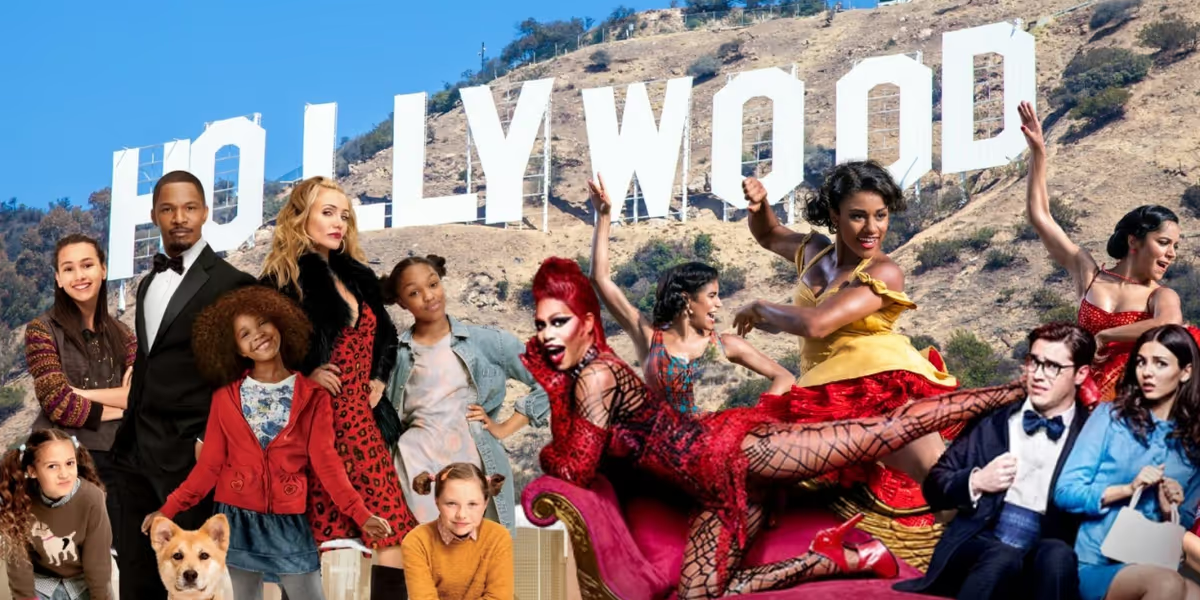
The movie was remade for television in 2016. Now with the subtitle “Let's Do the Time Warp Again,” the movie starred Victoria Justice and Adam Lambert, along with Broadway’s Ryan McCartan, Annaleigh Ashford, Reeve Carney, Ben Vereen, and Laverne Cox as Frank-N-Furter. Original cast member Tim Curry served as the Narrator and the Criminologist.
Annie
Annie, the popular musical by Charles Strouse and Martin Charnin, has been adapted for the screen three times. The first, and most well-known version, came in 1982, five years after the musical premiered on Broadway.
The cast featured several top performers of the day, including Albert Finney as Daddy Warbucks, Carol Burnett as Miss Hannigan, Ann Reinking as Grace, Tim Curry as Rooster, and Bernadette Peters as Lily. The soundtrack included the most popular numbers from the stage show, along with new additions such as "Let's Go to the Movies.” The movie served as the film debut of Aileen Quinn, who stars as the title character. It is available to stream on Netflix.
In 1999, a television remake premiered as part of The Wonderful World of Disney. Directed by Rob Marshall, who would go on to direct film versions of Chicago and Into the Woods, the movie featured a cast chock-full of Broadway talent including Alan Cumming, Audra McDonald, Kristin Chenoweth, and Victor Garber.
A contemporary film adaptation with a largely reworked script debuted in 2014. Led by Jamie Foxx and Cameron Diaz, the soundtrack includes several of the original songs, albeit with adjusted arrangements and lyrics. Rose Byrne, Bobby Cannavale, and Quvenzhané Wallis also star.