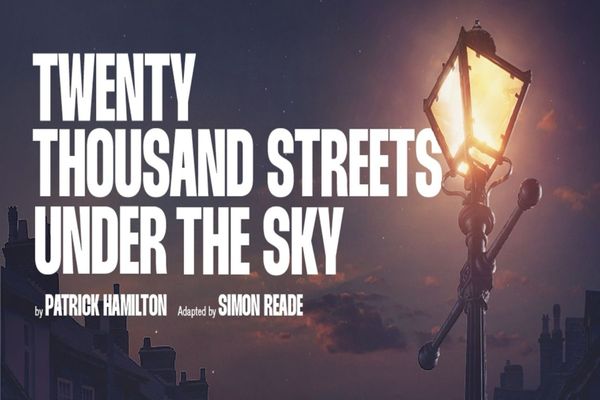
Guest Post: Simon Reade On Adapting Patrick Hamilton's TWENTY THOUSAND STREETS UNDER THE SKY, Coming To Southwark Playhouse
'Is that a kind of love story? Judge for yourselves.'

Patrick Hamilton (1904-1962) wrote his semi-autobiographical trilogy as a dark celebration of the seedy, smoggy, smutty London he inhabited in the late 1920s. Published first as Bob’s story (The Midnight Bell 1929), then with Jenny’s back-story (the salaciously titled The Siege of Pleasure 1932) and finally Ella’s simultaneous story to Bob’s (The Plains of Cement 1934, originally titled ‘Time, Gentlemen, Please’), Twenty Thousand Streets Under the Sky – A London Trilogy was compiled and published in one volume 1935.
Its private characters – three of them as young as the century – step out of the public houses into the maze of London: from Euston Road to Soho, the West End to Hammersmith, those twenty thousand streets of London lurking and shimmering beneath the capricious sky.
%20-%20credit%20Mitzi%20de%20Margary.jpg?format=auto&width=800)
Photo Credit: Mitzi de Margary
We meet pliable barman Bob, the cockneyfied son of an American cop and an Irish mother; Jenny, “a girl of the West End streets”, lured by the raffish George Perry into the dissolute world of sex work with Prunella, Jenny’s larger-than-life friend; and the barmaid Ella who is perfunctorily seduced by the incompatible Ernest Eccles, twice her age, while she remains hopelessly, unrequitedly in love with Bob. The tone of all their stories is tragi-comic, dramatising the suffering and despair of their ordinariness. Hamilton was what his biographer Nigel Jones in Through A Glass Darkly calls a “chronicler of the lost and lonely, the restless and the rootless.”
This new adaptation bears witness to the humanity of Hamilton’s vision – “the small fish in the weird teeming aquarium of the metropolis” – and seeks to capture all the conflicting emotions of his world, of the “sensation of pity and horror, of shock and weird fascination … swallowed up for ever in the great world of London.” (To some extent, Twenty Thousand Streets Under the Sky has self-conscious and ironic echoes of Jules Verne’s 1869-1871 science fiction adventure story Twenty Thousand Leagues Under the Sea.)
%20and%20Matthew%20Iliffe%20(Director)%20-%20credit%20Mitzi%20de%20Margary.jpg?format=auto&width=800)
Photo Credit: Mitzi de Margary
Bob dreams of being a writer (an English Tolstoy no less) and this dramatisation works Hamilton’s distinctive third person narrative voice into Bob’s aspirant writer’s voice. Similarly, Ella’s story is told in part through her “introspections” and the dramatisation seeks to capture some of that tone and ambience. From our perspective of Bob’s experience, Jenny might appear to be carelessly cruel, until we learn to appreciate her backstory in The Siege of Pleasure, a flashback to the first night she was led astray by men and alcohol.
The dialogue is laced with the subtext of Chekhovian, aching desire beneath deceptive banalities and cheeriness. It has sustained wry, dry humour, an irony of tone which echoes E.M. Forster, even Jane Austen at times. Yet there are also bursts of dire menace and anxious threat as the discourse spirals downwards into the Dante-esque, hellish circles of the “wicked old town.” Because of all this, it often sounds like T.S. Eliot at his most demotic in the Sweeney verses, and even proto-Pinter: “I’ll show you how to live, I’ll show you how to live! I’ll show you life with a capital L. I’m a past master of the art.”
%20and%20Rosalind%20Lailey%20(Ella%20Dawson)%20-%20credit%20Mitzi%20de%20Margary.jpg?format=auto&width=800)
Photo Credit: Mitzi de Margary
Part of the pleasure of bringing the whole story to the stage now is to repay the debt dramatists of the past one hundred years – and English literature at large – all owe to this great unsung anti-hero of a writer, Patrick Hamilton. The Twenty Thousand Streets trilogy takes us beyond the relative melodramas of his popular plays Gaslight and Rope and arguably delves deeper than his better-known novel Hangover Square.
Hamilton, as young as the century himself, pens heart-wrenching portraits of female vulnerability, of male emasculation and how it fuels impotent rage. We may project our own criss-crossing journeys across the twenty thousand cacophonous streets. Our destination redemption? Epiphany? Or the dead-end of despair? It is a tale of love and loss, lost love and love lost. Is that a kind of love story? Judge for yourselves.
Twenty Thousand Streets Under The Sky runs at the Southwark Playhouse, Borough from 10 September - 17 October

Sign up for all the news on the Fall season, discounts & more...
|
Powered by

|
.jpg?format=auto&width=300)