


Review: MAN TO MAN, Royal Court
Tilda Swinton returns to the Royal Court in dominant mood
 A title is the one line of a play a translator absolutely has to get right, and it's the line they most reliably fumble. In Jean-Paul Sartre's Huis clos (French for the legal term “in camera”), the existentialist philosopher stated — not entirely unreasonably — that "hell is other people”; which post-death destination the person that came up with No Exit (a phrase that belongs on a fire door, not a stage) ended up in is unknown.
Then there’s Anton Chekhov's examination of country manners Chayka which is known over here as The Seagull, even though the landlocked estate and its bored characters look out over a lake, not an ocean. If they had made that slip in modern times, the translator may have found themselves coming down with a bad case of polonium-210.
And then there's Manfred Karge's Jacke wie Hose. The German idiom means, roughly, that a jacket and a pair of trousers amount to the same thing, so why fuss over which one you're wearing? It perfectly encapsulates what the whole play is about, namely that personal identity can be a matter of tailoring, not conviction. Yet, now we are stuck with Man To Man which sounds more like a problem page in a gay lifestyle magazine.
In Weimar Era Berlin, Ella Gericke's crane operator husband Max dies suddenly. With no income, no pension rights as a widow and no legal way to hold his job herself, Ella cuts her hair and buries her husband in secret before taking his name, his clothes and his place on the construction site. She becomes Max.
This short-term plan becomes a longer one as this economic cross-dresser survives winter then continues through the rise of the Third Reich, navigating Nazi bureaucracy and fending off military conscription. As he moves around the country, “Max” conceals his real identity from work colleagues, the neighbours and an ever-inquisitive regime that is rounding up and shipping off more and more people to the concentration camps.
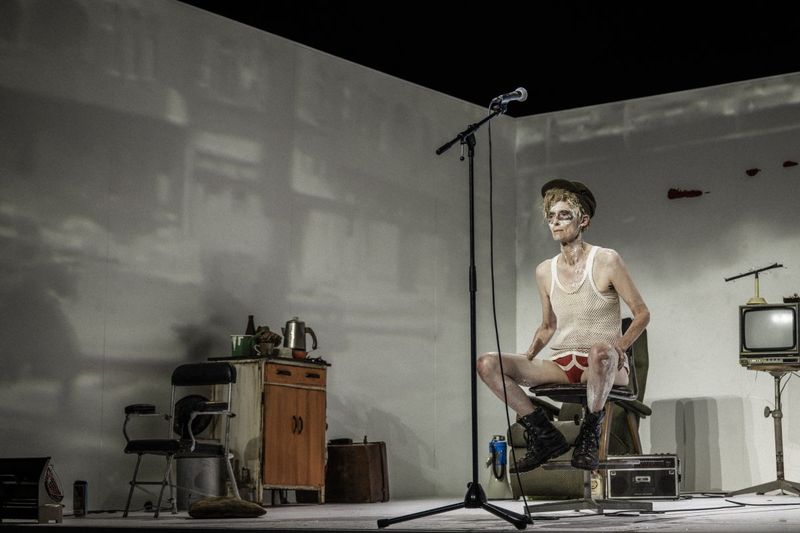
Those worrying that Tilda Swinton — the patron saint of Sunday afternoon arthouse movies and performance art best experienced through reviews — has gone mainstream should make themselves a cup of chamomile tea and relax. There are likely very few famous actors (never mind Oscar winners) queuing up to spend their night daubed in white paint and standing alone for 80 minutes dressed in little more than a string vest and giant red y-fronts. There are, though, plenty of people eager to watch la Swinton: the London run has already sold out ahead of press night before, like a rock tour, the play heads to Edinburgh, Berlin and New York.
And, to continue the analogy, there’s a real feeling that this is a band getting back together. In 1987, Stephen Unwin – then an associate director at the Traverse — directed a 26-year-old Swinton who had left Cambridge a couple of years earlier and only had one film (Derek Jarman’s Caravaggio) on her CV. Also in her mid-twenties, set designer Bunny Christie had already worked for The National Theatre and others before she originally came to Man To Man and returns here alongside Swinton and Unwin. In a neat move, the text has been remastered by Unwin to include references to 1989’s fall of the Berlin Wall and beyond.
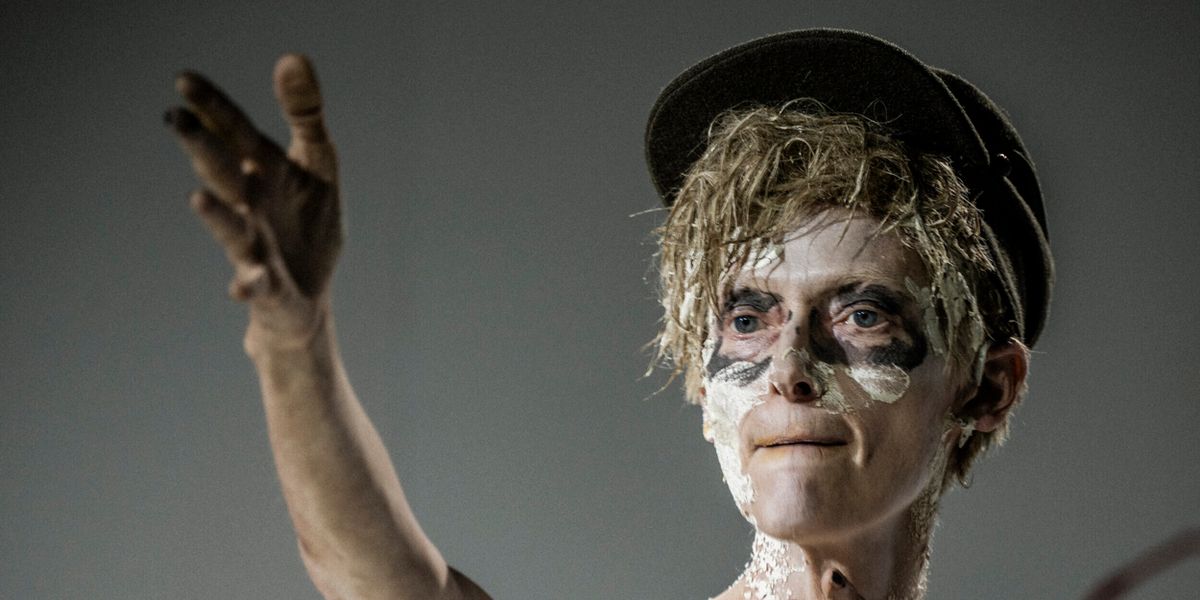
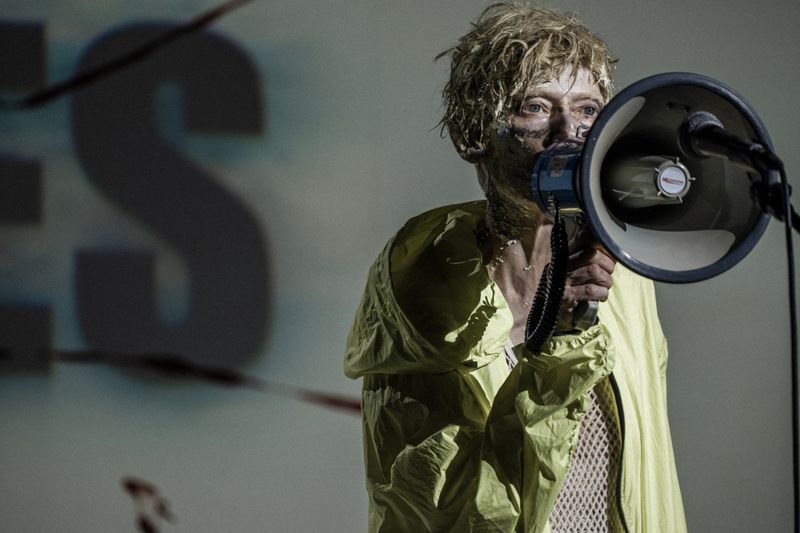
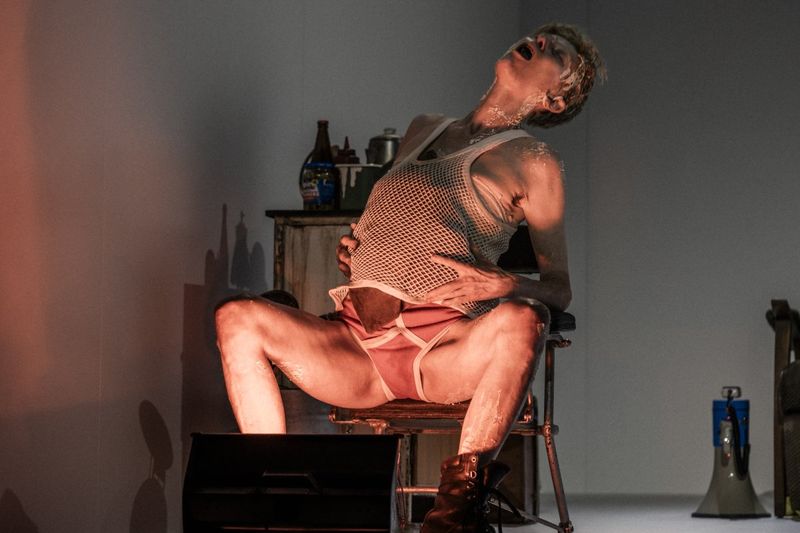
Swinton portrays everyone that “Max” meets — foreman, work buddy, Nazi official, potential lover — as she swaggers around the stage with a thick Home Counties accent, cropped blonde hair and a stare that reaches down the King’s Road. Her Ella doesn’t so much switch to “Max” mode as gently sink into it like a warm bath. She carries a gruff, rough manner from encounter to encounter that only occasionally dips into tenderness. The baggy underwear and vest stay put throughout but she adapts as she goes along, donning a bright yellow hi-viz jacket or slapping on some bright crimson lipstick.
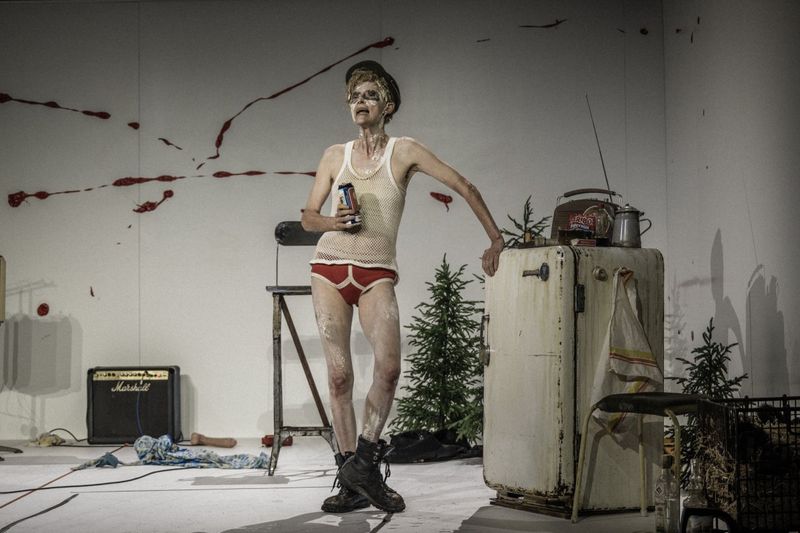
It’s an alluring performance that moulds itself around a challenging script. The twenty-eight short scenes have more stylistic variety than a Eurovision host’s wardrobe. Prose jostles for space alongside blank verse, rhyming couplets, pub songs, proverbs and whatever else was running through Karge’s mind at the time he wrote this. While the arthouse crowd will no doubt find this restless mashup of dramatic styles deeply arousing, there are times when the text barely resists the temptation to slide into pretentious twaddle.
Unwin’s direction has real verve even when it sags a little towards the middle; frankly, though, it could sag all the way to Sydney and still be barely noticeable when Swinton is in this kind of dominant mood. His updates to the text fit in smoothly but seem a tad plain next to Karge's scattershot writing and its more exciting conceptual thrust. Christie springs surprise after surprise with her set: four white walls and the interior of a grim East German flat seem much less boring after the TV explodes, the paint flies and a storm of ping pong balls emerge from above.
This isn’t the first time that this venue has hosted a reunion: last year, they put on a 25th-year-anniversary production of Sarah Kane’s 4.48 Psychosis featuring the original director, cast members and design team. If this institution is intent on continuing its nostalgic revivals of past triumphs, might I make a suggestion? In 2028, it will be 55 years since The Rocky Horror Show delighted the Royal Court’s audiences and — much later on — the critics (The Guardian’s Michael Billington called it “a deft piece of Pop-Artaud”). Maybe the time has come to dig out the fishnets and do the Time Warp again.
Man To Man continues at the Royal Court until 24 October.
Photo credit: Rüdiger Glatz

.jpg?format=auto&width=365)





Reader Reviews
To post a comment, you must register and login.