


Did You Know That These Broadway Shows Are Written By Married Couples?
We're taking a historical look at creative partnerships on Broadway and beyond.
Do you have a burning Broadway question? Dying to know more about an obscure Broadway fact? Broadway historian and self-proclaimed theatre nerd Jennifer Ashley Tepper is here to help with Broadway Deep Dive. BroadwayWorld is accepting questions from theatre fans like you. If you're lucky, your question might be selected as the topic of her next column!
Submit your Broadway question here!
Over the years, Broadway has seen a number of family acts sharing the stage. It’s extra special when family members team up to write a Broadway show together. The Great White Way has seen many instances of this historically, in a variety of different situations.
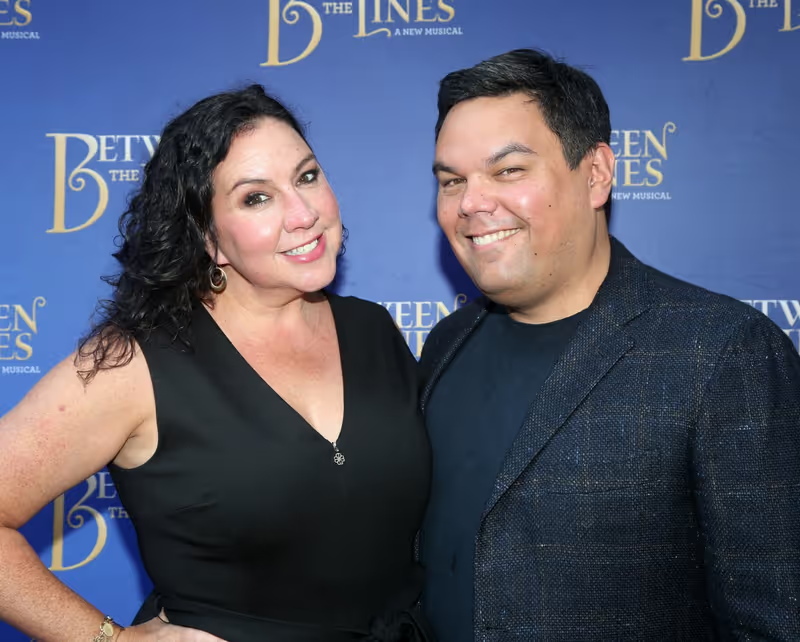
The most frequent configuration seen is spouses penning a Broadway show hand in hand. There are several recent prominent examples of this. Robert Lopez and Kristen Anderson-Lopez have written both separately and together. Together, the married pair are responsible for writing music and lyrics to Frozen, which played Broadway from 2018 to 2020, following the property’s world domination in animated film format. The Lopez’s Frozen showstopper “Let It Go” has become a major part of the zeitgeist and in addition to their Broadway work, they’ve also co-written many screen projects, including the songs for Coco and WandaVision.
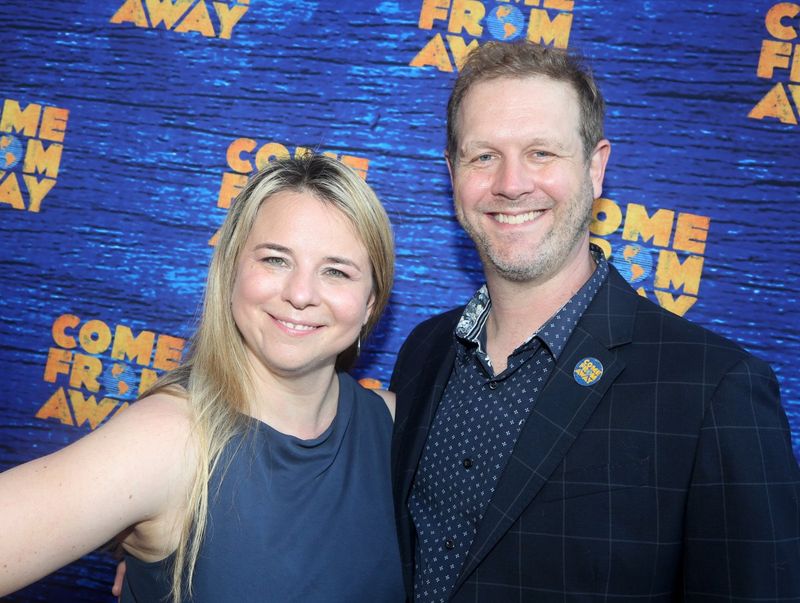
Married couple Irene Sankoff and David Hein made Broadway history with their hit musical Come From Away. The show, about an unexpected part of 9/11 history, moved audiences at the Schoenfeld from 2017 to 2022 (minus the pandemic break), becoming the longest running production at the theater. Sankoff and Hein shared writing duties on book, music, and lyrics on the show, and earned two Tony nominations as well as three Drama Desk nominations and one win for their work.
There are also longtime romantic partners who are not married who have been creative partners on Broadway. Marc Shaiman and Scott Wittman are the writers behind the Broadway scores of shows like Hairspray (2002), Martin Short: Fame Becomes Me (2006), Catch Me If You Can (2011), Charlie and the Chocolate Factory (2017), Some Like It Hot (2022), and Smash (2025). Their collaboration goes back even farther than 2002, as the two began working together on shows off-Broadway and off-off-Broadway in the 1970s. Shaiman and Wittman were together as a couple for 25 years and upon winning the Tony Award for Hairspray, made history for their nationally televised same-sex kiss. Shaiman declared as part of his speech, “I love this man. We're not allowed to get married in this world ... But I'd like to declare, in front of all these people, I love you.” Shaiman and Wittman ended their romantic relationship in 2005 but continue to have an unbreakable friendship and creative collaboration.
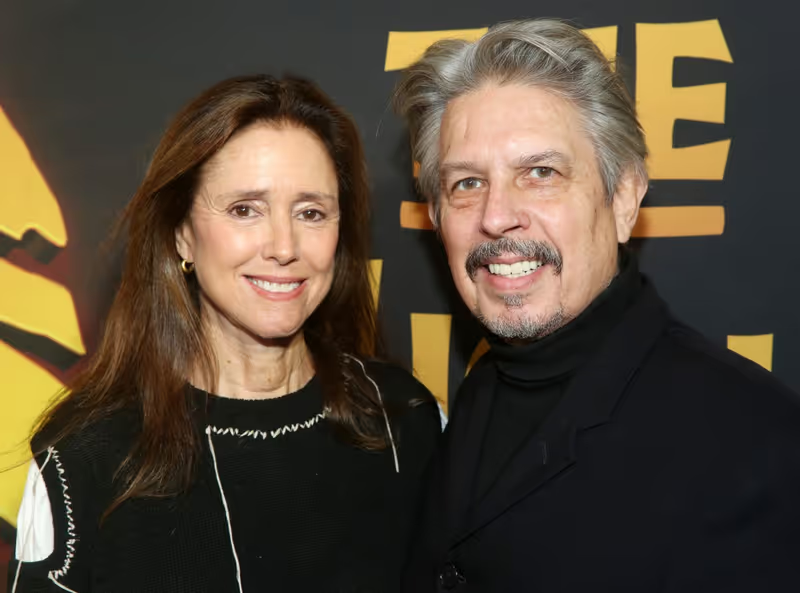
Julie Taymor and Elliot Goldenthal are another pair who have created shows while also in a longtime personal partnership. Taymor, well known for her direction and many other creative hats on shows like The Lion King (1997) and Spider-Man: Turn Off The Dark (2011), has sometimes functioned as a book writer on her productions. For Juan Darien, the 1996 piece billed as a carnival mass, Taymor and Goldenthal co-wrote the book, while Taymor also directed and designed several elements and Goldenthal also wrote music and some lyrics. Juan Darien transferred from off-off-Broadway to off-Broadway all the way to Broadway, where it was nominated for the Tony for Best Musical. Taymor and Goldenthal have collaborated on many other projects together.
Spouses have been collaborating on Broadway shows for over a hundred years. In the early 20th century, one of the main ways that women could get a seat at the table writing a Broadway show was if a male family member brought them in. Of course, these women were talented and deserving but in an era where women were often expected to not work outside the home, a female professional was the exception to the rule. Several of these exceptions resulted in extraordinary Broadway collaborations such as that of Kay Swift and James Warburg. Swift became the first woman to compose the music for a full length Broadway musical when Fine and Dandy opened in 1930. The lyrics to the show were by Paul James, a pseudonym for James Warburg. While Swift and Warburg had collaborated on songs for Broadway revues before, Fine and Dandy was a book musical with a kicky score. Warburg was the heir to a banking dynasty and became President Franklin Delano Roosevelt’s financial advisor during the Great Depression. Swift had a long and creative-fueled friendship and affair with George Gershwin and eventually became a major part of carrying on his legacy, as well as continued to write her own projects.
One of Broadway’s most prolific female writers, Anne Caldwell, penned over 30 Broadway shows between 1905 and 1928. She didn’t make her Broadway bow until the age of 37. Caldwell joined the profession when she married James O’Dea, a musical theatre writer, and he had her join the writing team for a Broadway show called Sergeant Brue. Caldwell continued to write for Broadway, penning both plays and musicals, both book and lyrics, both with and without her husband. She collaborated often with Jerome Kern and was a charter member of ASCAP.
Caldwell’s Broadway career didn’t begin until she got divorced and entered a second marriage, with a husband who not only supported her theatre career but propelled it. This was also the case for Alma M. Sanders, whose first marriage ended in her husband reporting that music broke up his home and his wife refused to make him breakfast. Sanders then married Monte Carlo and had a long career co-writing for Broadway with him. The two’s biggest hit was Tangerine (1921), ironically with a plot about divorce. Sanders and Carlo wrote nine Broadway shows together between 1918 and 1947.
Vaudeville performers and songwriters Maude Nugent and William Jerome were married and this meant that Jerome often got unfairly credited with Nugent’s biggest hit, “Sweet Rosie O’Grady”, even though she crafted the music and lyrics to that herself. “Sweet Rosie O’Grady”, written in 1896, became one of the first American songs to sell over one million copies of sheet music. Nugent did also collaborate with Jerome, including on the Broadway stage. Jerome wrote lyrics and Nugent wrote additional music for the 1905 musical Fritz in Tammany Hall.
A Broadway writing couple whose songs achieved Great American Songbook status were Nora Bayes and Jack Norworth. Bayes was one of the most major pop stars of the 20th century. Since her popularity occurred during the first two decades of the 20th century, Bayes isn’t as remembered as she might be had she reigned during a later era of media and technology. During her lifetime, as she co-wrote “Shine On, Harvest Moon” with Norworth, popularized “Over There” during World War I, and became a major Ziegfeld Follies headliner, Bayes made constant headlines. Bayes and Norworth’s writing projects together included multiple editions of the Ziegfeld Follies, other revues like Odds and Ends, and musical extravaganzas like Miss Innocence (1908) and The Jolly Bachelors (1910). Norworth was a major player just like Bayes; he wrote the lyrics to “Take Me Out To The Ballgame” and even built a now-demolished Broadway house that he named the Norworth Theatre in 1918.
We may still know the songs of Nugent and Jerome as well as Bayes and Norworth today, but we don’t see their full shows oft-revived. This is not the case when it comes to several spousal writing teams that came into play in the mid-20th century. Bella Spewack and Sam Spewack are not only memorialized through art because their show, Kiss Me, Kate, is frequently revived, but also because the married duo partially inspired the musical’s characters of Lilli Vanessi and Fred Graham. The Spewacks penned the book for the 1949 Best Musical Tony Award winner, and the show’s win for Best Book made them the first winners ever of that award. The Spewacks fought similarly to their characters in Kiss Me, Kate as they co-authored other Broadway shows like The War Song (1928), Boy Meets Girl (1935), and Leave It To Me! (1938).
Married pair Dorothy and DuBose Heyward are largely remembered for their place in creating the landmark musical Porgy and Bess (1935). The story of the impoverished star-crossed lovers in Charleston was first a 1925 novel, Porgy, by DuBose Heyward. Dorothy thought the novel would make a great play so the couple adapted it for the stage together as Porgy in 1927. Eight years later, the story was on Broadway again, this time as a musical called Porgy and Bess, with music by George Gershwin, lyrics by Ira Gershwin and DuBose Heyward, and book by DuBose Heyward. While Dorothy was not technically credit as a writer on the musical adaptation of Porgy, she was very involved in the process. Dorothy and DuBose Heyward also co-wrote a 1939 play called Mamba’s Daughters.
Walter and Jean Kerr were each independently better known for other types of writing than they were for their Broadway collaboration. Walter Kerr was the theatre critic for the the New York Herald Tribune from 1951 to 1966 and for the New York Times from 1966 to 1983. His decades in the field won him a Pulitzer Prize for his theatre criticism. A Broadway house is still named for him to this day. Jean Kerr was a bestselling author whose book of essays, Please Don’t Eat the Daisies, was adapted into a film and a successful sitcom. Together, the Kerrs wrote both Broadway plays (The Song of Bernadette, King of Hearts) and musicals (Touch and Go, Goldilocks). They also wrote Broadway projects independent from one another, and Jean Kerr’s included the major 1961 hit Mary, Mary which racked up over 1,500 performances.
Like the Kerrs, the Bergmans, Alan and Marilyn, wrote for Broadway, but were better known and more lauded for their writing work not on Broadway. The Bergmans co-wrote lyrics for two Broadway book musicals, Something More! (1964) and Ballroom (1978). The former is remembered for starring Barbara Cook and the latter for being Michael Bennett’s follow up to A Chorus Line, but neither show was a success. The Bergmans’ songs have also been heard on Broadway in revues and jukebox musicals. They were revered and awarded for their lyrics co-written for the screen, such as “The Way We Were”, “The Windmills of Your Mind”, and “You Don’t Bring Me Flowers”. The duo didn’t quite reach EGOT, but they did reach EGO.
In addition to giving birth to many writing projects together, Henry and Phoebe Ephron also gave birth to a slew of writers; they were the parents of Nora Ephron, Delia Ephron, Amy Ephron, and Hallie Ephron, all writers in their own right. Married duo Henry and Phoebe crafted three Broadway plays together: Three’s a Family (1943), Take Her, She’s Mine (1961), and My Daughter, Your Son (1969). Their Broadway ventures featured familial elements that were semi-autobiographical about the Ephrons’ own lives. Take Her, She’s Mine was specifically about the travails of being the parents of a teenager, based on Nora, in the 1960s. The Ephrons writing collaborations extended from Broadway to Hollywood, where they both wrote major films like Carousel (1956) and Desk Set (1957) and sometimes produced as well.
This piece is representative rather than exhaustive about spouses who have written Broadway shows together; there are plenty more!
Photo Credit: Bruce Glikas
Sign up for all the news on the Fall season, discounts & more...
.jpg?format=auto&width=300)





Comments
To post a comment, you must register and login.