


A Complete History of RAGTIME
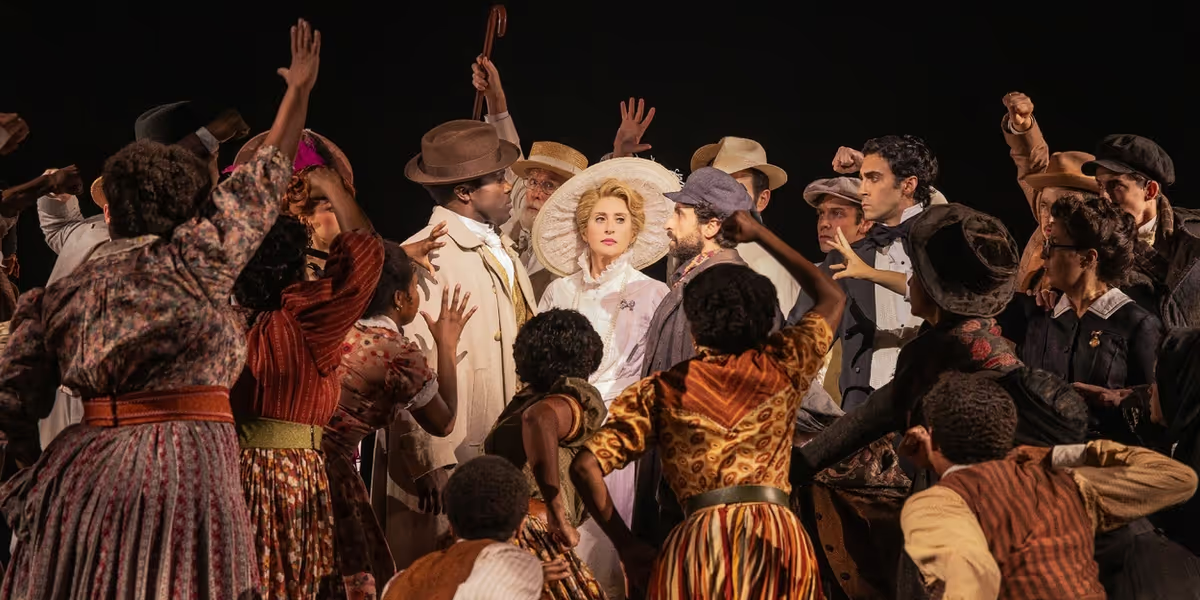
Ragtime is now running on Broadway (again!) at the Vivian Beaumont Theatre.
Do you have a burning Broadway question? Dying to know more about an obscure Broadway fact? Broadway historian and self-proclaimed theatre nerd Jennifer Ashley Tepper is here to help with Broadway Deep Dive. BroadwayWorld is accepting questions from theatre fans like you. If you're lucky, your question might be selected as the topic of her next column!
Submit your Broadway question here!
This time, the reader question was: What has Ragtime's journey to (and back to) Broadway been like?
(The author would like to extend her appreciation to Garth Drabinsky who provided details about the history of Ragtime which were not known and therefore not included in an earlier version of this article. The author and BroadwayWorld express their sincerest apologies to Mr. Drabinsky for various inaccuracies contained in the previous version of this article and their appreciation for his willingness and open-book approach to ensuring the completeness and accuracy of the story of Ragtime. In addition to continuing to entertain large audiences, this musical classic about American society, conceived, developed and produced in Canada, remains relevant and poignant to this day.)
Any history of Ragtime must start with the novel by E.L. Doctorow, which is the source material for the musical. Published in 1975, Doctorow’s masterpiece earned widespread accolades including the National Book Critics Circle Award. The major American author created the expansive world of Ragtime, utilizing a combination of fictional characters and real historic figures to tell a powerful tale about race, class, and family. The melting pot of American culture at the turn of the 20th century is brought to panoramic life in this tale that intertwines the lives of a privileged white family, a striving Black family, and a newly American Jewish immigrant family.
In crafting the story of Coalhouse Walker, Doctorow paid tribute to a 19th century German novella called Michael Kohlhaas. This in turn was based on a true story of the 16th century, about a citizen named Hans Kohlhase who fought the unfairness of the justice system, which favored noblemen over the average worker. So actually, the history of the musical Ragtime arguably began in 1500s Germany with a true event of injustice that came over the next 500 years to inspire a novella, a book, and later a Broadway musical.
Along the way, the 1975 novel by Doctorow was adapted into a 1981 film which included performances from Debbie Allen (as Sarah), James Cagney, Jeff Daniels, Fran Drescher, Samuel L. Jackson, Michael Jeter, Norman Mailer (as Stanford White), Elizabeth McGovern (as Evelyn Nesbit), Mandy Patinkin (as Tateh), and Mary Steenburgen (as Mother). The film, a veritable smorgasbord of winning performances by acclaimed actors, was directed by Miloš Forman, with a screenplay by Michael Weller and an original score for the screen by Randy Newman.
The stage musical version of Ragtime opened on Broadway in January of 1998 but it was announced for the stage all the way back in 1994. Toronto newspapers declared in January of that year that the next big “mega-musical” was now in development. The company Live Entertainment had acquired the rights to turn Doctorow’s novel into a stage musical. Live Entertainment, or Livent for short, was helmed by impresario Garth Drabinsky. Counted among Drabinsky’s credits are the original Broadway production of Kiss of The Spider Woman and the lavish 1994 Broadway revival of Show Boat. Livent was also a dominant force in the Canadian theatre landscape. In addition to theatre productions, Livent had an active role in developing, constructing, and in some cases renovating theaters themselves, including the Ford Center for the Performing Arts, now the Lyric Theatre, the Broadway house that was built to house Ragtime. The Ford Center was created in an astonishing period of time, thanks to the efforts of Drabinsky.
Drabinsky, who many have described as larger-than-life, had a strong vision for Ragtime from the beginning. After re-reading the Doctorow’s book in the early 1990s, Drabinsky was inspired to turn Ragtimeinto a stage musical. Through the agent Sam Cohn, he initiated a meeting with Doctorow. When the men sat down at the Russian Tea Room, they found themselves on the exact same page about what the musical could be. Drabinsky pointed out the intersectional tension created by the equilateral triangle of the story that was at the crux of the book and how the musical could recreate this, and Doctorow saw a kindred spirit who understood the heart of his novel. Drabinsky also appreciated that the metaphorical strength, page after page of Doctorow’s novel, would support great lyricism in the musical score.
A few years later, after the show had opened in Toronto, Doctorow wrote Drabinsky a letter. This letter was penned in the very house in New Rochelle that is depicted in the opening lines of Ragtime. Doctorow wrote:
“Dear Garth,
It’s been a week and I’m still feeling what I felt Opening Night. It is possible you’ve produced more than a hit show – that with all your gifted writers, composers, directors, designers, singers, dancers and musicians, working in concert, something more has been created than good theatre, as wonderful as that is. Something with extra-theatrical resonance, an aesthetic crossover of the kind I let Harry Houdini only dream about. Through all the trial and error of the development period (and with work still to be done), I believe the Ragtime company’s collective genius has found it to the heart of the American allegory implied in my novel. And the effect on an audience is to be recalled powerfully to its humanity.
I don’t know enough about Canada, but down here, I think the show could become a means by which, in our millennial disarray, we can begin to remember what we’re supposed to be in the way of a national community. Am I being grandiose? Well then, at least you know how moved I am by the magnificence of what you’ve all achieved.
Love, Edgar”
Ragtime was an immensely ambitious show: a deeply American, sprawling spectacular aimed for Broadway at a time where musicals of that type either weren’t made at all or were likely to close quickly. While the show might have initially been billed as a mega-musical in efforts to line it up next to successes like Les Miserables and Miss Saigon, Ragtime was actually an entirely different animal. Drabinsky was a force whose artistic vision was behind Ragtime from the beginning. He developed the show in a hands-on fashion, from that Russian Tea Room meeting onward.
After Drabinsky earned the rights to adapt the novel Ragtime for the stage, he led the charge to select the writers who would be the perfect fit for the project. (Every major creative player in Ragtime was selected by Drabinsky.) A number of outstanding writers and writing teams auditioned for the opportunity to write the score to Ragtime—including several who were established and several who gained additional prominence on Broadway in the years to follow. Terrence McNally was hired to pen Ragtime’s book before writers for the score were auditioned; their assigned task was to create four songs for the show that could fit into the outline that McNally wrote. In a practice that is frequently used by major movie studios today when selecting which writer(s) will adapt their property for the Broadway stage, Drabinsky invited a slew of writing teams to craft songs on spec, in order to have a chance at getting the job.
Among those who wrote songs in order to be considered for Ragtime were Jason Robert Brown, Adam Guettel, John Kander & Fred Ebb, Michael John LaChiusa, and Richard Maltby & David Shire. About a dozen writing teams were given eleven days to create four songs that would impress Drabinsky, McNally, and the others who would determine who scored Ragtime. Drabinsky explicitly invited a few notable writers to audition who declined the opportunity, including Marvin Hamlisch. (Hamlisch claimed he’d already written several works in a Ragtime style, and didn’t wish to repeat himself.)
Drabinsky’s association with Jason Robert Brown went back to an early 1990s Songs for a New Worldworkshop in Canada. This led to Brown being invited to write spec songs for Ragtime. Among Brown’s four Ragtime spec songs was “Something Like Home”, a soaring solo number for Tateh to sing to The Little Girl in the same place in the story that would eventually be occupied by the song “Gliding”. Brown at one point shared the song publicly on his website, giving a glimpse into the creative process of composing on spec. The song was also included on a private 2003 recording that Brown shared with family and friends, featuring some of his rarer works. Brown would make his Broadway debut with Parade, which Drabinsky was also instrumental in developing, later in 1998, the same year that Ragtime premiered in New York.
Drabinsky had worked comprehensively alongside Kander and Ebb in bringing the musical The Kiss of the Spider Woman to life. He produced the show on Broadway, where it won the Best Musical Tony Award. (Spider Woman was directed by Drabinsky’s friend, mentor, and great influence, Hal Prince; the two worked together on many productions over the years.) Based on the collaborative history, it made sense that Kander and Ebb would agree to audition to write Ragtime, despite the fact that they were a revered Broadway team (with credits including Cabaret and Chicago) who some might deem above a spec opportunity at that point in their career.
The prolific Michael John LaChiusa, who had already had his musical Hello Again off-Broadway and would have Marie Christine and The Wild Party on Broadway before the century was through, submitted his Ragtime cassette for consideration as well. Today, the New York Public Library possesses LaChiusa’s extensive collection, which includes his songs written for Ragtime. Titled “Here Comes McCloskey”, “Wouldn’t It Be Nice”, “Sarah” and “I Could Love You”, LaChiusa’s songs for Ragtime are archived along with the composer improvising some Ragtime music.
No information has yet to turn up about the Ragtime spec songs penned by the other writers. Adam Guettel’s papers are currently being processed at the Library of Congress, and include materials for unproduced and never-completed projects, so presumably they include some of his Ragtime work.
Three of Lynn Ahrens’ and Stephen Flaherty’s four songs written on spec for Ragtime were “Gliding”, “Ragtime”, and “‘Till We Reach That Day”. These were included in the final score. A song called “You Don’t Know” for the character of Evelyn Nesbit did not make it into the eventual stage version of the show. These songs were written in a unique fashion. Theatre songwriting teams are often asked which comes first: the music or the lyrics. (This cliched question is even satirized in the musical Merrily We Roll Along.) Typically the answer is one or the other, but in the case of Ahrens and Flaherty’s initial work on Ragtime, Ahrens wrote two lyrics while Flaherty composed the music to two songs, and then the team swapped and created the matching music or lyrics to the songs that their collaborator had already begun.
At the time that they auditioned for Ragtime, Ahrens and Flaherty had been writing together for about a decade. The two met in Lehman Engel’s famed BMI Musical Theatre Workshop, where they began collaborating in 1983. Their first major produced work was the musical Lucky Stiff, a farcical murder mystery which premiered at Playwrights Horizons in 1988. This was followed by Once On This Island, which also premiered at Playwrights Horizons. The show set in the Caribbean about an impoverished young woman whose love story becomes a great fable transferred to Broadway in 1990 and proved that Ahrens and Flaherty were not only extraordinarily talented but also wildly versatile. The pair followed this with 1992’s My Favorite Year, a nostalgic look at 1950s television sketch comedy which had a brief run on Broadway.
When all of the cassettes were delivered and considered, Garth Drabinsky together with Terrence McNally selected Ahrens and Flaherty to create the musical Ragtime alongside book writer McNally. Ahrens and Flaherty’s songs and vision for the score were a perfect match. The show received its world premiere in Toronto in 1996, and then its American premiere in Los Angeles in 1997, before making its way to Broadway in 1998. Part of the reason that the tryout went to both cities was so the Ford Center would have enough time to be built before Ragtime arrived. It was also a strategic decision to have the show premiere in Canada, taking advantage of the favorable exchange rate, at a final competitive cost compared to all other Broadway musical productions at the time.
The Toronto cast recorded a cast album consisting only of highlights from the show’s score. In Los Angeles, Drabinsky commissioned Flaherty to create a suite of songs from the show that could be performed at the Hollywood Bowl, and this led to “The Ragtime Symphonic Suite”, which appears on the original cast album. Moves like this, treating the new score with reverence, proved to be prophetic, given the place that the show wound up attaining within the musical theatre canon.
With a few exceptions, the Toronto cast was the group that moved to Broadway with the show. The Toronto to Broadway group included original cast members Brian Stokes Mitchell as Coalhouse (the sole cast member who also played the role in Los Angeles), Marin Mazzie as Mother, Audra McDonald as Sarah, Peter Friedman as Tateh, Mark Jacoby as Father, Steven Sutcliffe as Mother’s Younger Brother, Lynette Perry as Evelyn Nesbit, Jim Corti as Harry Houdini, Lea Michele as The Little Girl, and Paul Dano as The Little Boy.
The Los Angeles premiere featured several performers who would later go on to play their roles as replacements in the original Broadway production including LaChanze as Sarah, John Rubinstein as Tateh, John Dossett as Father, and Scott Carollo as Mother’s Younger Brother. Other casting for the Los Angeles production of the show included Marcia Mitzman Gaven as Mother, Susan Wood as Evelyn Nesbit, and Jason Graae as Houdini. Judy Kaye played Emma Goldman in Los Angeles and Broadway while Camille Saviola played the role in Toronto.
In the roles of the Little Boy and the Little Girl were several future stars; in addition to Lea Michele who originated the Little Girl in Toronto and on Broadway, future Tony Award winner Brandon Uranowitz, who is playing Tateh in the current Ragtime revival, was a Little Boy replacement in Toronto. Uranowitz followed future movie star Paul Dano into the Little Boy role. Also called Edgar, the clairvoyant child who shouts “Warn the duke!” was portrayed by Blake McIver Ewing in Los Angeles and Alex Strange on Broadway. Danielle Keaton, then Danielle Wiener, was the Little Girl in Los Angeles. The fact that both Paul Dano and Lea Michele originated roles in the show as children is remarkable; the import of the children's roles in the show and the vision of the original creative team led to these early career breakthroughs for future stars.
Ragtime’s original creative team on Broadway included director Frank Galati, musical stager Graciela Daniele, musical director and conductor David Loud, orchestrator William David Brohn, production designer Eugene Lee, Costume Designer Santo Loquasto, lighting designers Jules Fisher and Peggy Eisenhauer, sound designer Jonathan Deans, and projection designer Wendall K. Harrington. All made key contributions to the look and sound of the show.
The Broadway production of Ragtime was a glorious accomplishment, a riveting testament to the original American musical and to all that America itself could be. The show ran for 834 performances at the Ford Center, closing in the final year of the 20th century. It was nominated for 13 Tony Awards, taking home four. Ragtime was overshadowed during awards season by its neighbor across a newly thriving commercial 42nd Street, The Lion King. It was hypothesized that with different timing, Ragtime might have dominated the season’s awards and attention, leading to an even longer and more successful initial run. But as is, the show holds a revered place in the musical theatre canon. Ragtime did win the Tony Awards for Best Book and Best Score over its competition, one of the only times in Tony Awards history that those two awards have gone to one musical while the Best Musical prize has gone to another.
The grand legacy of Ragtime was not just the landmark musical itself, but also the birth of a new Broadway theater. Drabinsky and his architectural team envisioned a new house on 42nd Street that combined the existing Lyric and Apollo Theatres, which lay in disarray. Not only was the new Broadway venue built within a year at a cost of U.S. $44 million, it incorporated meticulously restored historic elements of each house that would’ve otherwise been destroyed. The large and glorious house, built in such a unique way, is still our newest Broadway theater to date.
Drabinsky went on to produce Fosse, which debuted in 1998 in Toronto and moved to Broadway in 1999, and Paradise Square which was brought to Broadway in 2022. His productions have earned 71 Tony Award nominations. He has won two Tony Awards for Best Musical (for Kiss of the Spider Woman and Fosse), and one Tony Award for Best Musical Revival (for Show Boat).
Ahrens and Flaherty continued to write musicals for stage and screen, including Broadway’s Seussical(2000) and Rocky (2012), off-Broadway’s A Man of No Importance (2002), Dessa Rose (2005), and The Glorious Ones (2007), and Anastasia, which became a beloved animated film in 1997 and a Broadway show in 2016. They are in the top echelon of our legendary living musical theatre writers.
The great Terrence McNally, whose plays and musicals not only captivated but also advanced social and political causes, died in 2020 of Covid-19. Among McNally’s legacy is Ragtime’s exemplary book as well as the books to Kiss of the Spider Woman, The Full Monty, and Anastasia, and plays including Frankie and Johnny in the Clair de Lune, Love! Valour! Compassion!, and Master Class.
When Ragtime’s original cast was brought back together for a reunion concert in 2023, one major cast member was devastatingly missed. Broadway powerhouse Marin Mazzie, a treasured member of the community, passed away in 2018. Because the reunion concert was originally planned for 2020, but postponed due to the pandemic, McNally had already penned a program note dedicating the performance to Mazzie and highlighting her immense contribution to the musical.
New York City has seen quite a few Ragtimes since the original Broadway production closed in January of 2000. In addition to plentiful student and amateur productions, there was a pared-down 2009 Broadway revival, a major 2013 Lincoln Center concert, a site-specific 2016 production on Ellis Island, and a 2023 reunion concert benefitting the Entertainment Community Fund. Ragtime has also been given major productions in cities all over America, never leaving the spate of frequently produced properties since its release—despite the fact that the musical can be a financially heavy lift, with its large scope and number of characters. The current Broadway revival of Ragtime at the Vivian Beaumont Theatre at Lincoln Center is a transfer of New York City Center’s Encores! 2024 production of the show. With its placement at the Beaumont, Ragtime completes a beautiful full circle for Ahrens and Flaherty, whose My Favorite Year was the first new American musical to play Lincoln Center’s Broadway space in 1992.
Prefer BroadwayWorld in Google Search?
Add us as a preferred source so our stories show up more often in Top Stories and Google’s AI answers — for you.

Sign up for all the news on the Fall season, discounts & more...
BroadwayWorld Merch
Shirts, mugs, phone cases & more
Powered by

|

.jpg?format=auto&width=300)





Comments
To post a comment, you must register and login.