


The History of Musicals Starting Off-OFF-Broadway
From Spelling Bee to Hedwig and the Angry Inch... these shows started off far from Broadway.
Do you have a burning Broadway question? Dying to know more about an obscure Broadway fact? Broadway historian and self-proclaimed theatre nerd Jennifer Ashley Tepper is here to help with Broadway Deep Dive. BroadwayWorld is accepting questions from theatre fans like you. If you're lucky, your question might be selected as the topic of her next column!
Submit your Broadway question here!
This time, the reader question was: So many Broadway musicals have started off-Broadway, but are there many that have started off-off-Broadway?
The history of shows that have transferred from off-Broadway to Broadway is well documented. Hundreds of Broadway plays and musicals started out off-Broadway before making the leap to a Broadway house. But much more rare is the circumstance of a show starting out off-off-Broadway (that’s right, two ‘off’s!) and traveling all the way to the main stem. One of these shows is playing right now, and is a major theatre success story with off-off-Broadway roots!
To start, many folks are confused about which factors determine if a production is considered a Broadway show, an off-Broadway show, or an off-off-Broadway show. One of the main distinctions between the three prominent levels of theatre production in New York City is theatre size. If a theater has 500 or more seats, it’s considered a Broadway house. Theaters with 100-499 seats are labeled off-Broadway. The smallest houses, with fewer than 100 seats, are denoted as off-off-Broadway. There are some exceptions to this rule and we all know that not every venue falls into one of those three categories based on its size. (For example, Madison Square Garden, with its 19,500 seats, is not a Broadway theater.) Still, those capacity guidelines are a key clue if a theatergoer is trying to determine which type of show they’re seeing.
Contracts and budgets also differ greatly between the three kinds of productions, with off-off-Broadway shows embracing extremely resourceful practices and low wages. Off-off-Broadway was founded as a response to the capitalist elements of theatre in New York. It aspired to be an arena where artists could create with no financial restrictions or major interference from the establishment. Off-off-Broadway theater can be created by anyone, without much needed in terms of permission. In contrast, in order to be able to create off-Broadway, a show needs to be chosen to receive a spot from a major non-profit off-Broadway company (often with an operating budget of $1 million+) and/or raise capitalization that is often around $1 million.
In other words, off-off-Broadway productions are often the kind that you see in basements, in apartments, in schools, in 40-seat cabaret rooms, or in grungy spaces you can’t believe could contain theatre at all. Off-off-Broadway is an essential part of the New York theatre ecosystem, giving voices an opportunity to develop, indie art a space to soar, and artists a chance to work without the pressure and systems of larger productions.
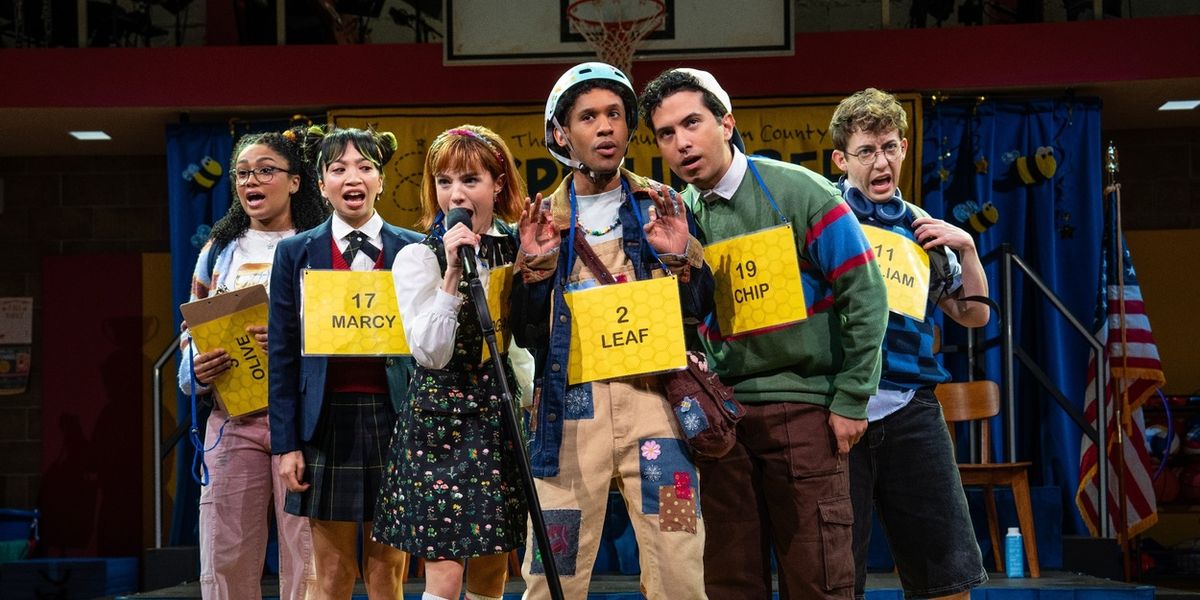
The plays and musicals that have originated in some form off-off-Broadway and then rocketed all the way to Broadway are a rare breed. And one of these is The 25th Annual Putnam County Spelling Bee! The current revival of the musical with book by Rachel Sheinkin and music and lyrics by William Finn is playing at New World Stages, off-Broadway. It is the first major New York revival of the show since it’s original Broadway production in 2005. Spelling Bee is about a group of quirky middle schoolers who compete in an unconventional spelling bee where all of their fears and aspirations are laid bare. The show includes audience participation, as several ticket buyers are chosen at each performance to join the bee and spell along with the characters.
The seed for Spelling Bee was planted when a playwright named Rebecca Feldman wrote a play called C-R-E-P-U-S-C-U-L-E. The show ran for two weeks in 2002 in a space on the Lower East Side called the Present Company Theatorium that was once a garage. One of its stars was Sarah Saltzberg, who was at the time the nanny of the Pulitzer and Tony Award-winning writer Wendy Wasserstein. After seeing C-R-E-P-U-S-C-U-L-E, Wasserstein told her close friend William Finn that he had to see it as well and consider adapting it into a musical. C-R-E-P-U-S-C-U-L-E had the same basic premise as the musical it was adapted into: a middle school spelling bee with unexpected underpinnings and audience members joining the mix.
The element of improvisation that was present in C-R-E-P-U-S-C-U-L-E continued as the show Spelling Bee was born, first playing an out-of-town tryout at Barrington Stage Company before an off-Broadway engagement at Second Stage Theatre off-Broadway and then a transfer to Broadway’s Circle in the Square. The current off-Broadway revival of the show is playing just a block west of where its Broadway premiere was about 20 years ago. And just as with earlier iterations, there are a few different lines of improv each night relating to the audience guest spellers. It is this sort of inventive human element that can sometimes be nurtured and preserved when a show moves from off-off-Broadway to any kind of future life.
A show that previously followed Spelling Bee’s uncommon path from off-off-Broadway to off-Broadway to Broadway was Pump Boys and Dinettes. This offbeat 1980s success story began as a two-man show with a flexible set list performed and created by Jim Wann and Mark Hardwick. The two performed songs as they developed character personas as two guys working at a country gas station. Wann and Hardwick performed this on stage at The Cattleman, a themed steakhouse restaurant on 5th Avenue near 45th Street that was meant to transport customers back to a saloon in San Francisco in the 1800s. A space free from the confines of Broadway or off-Broadway, the playing area could be considered either off-off-Broadway or a cabaret venue.
Hardwick and Wann kept developing their country music-infused act after leaving the restaurant entertainer jobs and their work evolved into a full length musical called Pump Boys and Dinettes. Joined by two additional gas station pump workers as well as two diner waitresses, the characters shared the adventures and loves of a life working on the highway. Pump Boys and Dinettes opened off-Broadway at The Westside Theatre on 43rd Street in 1981, and then moved to Broadway at the now-demolished Princess Theatre, formerly known as the Latin Quarter.
Unconventional Broadway spaces like the Princess Theatre—which had once been a nightclub called the Latin Quarter and contained just enough seats to be counted as a Broadway space—were important as they inherently embraced alternative work that had started out in indie venues. The casualty of several irregular, small Broadway venues in the 1980s, from the Princess to the Rialto to the Edison to the Bijou, was a huge loss that seemed unimportant to many at the time. Just like Spelling Bee, Pump Boys and Dinettes, which had originated in different form all of the way off-off-Broadway, was nominated for Best Musical at the Tony Awards and became a hit with a long run on Broadway and a robust life in licensing. Also like Spelling Bee, Pump Boys and Dinettes utilized its Broadway theater in a homey way, hearkening back to its indie theater roots. While Spelling Bee decorated Circle in the Square as though it was a middle school, Pump Boys conducted an intermission raffle and hung photos of previous raffle winners on the lobby walls.
Rewinding a bit farther in theatre history, one of the major musicals of the 1970s started out off-off-Broadway: Godspell! The joyful pop-rock retelling of Biblical tales and the crucifixion began its New York life at the famed off-off-Broadway theater La MaMa. La MaMa, an East Village hub for artistic expression, has been at the center of the off-off-Broadway world since it was founded in 1961. Godspell, with book by John-Michael Tebelak and music and lyrics by Stephen Schwartz, was first created in its earliest form by drama students at Carnegie Mellon University. The show was further developed and landed at La MaMa before garnering enough attention to earn an off-Broadway run. At La MaMa, the improvisational aspects of the show were honed and transformed into a more permanent script.
Godspell jumped from off-off- Broadway at La MaMa to off-Broadway at the Cherry Lane in 1971. It wasn’t until the show got to the Cherry Lane that songs by a then-23-year-old Stephen Schwartz were integrated into the piece. From “Day by Day” to “Save the People”, the score of Godspell captured audiences and the original off-Broadway production ran for over 2,000 performances off-Broadway, first at the Cherry Lane and then at the Promenade. In 1976, five years after beginning its off-Broadway run, Godspell closed—and then transferred to Broadway. The musical racked up about 500 Broadway showings, running for less than a year uptown. It was revived on Broadway in 2011. Much like the two other musicals discussed, the show retained folksy underpinnings from its off-off-Broadway origin, from ongoing elements of improvisation to audience involvement.
And finally, one last example of a musical making it all the way to Broadway after starting its life off-off-Broadway is Hedwig and the Angry Inch. The unlikely tale of a botched sex change operation told in the form of a raucous rock musical was first seen at Westbeth, an intimate theatre space in the West Village. In 1997, John Cameron Mitchell’s opus, with songs by Stephen Trask, astounded 83 people per performance off-off-Broadway. It was also developed prior to that with performances at several other off-off-Broadway spaces.
Hedwig was picked up and moved to the Jane Street Theatre off-Broadway in 1998, where it became a sensation, running for almost 900 performances and selling its film rights for a movie that would come out in 2001. In 2014, Hedwig and the Angry Inch was finally seen on Broadway, in a major revival starring Neil Patrick Harris in the title role. A series of acclaimed replacements followed Harris as Hedwig, including Andrew Rannells, Michael C. Hall, John Cameron Mitchell himself, Darren Criss, and Taye Diggs.
The Berlin-born queer hero reckoning with their gender surgery Hedwig might not have been seen as a likely choice for the protagonist of a Broadway musical, but because the show was able to prove its worth first off-off-Broadway and then off-Broadway, it had the opportunity to play a Broadway run. Much like musicals about a middle school spelling bee, a group of gas station workers, and a clownish and playful Bible retelling, Hedwig and the Angry Inch deserved a large following based on its quality. Off-off-Broadway is worthwhile in itself and is not meant to be a means to prove commercial viability. But, in the cases of these musicals, it allowed shows with somewhat implausible premises to launch and then find larger audiences based on the opportunities that they received off-off-Broadway.
Prefer BroadwayWorld in Google Search?
Add us as a preferred source so our stories show up more often in Top Stories and Google’s AI answers — for you.
Sign up for all the news on the Fall season, discounts & more...
.jpg?format=auto&width=300)
.png?format=auto&width=365)





Comments
To post a comment, you must register and login.