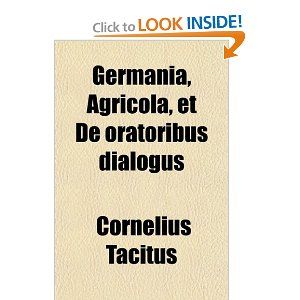
The Germania is an ethnographic work on the diverse set of people Tacitus believed to be Germanic tribes outside the Roman Empire. Ethnography already had a long and distinguished heritage in classical literature, and the Germania fits squarely within the tradition established by authors from Herodotus to Julius Caesar. The book begins (chapters 1–27) with a description of the lands, laws, and customs of the tribes. Later chapters focus on descriptions of individual tribes, beginning with those dwelling closest to Roman lands and ending on the uttermost shores of the Baltic Sea, with a description of the Fenni and the unknown tribes beyond them. Tacitus had written a similar, albeit shorter, piece in his Agricola (chapters 10–13).
The Agricola (written ca. 98) recounts the life of Gnaeus Julius Agricola, an eminent Roman general and Tacitus' father-in-law; it also covers, briefly, the geography and ethnography of ancient Britain. As in the Germania, Tacitus favorably contrasts the liberty of the native Britons with the corruption and tyranny of the Empire; the book also contains eloquent and vicious polemics against the rapacity and greed of Rome, in one of which Tacitus says is from a speech by Calgacus and ends with Auferre trucidare rapere falsis nominibus imperium, atque ubi solitudinem faciunt, pacem appellant. (To ravage, to slaughter, to usurp under false titles, they call empire; and where they make a desert, they call it peace.