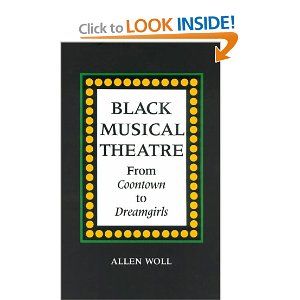
Black Musical Theatre begins its historical survey with Clorindy, the Origin of the Cakewalk and A Trip to Coontown, in 1898, and concludes with the Broadway smash Dreanigirls, in 1981. The section on the ragtime pianist and composer Eubie Blake and his popular 1920s show, Shuffle Along, attests to early black influence in American musical theater. Prior to the 1920s, black musical theater was enriched by Walker and Williams, Cole and Johnson, Miller and Lyles, and Ernest Hogan. White producers and composers such as George Gershwin (Porgy and Bess) who were deeply involved in black musicals are given due coverage, and the problems inherent in relations with whites over such issues as stereotyping are fully examined. Other political issues such as the lack of social criticism in white-created musicals is treated with perception. The photographs are often chosen from the Billy Rose Theatre Collection, New York Public Library, and add a visual dimension to the exposition that will be of great value to students of musical history. Costume and scenery designers will also appreciate the stills from Hot Mikado, Carmen Jones, and The Wiz. Other illustrations include sheet music, performers (such as Louis Armstrong), and programs. The tap dance, gospel songs, jazz. and other elements of musical theater were perfected by black performers and composers, and were an intricate part of the Broadway tradition that has since extended its influence into television, popular music, and film. Both academic and public libraries should buy their share of this readable, socially relevant, thoroughly researched book. -- From Independent Publisher


























.jpg?format=auto&width=365)