


Review: Davidsen, an ISOLDE for the Ages, Alongside Spyres' Splendid TRISTAN in Wagner at the Met
Sharon’s new production is grand showcase for the stars, with Speedo Green and Konieczny, under Nezet-Seguin
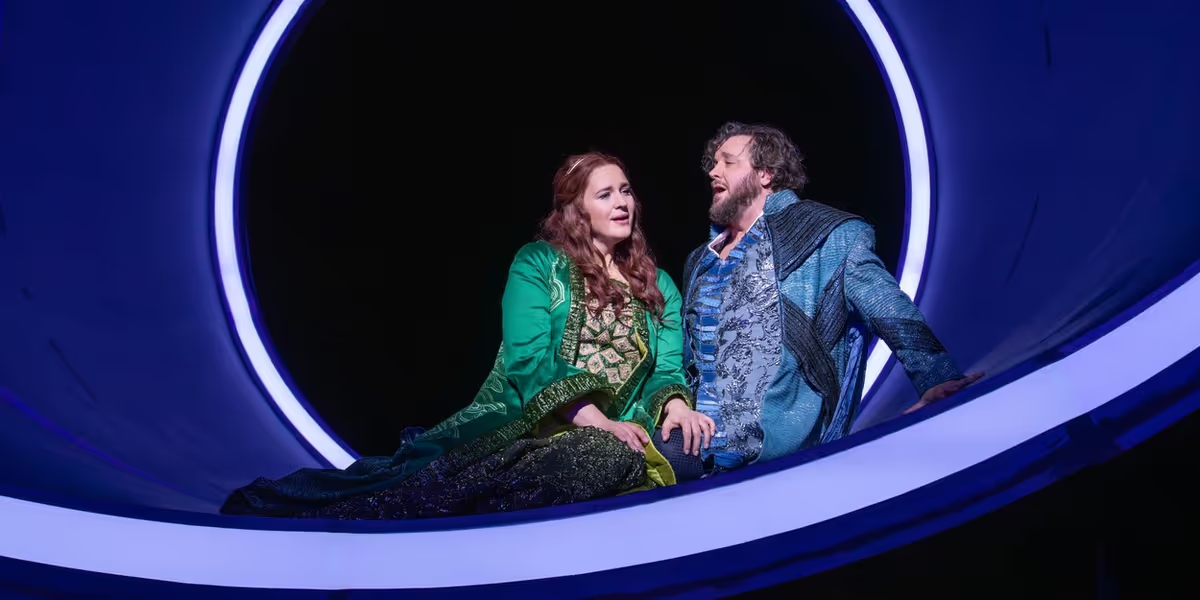
Voice! Voice! And more voice! That’s what we got from the Met’s new production of Wagner’s TRISTAN UND ISOLDE last night, especially from the glorious soprano of Lise Davidsen as the Irish princess Isolde, with no small help from her Tristan, baritenor Michael Spyres.
In this take from director Yuval Sharon in his Met debut, under Yannick Nezet-Seguin’s baton, Davidsen is spectacular in every way possible: a breathtaking interloper into the complex proceedings who is, by turns, elegant, willful, treacherous, loving and grief-stricken. She was divine in the Liebestod. I thought I’d been spoiled forever by the Isolde of Birgit Nilsson, but here at last was a grand successor with a style all her own. They could have switched the name to ISOLDE UND TRISTAN, and I wouldn’t have blinked an eye.
She was well paired with the Tristan of Spyres, though he marshalled his forces a bit at the start before showing his endless breath control, both in solo arias and duets. Yet despite Spyres’ best efforts, Es Devlin’s unusual stage design (looking like the aperture of a camera, sometimes breaking into pieces) occasionally swallowed up his voice before allowing it to come back with a roar when he moved to a different spot in the enclosed space. But at his best—very often—he was glorious; his work in the opera’s unforgettable love duet, “O sink hernieder.”
Ryan Speedo Green, as King Marke (Tristan’s uncle and Isolde’s intended), and Tomasz Kocieczny, as Tristan’s companion Kurwenal, did stellar work in supporting, yet key, roles. The same was true for Thomas Glass as Melot, Tristan’s best friend, who turns on him and stabs him what-will-be fatally. Green was especially good in his confrontation duet with Tristan, “Tatest du’s wirklich,” while Kocieczny’s aria as Tristan returned to life was memorable.
The only disappointment among the major players was Ekaterina Gubanova’s Bragaene, Isolde’s maid, thought she improved somewhat as the opera’s five hours went on.
The Met Orchestra under Nezet-Seguin didn’t sound quite as plush as one would have hoped in this opera, but they couldn’t keep this cast from dazzling us. The Met Chorus did its usual professional work, under Tillman Michael. A special bravo to Pedro R. Diaz, whose English horn solos in a shepherd’s song were stunning, even surviving the odd costume provided by Clint Ramos, whose work was generally fine, even when unflattering.
John Torres, in his Met debut, provided the crucial lighting design, Jason H. Thompson did the repetitive projections of the crashing sea. I’m not sure of the point of the major use of video in Ruth Hogben’s visual design, since the projection onto the texture of the aperture design of the set often didn’t align the pieces (eg, dishes at the banquet). Elsewhere, when capturing the wounded Tristan, the film seemed reminiscent of the treatment used in DEAD MAN WALKING a few years ago, with its closeups of medical instruments and such.
Even with Sharon’s sometimes-gimmicky production—body doubles galore (two extra Tristans and two more Isoldes) and an occasionally dizzying set design, breaking into revolving pieces and unnecessary dancers in Annie-B Parsons choreography, for starters--the impact of evening was stunning. The audience cheered like it could have sat through a repeat performance. And I wouldn’t have said no to one myself, five hours or not.
Caption: Lisa Davidsen and Michael Spyres in Wagner's TRISTAN UND ISOLDE
Credit: Karen Almond/Met Opera
Prefer BroadwayWorld in Google Search?
Add us as a preferred source so our stories show up more often in Top Stories and Google’s AI answers — for you.
Sign up for all the news on the Fall season, discounts & more...

Reader Reviews
To post a comment, you must register and login.