


Review: PRIDE, National Theatre
The musical adaptation of the hit film overflows with joy
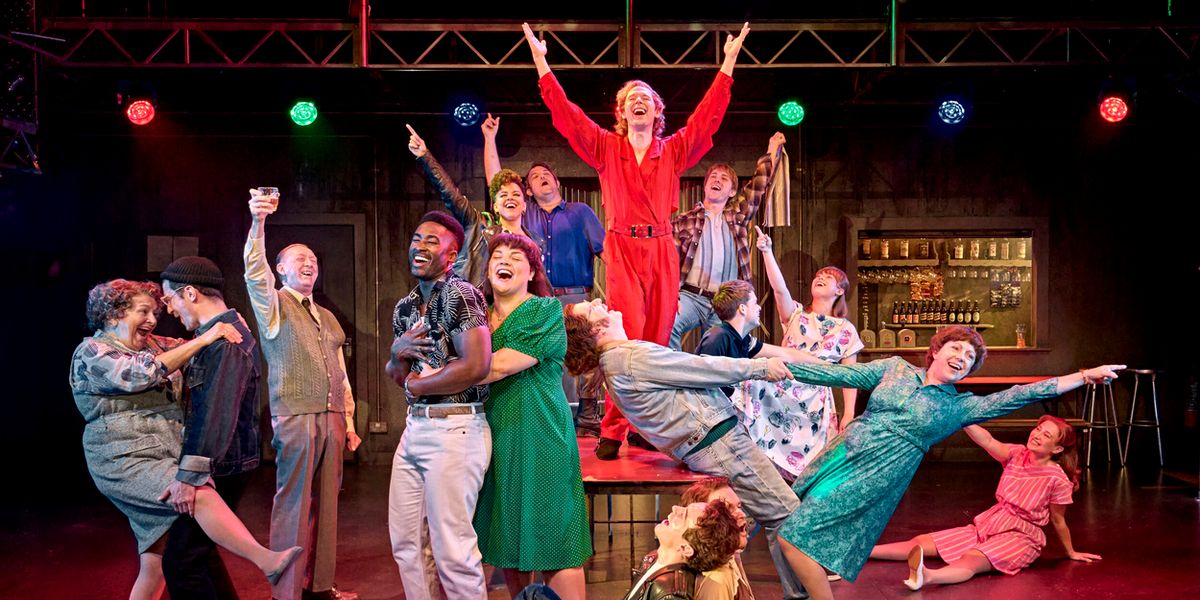

Before the lights even fall for the end of the show, people are on their feet. Deafening applause fills a room that seconds before was full of barely stifled sobs and sniffles. Such is the undeniable heft of feeling that sits at the centre of new musical Pride, based on the 2014 film of the same name.
Unusually, this musical adaptation has been crafted by the same director and writer as the film, Matthew Warchus and Steven Beresford. Both follow the extraordinary true story of Lesbians and Gays Support the Miners (LGSM), a London-based queer fundraising group, and their bond with the inhabitants of a Welsh mining village – all set against an 80s backdrop of Thatcherist politicts and the dawn of the AIDS crisis.
%20The%20Cast%20of%20Pride%20at%20the%20National%20Theatre_%20Photographer%20Manuel%20Harlan%200039.jpg?format=auto&width=800)
Cast of Pride
Photo Credit: Manuel Harlan
Expectations have long been high for this musical, the film having become a widely beloved modern classic. Here, Warchus & Beresford stay unusually faithful to their screenplay (if it ain’t broke…) but draw upon the richly queer history of musical theatre to reimagine and reinterpret the story with a playful eye. This change of form allows them to pull out new character moments, and new opportunities for both comedy and emotion.
Faithful as it may be, what sets the stage show apart from the film is the undeniable impact of a full auditorium. This story about human connection becomes infinitely more profound when witnessed alongside a room of strangers, and reminds us not only of the power of political solidarity, but also of the inherent value of live theatre.
%20The%20Cast%20of%20Pride%20at%20the%20National%20Theatre_%20Photographer%20Manuel%20Harlan0113.jpg?format=auto&width=800)
Cast of Pride
Photo Credit: Manuel Harlan
Warchus uses his dramatic expertise to make theatrics into a storytelling tool. The core ensemble of LGSM become our storytellers, interacting with both past and present in a way that starts off slightly jarring but comes to be deeply meaningful.
The real triumph of this theatricality, however, is the Act 2 opener led by Jonathan (Samuel Barnett). A spectacular combination of fourth wall breaks, sorrowful introspection, and pure showbiz, it’s a prime example of this, drawing on the richly queer history of musical theatre as an art form. Warchus knows when to go full glitz and when to pull it back to basics, which becomes a defining success of the show.
Nowhere is this more evident than in the score (by Christopher Nightingale, Josh Cohen, and DJ Walde), which combines full-out belting MT numbers with the choral-influenced music of South Wales. It is a smart way of contrasting these two very different communities, leading to showstopping moments when both halves come together. It should be said that there are at least a few more forgettable musical numbers, which perhaps could have been more boldly imagined. The pacing too, is perhaps slightly unbalanced - Act 1 is a perfectly fun musical, albeit a bit slow, whereas Act 2 is consistently outstanding, and home to most of the show's best songs.
%20The%20Cast%20of%20Pride%20at%20the%20National%20Theatre_%20Photographer%20Manuel%20Harlan%200306.jpg?format=auto&width=800)
Cast of Pride
Photo Credit: Manuel Harlan
Many of the most memorable musical numbers are those that use the weight of the full ensemble, both vocally and visually. This is true of all the iconic scenes set at the picket line and the pride parade, as well as the Pitts and Perverts gig. That’s not to say that there aren’t quiet moments that shine through - especially when it comes to the use of a ‘mum’ motif used by Lewis Cornay as Bromley and later reprised in a very smart and moving way.
Pride is an example of musical theatre casting done right. Casting Director David Grindrod has assembled a talented ensemble of primarily Welsh and/or LGBTQ performers, and the authenticity is noticeable. There’s not a weak link in sight, and almost every character is given their moment in the spotlight. No celeb stunt casting here: just working stage actors at the top of their game.
%20The%20Cast%20of%20Pride%20at%20the%20National%20Theatre_%20Photographer%20Manuel%20Harlan%200580%20(1).jpg?format=auto&width=800)
Cast of Pride
Photo Credit: Manuel Harlan
The standout, however, is Samuel Barnett as Jonathan. Expanded from the film, due to his natural affinity for theatre, he exudes a familiar retro campness, adding flourishes to background moments. His musical numbers are fabulous, and so fun to watch. Like many of the characters, he also grapples with the spectre of AIDS, and this delicate balance is pulled off well.
Star turns also come from Jhon Lumsden as revolutionary Mark Ashton, every inch the young rebel and a strong leading man. Cornay’s Bromley charms in Act 1, before eventually breaking into one of the show's most iconic songs. It’s a shame Courtney Barnett as lone lesbian Stef isn’t given more to do (or some fellow lesbians), but she holds her own well.
Pride would lose much of its heart without all of the women of the valley, who have a hilarious group number on their big London night out. This, like so much of the show, is so imbued with joy, surprise, and comedy that it’s impossible not to grin your way through.
%20The%20Cast%20of%20Pride%20at%20the%20National%20Theatre_%20Photographer%20Manuel%20Harlan%200808.jpg?format=auto&width=800)
Cast of Pride
Photo Credit: Manuel Harlan
But stories with so much emotion behind them are a delicate balance - in less competent hands, it could have become twee or overwrought, trying too hard to eke tears out of its audience. Thankfully, the poignant moments of the second act are handled with respect and sensitivity (which is not to say the tears weren’t flowing).
It definitely could be said that a story as revolutionary as this (with Ashton a proud communist), deserves a more experimental and radical adaptation. While there’s something there, presenting this story as an accessible, entertainment-filled musical is arguably more radical - it shows how this true piece of British history is universally relevant and appeals to a much wider audience, ultimately expanding the reach of the show's message of solidarity.
In a Britain more divided than ever, this message of solidarity couldn’t have come at a better time. Pride feels on the brink of being the next big thing – and how glorious that the next big British musical is so proudly and fiercely queer and working class.
Pride runs at The National Theatre (Dorfman) until 12 September
Photo Credits: Manuel Harlan

Sign up for all the news on the Fall season, discounts & more...
|
Powered by

|
.jpg?format=auto&width=300)





Reader Reviews
To post a comment, you must register and login.