Interview: 'My Father's Choreography Has A Clear Sense Of Ceremony': Set Designer Charlotte MacMillan on Revisiting A SLEEPING BEAUTY
'There's something rather extraordinary about his work being performed for a new audience who may never have encountered him before'

Ahead of English National Ballet’s performances of Sir Kenneth MacMillan’s The Sleeping Beauty at the Royal Albert Hall, set designer Charlotte MacMillan discusses drawing on centuries of theatre design, using projection to create a sleeping palace suspended in time, and what it means to help bring her father’s celebrated production to a new generation of audiences.
How did you approach designing visuals for such a well-loved classic?
Firstly, I looked at Nicholas Georgiadis’s existing costume designs. Georgiadis had a background in architecture, so I tried to imagine where he might have looked at within historical designs for inspiration. This led me to the work of the Bibiena Family, an Italian dynasty of Baroque theatre designers active across three generations from the 1680s. Their signature contribution was the scena per angolo; "scene viewed at an angle," replacing single-point perspective with multiple vanishing points placed at the sides of the stage rather than on a central backdrop. That, in turn, led me to explore how modern projection technology and animation could help realise my drawings.
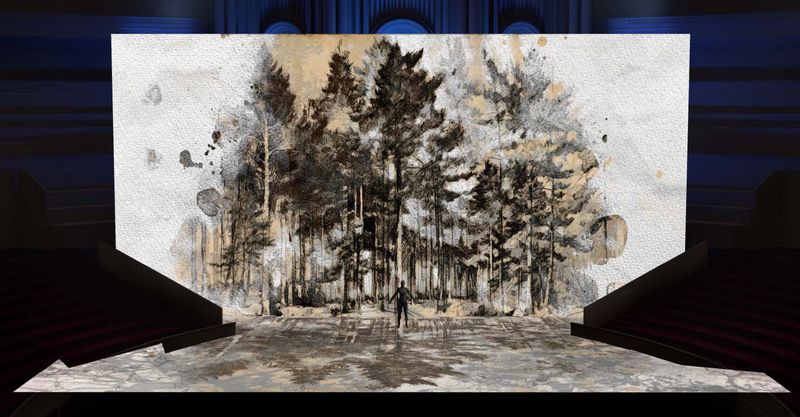
The production will be performed at the Royal Albert Hall. Did the scale and unique architecture of the venue influence your designs?
The Royal Albert Hall was actually a very direct reference point. Its interior has a very particular quality; it’s enormous but also enclosed, almost cocoon-like. The terracotta, the deep reds, the layering of tier upon tier of gilded boxes - it wraps around you.
That felt like exactly the right starting point for a sleeping palace, a space that is simultaneously ceremonial and suspended. The Hall was built to last forever, and there's something slightly airless about it, in the best sense. Time moves differently inside it.
Do you draw inspiration from any paintings, landscapes, films or literature when creating the projections?
Many years ago, when I was about ten years old, The Royal Ballet toured Romeo & Juliet to Venice. I was largely unmoved by that experience, finding all the walking rather tedious. On a rainy day, my parents took me to see the Teatro Olimpico, designed by Andrea Palladio and completed by Vincenzo Scamozzi in 1585.
The permanent stage set has multiple forced-perspective street vistas radiating out from the central arch and two side arches, and it was magical. It was like being inside a doll’s house, and it had a profound effect on me. Halfway through designing the concept for this production, I realised that it had been a direct influence all along.

What opportunities does projection design offer that traditional scenery cannot?
Projection actually connects quite directly to the oldest traditions of theatre craft. Before electricity, scene painters created entire worlds through trompe l’oeil: rolling seas on wooden poles, silk skies, hinged forest wings. The whole art was about fooling the eye into believing in depth and space that wasn't physically there.
For The Sleeping Beauty specifically, a story suspended between waking and dreaming, that quality of light-based illusion feels very natural. Projection can shift a world in an instant, which is something painted scenery was always trying to do, just with more stagehands. With Royal Albert Hall’s thrust stage, we’re unable to use those more traditional forms of scenery, so projection becomes a very useful tool.
What do you hope the projections add to the audience’s experience of The Sleeping Beauty?
The projections are really about scale and atmosphere rather than spectacle for its own sake. The Royal Albert Hall is a vast space, and the architecture of the design needs to fill it both physically and emotionally. The projections allow the palace to breathe and shift in a way that painted scenery alone couldn't achieve at that scale.
More than that, I wanted them to carry the sense of time passing - or not passing. The sleeping palace should feel genuinely suspended. Light changes almost imperceptibly, dust seems to hang, shadows deepen over a hundred years. That's very hard to achieve with static scenery. Projection lets you make the building itself feel both alive and dormant at the same time.
As the daughter of Sir Kenneth MacMillan, what does it mean to be contributing creatively to one of his most celebrated ballets?
It's an unusual position to be in, honestly. My father made this production long before I was working in theatre, and it spent eighteen years in the American Ballet Theatre’s repertoire before English National Ballet acquired it, so I'd actually never seen it staged. I came to it almost as a stranger, which in some ways made it easier. I wasn't trying to reproduce a memory of it.
What I found when I did encounter it was a production with very strong bones. His choreography has a clear sense of space and ceremony, but the design needed to breathe differently for the Royal Albert Hall. The process was less about being faithful to something I grew up with and more about asking what this production needs now, in this building, at this scale.

Your father created this production, and you have now helped to reimagine it for a new generation. What has that journey meant to you personally?
The responsibility of it wasn't lost on me. But I also think he was someone who believed work should live and adapt; he wasn't precious about that. A production that simply preserved itself in amber wouldn't have interested him much. I tried to hold that lightly and honour what was essential, without being afraid of what the work needs now.
What it has meant personally is harder to say simply. It's felt like a conversation across a very long distance. And there's something rather extraordinary about his work being performed in this building, at this scale, for a new audience who may never have encountered him before. That feels important.
English National Ballet's The Sleeping Beauty runs at the Royal Albert Hall from 25-28 June
Sign up for all the news on the Summer season, discounts & more...

.jpg?format=auto&width=365)