


The fish leads a more exciting life when it jumps out of the water to visit mischief on the birds. That’s what Emily (Nicole Joy-Fraser), a 288-year-old spirit, tells Brooke (Lisa Nasson), a young Mi’kmaq woman who Emily feels is treading water instead of emerging from it. In Nasson’s MISCHIEF, a co-production between Native Earth Performing Arts, Tarragon Theatre, and Halifax’s Neptune Theatre directed by Mike Payette with Joelle Peters, Brooke is still coming to terms with her mother’s disappearance three years ago. Working every day in her uncle Chris’ (Jeremy Proulx) convenience store, she’s barely keeping it together, a bundle of suppressed rage waiting to go off like one of the fireworks they sell without tax.
Brooke would rather stay behind the counter than deal with the store’s racist customers or participate in the community protests to remove the statue of Halifax’s founder, Edward Cornwallis, who issued the Scalping Proclamation in 1749; that proclamation paid a bounty to anyone who brought proof of having killed a Mi’kmaq adult or child in an attempt to terrorize the Mi’kmaq off of mainland Nova Scotia. But Emily, who clutches her head in phantom pain, tells Brooke that being quiet will neither make a difference nor serve as protection.
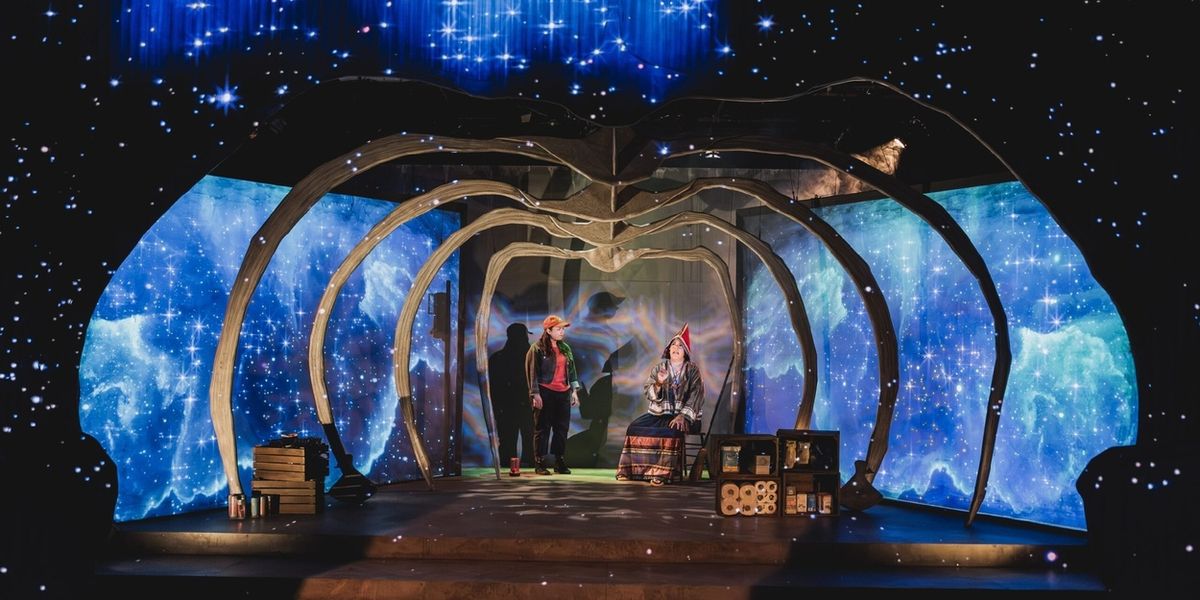
Reminiscent of another exciting Native Earth co-production, Caleigh Crow’s There Is Violence and There Is Righteous Violence and There Is Death, or the Born-Again Crow in its exploration of righteous vengeance, crossed with the familial warmth of Ins Choi’s Kim’s Convenience, MISCHIEF has its own personality and charm, assisted by some stellar, starry design work by Andy Moro. Once it finds its feet in the middle of its first act, it soars in the second, taking that metaphorical leap out of the water to lead a fascinating life.
Revenge is hot right now, and in MISCHIEF, it’s best served with fire. Nasson’s debut full-length play crackles with intensity throughout, and hits the ground running, full of rapid-fire exchanges and verbal beatdowns of colonizers. If anything, the pacing, which is off like a shot from the start, could be given a chance to ramp up after we spend a little more time with scheming but sensitive uncle Chris and protest ringleader Tammy (Trina Moyan), who’s a little scattered but has a good heart.
While the dialogue blazes forward, Brooke keeps her fuse capped, afraid that even the smallest spark will lead to an explosion and wary of her mother’s fate. But outside-of-time spirit visitor Emily, who keeps appearing in the store’s back room, reminds her that preemptively drowning your flame is no way to live. (She also, in an entertaining running gag, continually corrects the colonizing Christian corruption of Brooke’s cursing; there’s no Jesus here.)
Moro’s beautiful and clever set design puts us all in the belly of the beast, the corrugated metal walls of “Chris’ Convenience” arranged around the stark white bones of a whale ribcage. Convenience store shelving does double duty as tree branches later on, suggesting a continuity between the commercial/material and environmental/spiritual worlds. Moro’s projections are also top-notch, with a glorious, star-filled sky and animal imagery underscoring the show’s message regarding the fish and the bird, and a fast-moving background for a wild ride through Halifax that might make you feel like you’ve been to the amusement park.
Outside of the statue, much of Brooke’s ire falls on a bookended pair of clueless white guys played by Devin MacKinnon, the first a right-winger fisherman who regularly comes to the store equally looking for cheap smokes and a racist stereotype-laden fight, and the second a sensitive lefty so concerned with causing offense that he swings back around, stammering and saying precisely the wrong things. It’s an effective way of skewering a wide range of settlers while Brooke emphasizes her desire not to be seen as a symbolic figurehead for her entire cultural group — as desperately as Tammy wishes to take down the Cornwallis statue, a figurehead for attempted genocide in a hero’s pose.
MISCHIEF would be solid as a crackling comedy alone, but it has plenty of heart as well. The relationships between Brooke, Chris, and Tammy feel fresh, with each given a layer of vulnerability that adds depth. Brooke hates being smothered by her uncle’s concern but still craves his love; Chris stops constantly joking when he reveals just how hard it was to lose his sister, and tough-talking Tammy panics when her act of resistance meets its own resistance.
MISCHIEF’s ending feels like it comes a little too soon; some pieces could stitch together more clearly by the end, particularly where it comes to the simultaneously wise and bumbling Emily and the wound at the heart of the family.
But that just means there’s plenty of life to these characters yet. Perhaps a Mischief 2: More Mischief will yet leap from the water.
Photo of Lisa Masson and Nicole Joy-Fraser by Jae Yang
Prefer BroadwayWorld in Google Search?
Add us as a preferred source so our stories show up more often in Top Stories and Google’s AI answers — for you.
Sign up for all the news on the Fall season, discounts & more...
|
Bee Gees Celebration Théâtre Capitole (12/16-1/02) |

|
Rogers v. Rogers Canadian Stage (11/08-12/13) |

|
Spring Awakening Soulpepper Theatre (9/10-10/04) |
|
Creditors Canadian Stage (4/09-5/02) |

|
The Tempest Stratford Festival (4/28-10/24) PHOTOS |
|
MrBallen: Lights out Live Meridian Arts Centre (10/04-10/04) |
|
THE ART OF SOUND CBC Glenn Gould Studio (6/26-6/26) |

|
Heist Theatre Aquarius (4/28-5/15) |

|
BE MORE CHILL Terminal Theatre (2/02-2/20) |
|
The Rainbow Fish Musical Wychwood Theatre (9/19-10/18) |

Reader Reviews
To post a comment, you must register and login.