


Review: SPACE DOGS, The Other Palace
This musical tells the story of one of history's best known canines
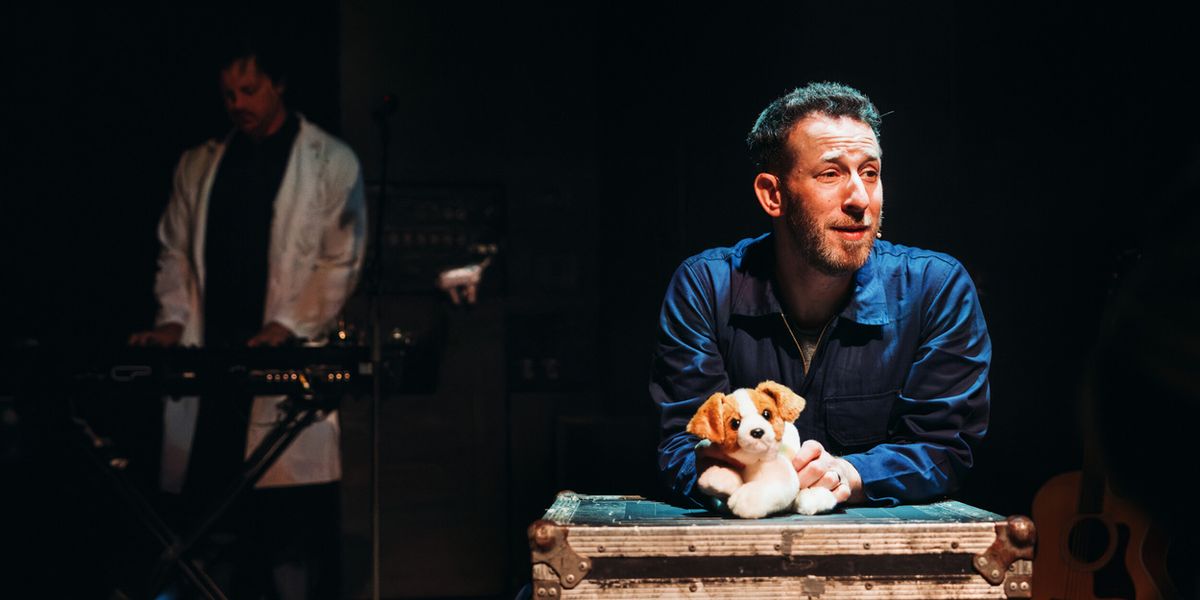

Broadway veterans Nick Blaemire and Van Hughes begin their show tossing canine plushies into the audience, Oprah-style. “We’re Nick and Van and we wrote this,” they gleefully announce.
This is typical of the anarchic energy running through Space Dogs, Blaemire and Hughes’ self-written musical about Laika, the Moscow stray dog who became the first animal to orbit Earth in 1957. We head to the USSR’s remote space centre in Kazakhstan armed with rudimentary dog puppets, a soundtrack of 1980s-style power ballads, with charmingly clunky lyrics like “fill the void you can’t avoid”, and a selection of rough-and-ready handmade props – Sputnik is a mirrored disco ball, hauled up to ‘space’ by a pulley.
Sometimes this has the punky back-to-school flavour of Horrible Histories, with Blaemire and Hughes shoehorning in as many fun facts about the Space Race as they can – including an odd repeated assertion that the Cold War happened chiefly because of differing casualties in World War Two – while making sure to tell us often that this is mostly just propaganda. Results here are mixed: asking if anyone has any questions halfway through is vaguely condescending to a mostly adult audience.
%20Nick%20Blaemire%20and%20Van%20Hughes%20-%20Space%20Dogs%20-%20Photo%20credit%20by%20Alex%20Brenner%20-%202383.jpg?format=auto&width=800)
Photo credit: Alex Brenner
More interesting, meanwhile, is the exploration of rocket engineer Sergei Korolev, known in the show only as the Chief Designer, since his name was not revealed to the public until after his death. Former Stalinist purge victim Korolev is portrayed by Hughes as constantly torn between scientific progress and the cost of said progress, and as having a genuine affection for Laika. His psychological breakdown later on pushes the show into more structurally and emotionally ambitious territory, as though Oppenheimer had brought a beloved pet to Los Alamos.
Space Dogs can feel sometimes like watching two different shows, but the writers manage to balance the family-friendly with the introspective when it comes to the dogs themselves. Laika and the 40-odd other female dogs involved in the Soviet space programme provide comic relief as part of a “healthy lesbian community” at the lab, and Laika herself yearns for a real family, scratching out soul-searching ‘Dear Diary’ entries in the soil with her paws. Eventually, she’ll learn to trust Korolev by slowly padding out notes on his electric keyboard.
There is something universally touching about seeing these dogs experience weightlessness for the first time and realise the depth of their own sacrifice. It’s impressive how much pathos director Will Blum can eke out of a run-of-the-mill stuffed animal, and there are some inventive approaches to lighting – handheld torches and the like – that inject a dose of visual interest when the script lags.
We all know how it ends for Laika, in an overheated cabin high above the Earth, but the show is hesitant to admit this. “We don’t need to tell them everything,” Blaemire and Hughes whisper, frantically editorialising. More of this kind of tension between objective truth and subjective interpretation would have been welcome, and would have elevated Space Dogs above rowdy after-school club curiosity.
Read our interview with Van Hughes and Nick Blaemire on bringing Space Dogs to London here.
Space Dogs plays at The Other Palace until 9 August
Photo credits: Alex Brenner
Sign up for all the news on the Summer season, discounts & more...







Reader Reviews
To post a comment, you must register and login.