


Review Roundup: WAITING FOR GODOT, Starring Keanu Reeves & Alex Winter
Read All the Views of Waiting for Godot, directed by Jamie Lloyd.
 Click for Tickets
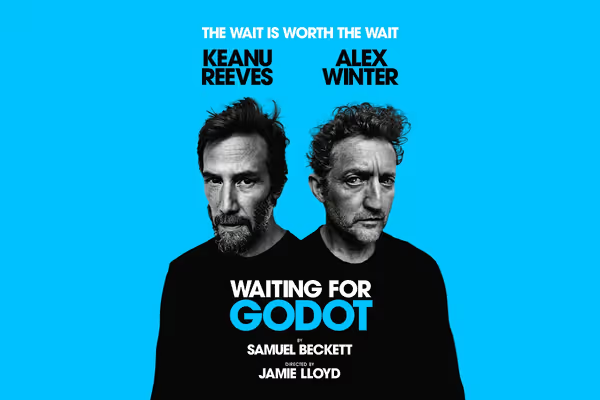
Jamie Lloyd’s new production of Samuel Beckett’s masterpiece Waiting for Godot is now open on Broadway. Starring Keanu Reeves as ‘Estragon’ and Alex Winter as ‘Vladimir', the strictly limited engagement is set to run through January 4, 2026 at Broadway’s Hudson Theatre.
The production also features Brandon J. Dirden as ‘Pozzo,' Michael Patrick Thornton as ‘Lucky,’ with Zaynn Arora and Eric Williams who will share the role of ‘A Boy.’ The cast is completed by understudies Jesse Aaronson and Franklin Bongjio.
Beckett’s masterpiece, Waiting For Godot, is acknowledged as one of the greatest plays of the 20th century. Originally premiering in 1953 in French with a subsequent English-language production premiering in 1955 in London, it has become a cultural touchstone having been translated into dozens of languages and has inspired artists in the worlds of film, television, dance, opera, visual arts, fashion, and even video games. London’s National Theatre surveyed over 800 leaders of the theater world and Waiting For Godot topped the list as the most significant play of the last 100 years.
Let's see what the New York City theatre critics are saying about the new revival...
 Laura Collins-Hughes, New York Times: It isn’t that Reeves and Winter are underprepared; they have done their research, and diligently. But they have not yet reached the point at which they can let that scaffolding fall away as they slip at last into the skin of their characters. For now, they appear still to be standing at a distance from them, intimidated. Didi and Gogo spend their restive, blurred-together days in hope of a promised rendezvous with the elusive Godot, whose name in this production is pronounced GOD-oh: a solid hint to meaning. Didi and Gogo live in doubting, suspended animation, awaiting the certainty of his instructions.
Adam Feldman, TimeOut: The pleasant prospect of seeing Reeves and Winter together makes this production to some extent critic-proof—and anyhow, this is a play in which “Crritic!” is the worst insult that Estragon can think up. But although Reeves and Winter are the main reason most people will go to this Godot, it is this revival’s other assets—the direction, the set and above all Dirden and Thornton—that keep it from being an exercise in meta stasis. For me, those elements make the production worth seeing, but the nice thing about Waiting for Godot is that it just keeps coming. This is the play’s third Broadway revival in the 21st century, and there have been numerous Off Broadway versions in recent years, too. If you decide to skip this one, you won’t have to wait very long for another.
Robert Hofler, The Wrap: Regarding the broken link in this ensemble, what Reeves does have going for him is a look. The late theater illustrator Al Hirschfeld would have drawn him with a minimum of very long lines. This Gogo is so tall and thin as to be suffering from severe desiccation, the eyes small beads of black glass, the body so starved for another of Didi’s carrots that hair has sprung out all over his face in a kind of hirsute protest. Gilmour’s costumes emphasize this physical starkness by making Gogo’s suit too small, Didi’s suit too big. Of course, there are the Laurel & Hardy black derbies, also worn by Pozzo and Lucky. Gogo and Dido aren’t so much big and thin as they are tall and short. They are also the stomach and the brain, the id and the ego. But a look only goes so far. It is not a performance, and Reeves very studied and mannered delivery of his lines is enough to ban the word “staccato” from Webster’s.
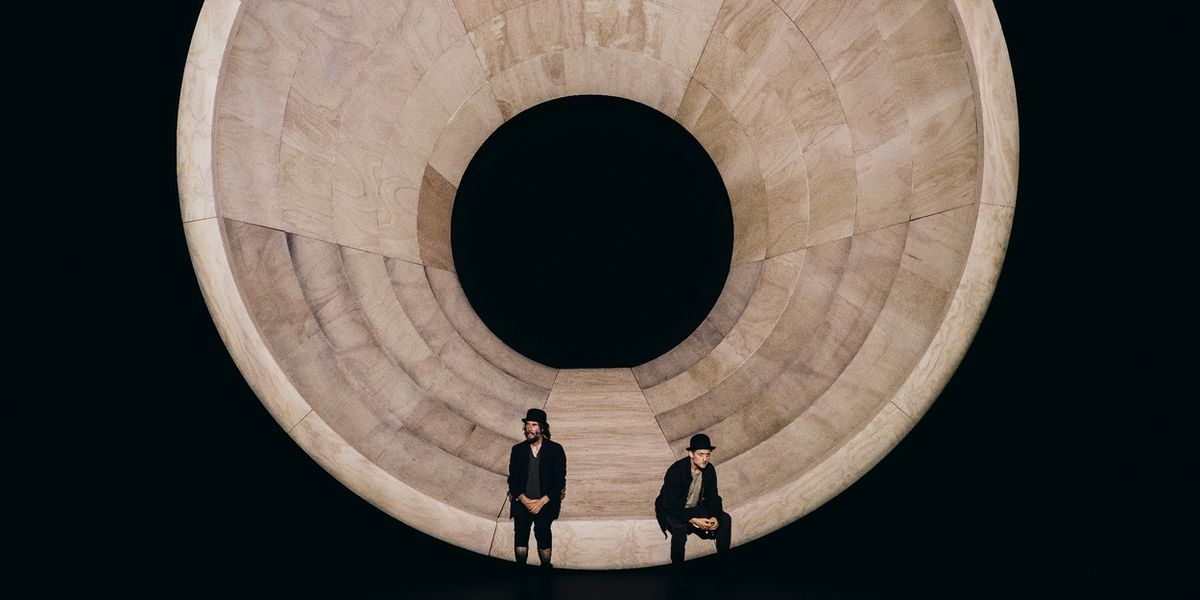
Johnny Oleksinski, New York Post: Acting aside, this is one of Lloyd’s better dramatic efforts. He boldly does away with the typical “Godot” aesthetic of gray emptiness and an ominous tree in the back. Instead, designer Soutra Gilmour’s set is a bright, giant wooden cylinder that looks like something Timothee Chalamet might pilot in “Dune.” There are none of Lloyd’s usual screens or al fresco adventures, either. Unlike what the director did to Jessica Chastain in “A Doll’s House,” he generally allows Reeves and Winter to actually walk around. But cool scenery doesn’t go very far when one of the actors on it simply cannot handle Beckett.
Frank Rizzo, Variety: But Lloyd’s awkward staging here and questionable affectations (including an audience clap-along) makes Pozzo’s relationship with Lucky unfocused and puzzling. Beckett’s symbols of master and slave — the whip, the rope, the servant weighed down with baggage — are either mimed or cut and in doing so lose its real horror. Thornton uses a wheelchair, and here his Lucky is guided by his tormentor. But the character’s state of servitude is largely hidden in clumsy blocking. Thornton, however, is magnificent in Lucky’s epic “thinking” tirade, a babbling aria with its own inner logic.
Adrian Horton, Guardian: Lloyd’s take on Beckett is an especially disorienting, purgatorial one – at one point, Gogo and Didi approach a literal blinding light at the end of the tunnel, only to turn back. But it is more coolly strange than spiritually disquieting, seeming to strain for provocation without need. The introduction of the mysterious Pozzo (Brandon J Dirden) and the enslaved Lucky (Michael Patrick Thornton) throw a wrench into the duo’s day and into the show’s polished limbo. Dirden, who is Black, plays Pozzo with more than a dash of Calvin Candie, Leonardo DiCaprio’s unforgettably sadistic and dandyish plantation owner from Django Unchained. Thornton, who is white and uses a wheelchair, appears without Lucky’s standard rope or Pozzo’s whip – the production forgoes almost all props – but bound with a gimp mask. The racial inversion of the invoked history of US enslavement suggests the arbitrariness of human cruelty. But though Thornton turns Lucky’s famously impermeable monologue – an erudite-seeming rambling on the command to “think!” – into a spellbinding swirl, there’s a ghoulish, overdone quality to their intrusions that tip the show into uncomfortable sensory overwhelm.
David Rooney, Hollywood Reporter: Perhaps many Broadway theatergoers paying up to $500 a ticket to see beloved screen stars up close in a uniquely intimate play may come away feeling satisfied. Reeves and Winter certainly throw themselves into crowd-pleasing moments like a frenetic hat-swapping routine.
But New Yorkers who have seen more seasoned stage actors in the roles in more penetrating productions — Nathan Lane and Bill Irwin in 2009; Ian McKellen and Patrick Stewart in 2013 — might be forgiven for feeling that Lloyd has given insufficient thought to any concept beyond the novelty casting of an iconic screen comedy duo.
Frank Scheck, New York Stage Review: The actors manage to hold their own, although their lack of seasoned stage chops is made more evident by the excellent supporting turns from theatrical veterans Brandon J. Dirden, mesmerizing as a Southern-accented Pozzo, and Michael Patrick Thornton, arresting as a wheelchair-bound Lucky. Reeves has always projected a certain spacey, ethereal quality in his persona which works well for his Estragon, while the hangdog Winter effectively conveys an air of pathos as Vladimir. But they don’t come close to truly conveying the characters’ existential despair, nor their vaudevillian-style clowning. To compensate, Lloyd has them frequently sliding up and down the sloping walls of the set, like children at a playground, to garner cheap laughs.
Dan Rubins, Slant Magazine: “We are bored to death, there’s no denying it,” Vladimir reminds Estragon. “A diversion comes along and what do we do? We let it go to waste.” If there’s a deeper meaning bleeding out from Lloyd’s revival, perhaps it’s this production’s exploration of how desperately we try to grapple with the passing of time, toiling to turn each ephemeral moment into a scene worth playing.
 Juan A. Ramirez, Theatrely: Lloyd’s vision takes place within a massive vortex (designed by Soutra Gilmour) that suggests an internet-age existence both futuristic and, by dint of its looking like a submarine cable, perilously tactile. It’s not the country road Beckett calls for, but the information superhighway. As in the best opera sets, it’s simple, gorgeous, effective and relentlessly watchable. Its brutalism creates some fantastic tableaux and allows for great moments of physical comedy, as the men run up its walls and slide back down, Sisyphus style, or stand on its curve with their feet comically slanted. At one point, while Thornton shines in his speech, Dirden peeks from outside of it, clinging to its edges like a Grand Guignol villain, bowler hat and all, with mustache-twirling delight. (Gilmour also did the costumes, which include a rather kinky muzzle for Lucky; all leather and straps.)
Shania Russell, Entertainment Weekly: Lloyd's Godot makes plenty of fascinating choices, some more effective than others. The characters often stare back at the audience; the tree is nowhere to be seen; the props are pantomimed; and there is a throwaway reference to Bill & Ted, equally likely to elicit chuckles as it is to yank you from the play's subject matter back into a world where you're staring at Reeves and Winter's reunion rather than Vladimir and Estragon's despair.
Chris Jones, New York Daily News: It’s an interesting evening, this “Waiting for Godot,” spent in the company of very capable actors, for sure. Lloyd certainly has blown some cobwebs off a play that long has confounded anyone who has tried to sell it to regular folks. Famously and disastrously, the first U.S. production of “Waiting for Godot” (starring Bert Lahr and Tom Ewell) ended up at the Coconut Grove Playhouse in Miami, where it was billed as “the laugh sensation of two continents” and thus met mostly by confused audiences who wanted not so much to meet Godot (sorry) as to get their money back. They didn’t know or care they were seeing one of the most important plays of the 20th century.
Joe Dziemianowicz, New York Theatre Guide: While the stars bring marquee magnetism, the production design lends mystery. The script’s stage directions call for “A country road. A tree. Evening.” Soutra Gilmour’s set features only a huge wood-paneled tube. Is it a hollow redwood? Arty tunnel to nowhere? Crafty storm drain? Who knows. But the circular shape squares with the play’s cyclical nature. Didi and Gogo gab and grouse. They wait for no-show Godot. Repeat.
Jonathan Mandell, New York Theater: What I am most uncertain about in this particular production is the existence of Lloyd’s guiding intelligence. Is he deliberately dismissing the uncertainty and ambiguity embedded in the script? Or did the fashionable British director simply go with what he knows — the cool, ostentatiously minimalist aesthetic that he last demonstrated on Broadway in “Sunset Blvd,” with the same costume and scenic designer Soutra Gilmour? Again, the actors are dressed all in black, and again their live presence is upstaged by the set (although this time it’s the tunnel that dwarfs them rather than video projections.) The tree, which is usually central in the play (Didi and Gogo talk about hanging themselves from it) is now off-stage, as if its visual presence would interfere with the sleek lines of the design. There are also no props – when Didi offers Gogo a carrot or a turnip, it’s mimed.
Patrick Ryan, USA Today: "Waiting for Godot" is the feel-bad play of the fall, with transfixing performances from Winter and Reeves that help you look past the production's shortcomings. There are few actors whom we'd rather see philosophize about mortality. As Ted once said so eloquently, "All we are is dust in the wind, dude."
Elysa Gardner, New York Stage Review: For a play that’s famous for the lack of progress its characters make, Waiting for Godot has succeeded in bringing an awful lot of A-list names to the New York stage. The latest to take on Samuel Beckett’s co-dependent hobos, Keanu Reeves and Alex Winter, have teamed up in the past on film—perhaps most notably, and most appropriately in this case, as the central duo in the Bill & Ted franchise. The real star of this new Broadway revival, however, is the set. British designer Soutra Gilmour, a frequent collaborator of the director, Jamie Lloyd, has fashioned a stark, stunning, semi-spherical structure that seems to take us inside a tunnel of sorts. Or is it a drainage pipe? Or, just maybe, an enormous tree—since Lloyd has opted not to physically represent that object, which is mentioned repeatedly and used symbolically in the work.
Sara Holdren, Vulture: Because the production feels too cool (in more ways than one), its hottest performance leaps out like a firecracker set off in a Soho boutique: Brandon Dirden’s superlative Pozzo. Once per act, a second duo crashes in on Didi and Gogo, providing the tramps’ power balance with a lurid, distended foil. Pozzo is a histrionic slave-driver, Lucky his abused chattel who speaks only once, spewing forth a churning flood of half-thoughts, broken refrains, and dire imagery — a mind shattered, perhaps by direct violence, perhaps simply by the daily assault of living on “this bitch of an earth.”
Greg Evans, Deadline: As for the acting, there’s little doubt that Winter is the most natural (and more experienced) stage actor of the two, more versatile and, when necessary, capable to drawing real pathos from this grim, gorgeous work of art. You believe his every changing mood. Reeves, as they say, is Reeves, an exceedingly charming actor who projects more than he acts but always seems to have full control of an audiences’ attention (and affection). Yes, even when he seems to be trying too hard to be stentorian or angry or carrying out a bit of slapstick tantrum, he has us rooting for him.
Tim Teeman, Daily Beast: Reeves and Winter make you feel it when the men embrace—as if one is holding on to the life raft embodied by the other—and when they quietly care for each other, strange day after strange day. If this is stunt casting, then it is stunt casting with a sweetened depth. Their Didi and Gogo are a plausible flipside to Bill and Ted, for whom loyalty and friendship were the bedrock of their heroism. Whether Beckett intended it or not, and no matter the forces of nihilism assailing them, you feel this Didi and Gogo are going to be excellent to each other for eternity.
Thom Geier , Culture Sauce: Reeves, in a striking Broadway debut, takes an approach that’s remarkably true to his persona. His Estragon recalls his slack-jawed hero from The Matrix series if Neo had refused both the red pills and the blue pills — one to see the world as it really is, and the other to live in blissful ignorance of the truth. Instead, he prefers to ponder his options and not commit to any one course of action. He and Winter create a version of Godot that works on its own terms even if fails to break out of the shadow left by more distinguished predecessors. Their tramps prefer passing the time on the outskirts of existential dread without daring to plumb its depths. That’s a shame, but at least this solid revival might introduce this challenging work to a wider audience. Beckett will survive the shortcomings of this production. Because classics, like frail humans stuck in the limbo of an existence they cannot fully comprehend, are remarkably durable.
Brian Scott Lipton, Cititour: Unquestionably, Reeves and Winter have the necessary chemistry to play these men who have spent countless years together, barely separated for more than a few hours at a time. We believe they are unable to leave each other, more out of familiar comfort than actual fear. In fact, they won’t even commit suicide unless they’re sure both can succeed at the task. The duo brilliantly captures the pair’s codependence, if little else. That said, “Godot” Is essentially a vaudevillian exercise that requires two actors who can transform Beckett’s verbal exercises, such as when they take turns calling each other horrible names (including “critic”), into laugh-inducing comedy routines. Sadly, you’re more likely to hear chuckles (if not silence) during these exchanges.
Matt Windman, amNY: The production seems intent on reaching new audiences and making the play feel more accessible to people who know “Bill & Ted” and “The Matrix” rather than Beckett. Some will be hooked, and others will surely find the repetition unbearable and slip out at intermission. “Godot” has always divided audiences. Reeves and Winter may not save the world this time, but their endless adventure in Beckett’s wasteland is a strange, curious, and surprisingly affecting experiment.
David Cote, Observer: For Beckett devotees, this Godot will come across as both idiosyncratic and faithful, a weird masterwork seen and heard afresh. Fans of Bill & Ted and the John Wick franchise may be converted to theater of the absurd. Because if they attend expecting time-travel gags or hitman Gun-Fu, it’ll be a long wait.
Average Rating: 67.4%
- To read more reviews, click here!
- Discuss the show on the BroadwayWorld Forum
|
Powered by

|






Reader Reviews
To post a comment, you must register and login.