


Review: THE COMFORT WOMAN, Omnibus Theatre
This story of Korean women's experience of sex trafficking under the Japanese Empire returns to London following an acclaimed 2024 run
 Content Warning: references to sexual violence and suicide
Somewhere between 20,000 and 300,000 women, mainly from the Korean Peninsula, were trafficked into sexual slavery by the Imperial Japanese Army before and during the Second World War: the so-called ‘comfort women’. Writer-performer Minjeong Kim’s one-woman show tells just one of their stories.
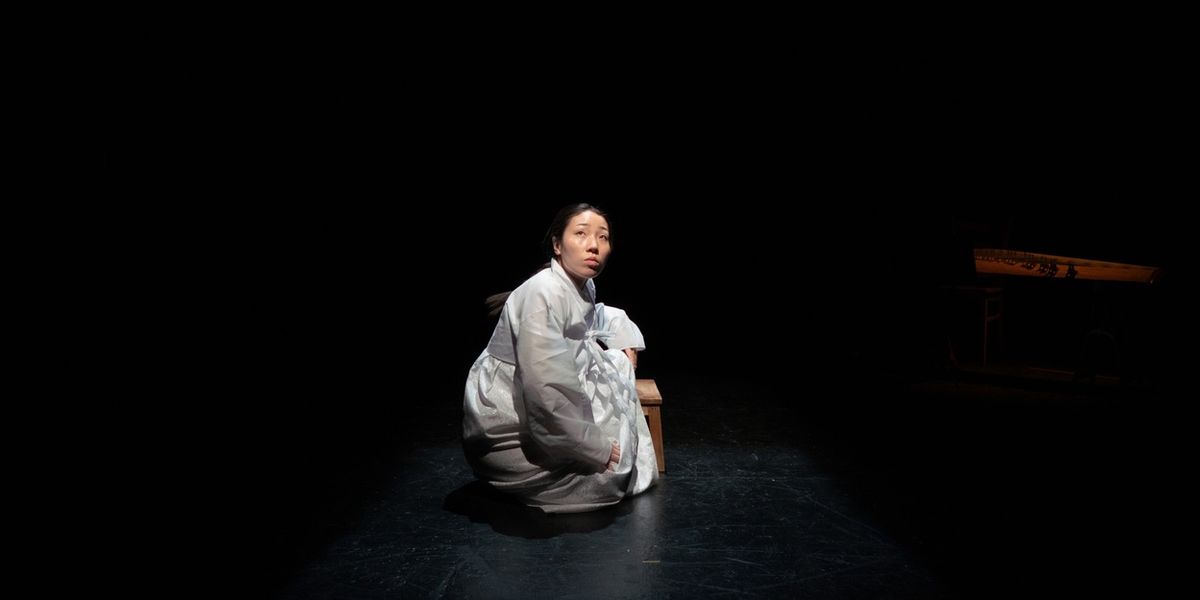
The titular Comfort Woman is Minja, a girl in her early teens living in a rural Korean village, who is sexually trafficked by the Japanese army with the help of a Korean man in her community (we never find out how complicit this man was in her kidnapping).
Kim, an intensely physical performer, imbues Minja with a youthful sense of joy in the world around her, and with more astute comic timing than one would expect from this subject matter – an early scene where she tries Korean rice wine for the first time is a spirited character introduction. The result is a carefully drawn picture of Minja’s life before her capture, that makes what comes next a particularly crushing punch in the gut.
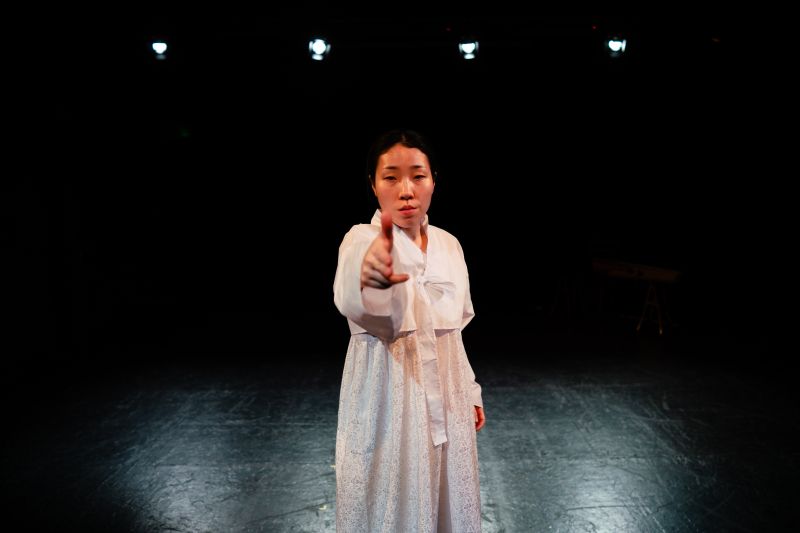
Photo credit: Abigail Sage
As Minja’s life in the Japanese barracks unfurls, Kim’s grace and physical expressiveness guides the audience gently through a story that is unflinching in its portrayal of sexual violence and of the tightrope of emotional composure Minja must walk in order to survive. Kim also morphs herself into all the characters with whom Minja interacts, and she is especially compelling when playing the Japanese soldiers who nonchalantly rape her, resisting caricature and embracing the banality of evil.
The story becomes increasingly driven by bouts of intense emotion, and Abigail Sage’s lighting follows suit. Sage is unafraid to play with snatches of darkness and flickering spotlights, and this works well alongside Kim’s writhing movement and director Anna Udras’ willingness to use the whole space. Kim is accompanied by Ji Eun Jung, a gayagum (Korean traditional harp) player, whose haunting, subtle compositions add depth and a sense of movement without feeling intrusive.
If there’s anything to criticise about this hymn to survival, it’s that slightly too much of the narrative in the barracks is consumed by women other than Minja – her friends with whom she does the laundry, one of whom is pregnant and longs to escape, and the other of whom provides a dose of cynicism about enforced sterility in the barracks. While well-acted by Kim, these figures feel one-dimensional and designed to teach a history lesson rather than illuminate Minja’s emotional journey – her attempted suicide shortly before liberation feels unfortunately rushed as a consequence.
Any quibbles with The Comfort Woman’s pacing, though, feel assuaged by Minja’s final, serene monologue, which reads like a sphragis or an epitaph, allowing Minja the final word on her story. She receives partial closure from the various public testimonies of other comfort women that came to light in the 1990s, but this is dampened by a reminder that the Japanese government has yet to make a full apology for trafficking women against their will.
The Comfort Woman is a play that relishes this kind of grey area, between praising the bravery of survivors and refusing to let their trauma turn them into martyrs instead of people. A short film adaptation in the pipeline may promise a more fleshed-out version of Minja, and the play has certainly established Minjeong Kim as a debut writer to watch.
The Comfort Woman plays at Omnibus Theatre until 7 March
Photo credits: Abigail Sage
Sign up for all the news on the Fall season, discounts & more...
.jpg?format=auto&width=300)






Reader Reviews
To post a comment, you must register and login.