


Review: BBC PROMS: PROG ROCK: A FANFARE FOR THE COMMON MAN, Royal Albert Hall
Prog finally gets its prom.
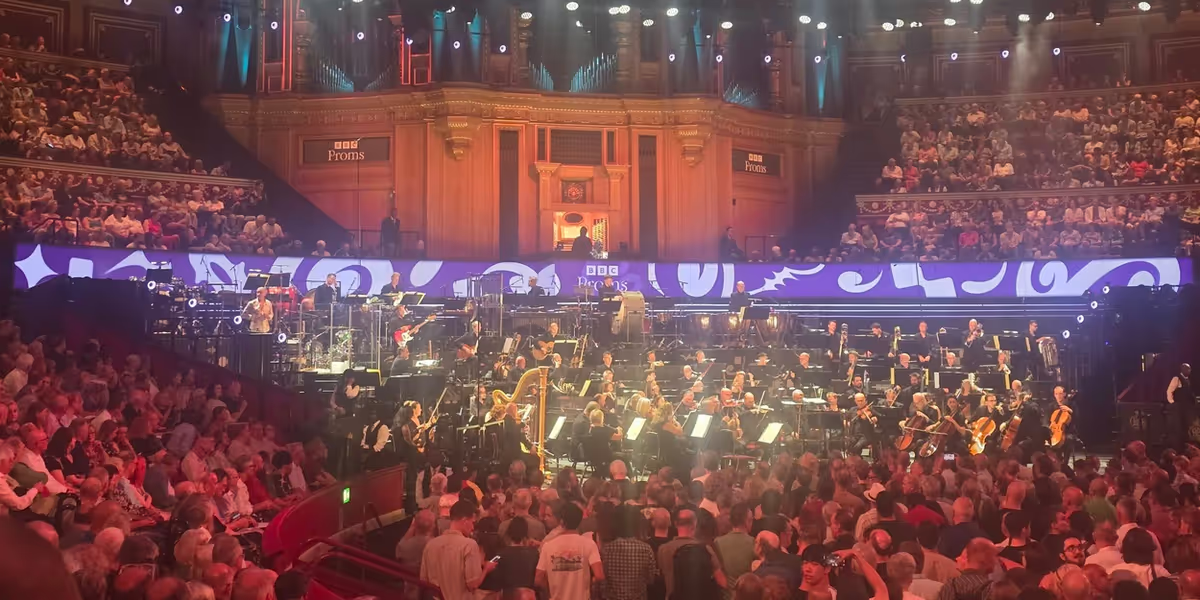
 Finally, prog gets its Prom. The BBC's heart is unarguably in the right place in handing the genre's back catalogue to their Concert Orchestra, in tribute to a "pioneering, British-driven movement" rendered, as the billing has it, "on an orchestral scale". And yet the result falls a fair way short of the ambition.
If the mission passes muster, the omissions are the head-scratcher. No room for Procol Harum, whose "A Whiter Shade of Pale" more or less made the classical-rock ballad respectable, and who cut a whole live album with the Edmonton Symphony in 1972. No nods to prog's heavier cousins in Queensrÿche, Dream Theater and Iron Maiden. Nor for Marillion, nor Camel, and — richest of all — nor for the Electric Light Orchestra, a band that put the orchestra in its name and still can't make the guest list. Instead the Proms wheel out a couple of genuine prog heroes and fill the rest of the stage with sidekicks.
The evening opens and closes on the same theme, with Emerson, Lake and Palmer's two great raids on the classics — Copland's "Fanfare for the Common Man" to start, Mussorgsky's "Great Gate of Kiev" to finish — both handed back to the orchestra ELP once plundered them from. Copland wrote his fanfare in 1942; ELP made it a number two single in 1977, the very year punk was meant to have driven a stake through prog's swollen heart. Now the BBC Concert Orchestra reclaims the reclamation. Prog gets the respectability it always craved and finds it fits like a strait-jacket.
The trouble with canonising a genre built on such precision and virtuosity is that someone then has to sing the damn thing. Most of the numbers tonight lack their original warbler: no Gabriel, no Anderson, ELP down to a drummer. The songs are farmed out instead to a rota of admiring outsiders, to wildly uneven effect. Super Furry Animals' Gruff Rhys makes the worst of it, delivering Jethro Tull's "Living in the Past" as flat and lifeless as motorway roadkill, reading the words off the autocue as though he'd been handed them five minutes before curtain-up and had never heard the tune in his life. A less starry ringer who actually knew the song would not have gone amiss.
After Rhys stinks the room out, Guy Garvey clears the air. The frontman of Elbow and purveyor of straight-to-the-heart lyrics since the band's 2001 debut is the only guest vocalist to admit out loud that he loves this stuff, and it tells. He barely glances at the autocue, working the orchestra and the room instead, and for the length of Genesis's "I Know What I Like (In Your Wardrobe)" the thing briefly stops being a classical concert and becomes a gig.
Jane Weaver draws the short straw twice over. Renaissance's "Northern Lights", one of prog's poppiest three minutes, simply drowns in the sound mix: she fights the orchestra the whole way and loses handily, left trailing behind a conductor who either fails to notice her struggle or declines to care. She finds her feet on "Nights in White Satin" (the one number everyone, prog tragic or not, already knows), where a 19-year-old Justin Hayward's ode to a parting gift still lands like a warm hug among the colder, knottier material, and Weaver nails both its ethereal verses and its earworm chorus.
The evening's greatest luxury comes courtesy of the one man singing his own song. Peter Hammill, gravel-throated founder of Van der Graaf Generator, gives "Refugees" its full melancholy weight and leaves every other singer in the building looking like a tribute act. Which, of course, is precisely what they are.
After the interval, ELP's "Karn Evil 9" is pared to a brisk two minutes — barely time for its famous "welcome back, my friends, to the show that never ends" before it's gone — with Carl Palmer back behind the kit, installed in a self-contained booth high up and to the left, the last Emerson, Lake & Palmer man standing, surveying the faithful from on high like a saint who's wandered into his own stained-glass window. A canny way to herd everyone back to their seats, if a stingy one; more would not go amiss, even though we all have homes to get back to.
Elsewhere the programme makes prog's enemies' case for them. The genre has never wanted for satirists — the sardonic Wirral wit of post-punk survivors Half Man Half Biscuit, the hilarious biopic-puncturing Walk Hard — and prog, the most self-serious rock of all, hands them their fattest target. Soft Machine's "Out-Bloody-Rageous" is uncompromisingly abstruse, exactly the unstructured noodle the anti-prog brigade always insisted was there to fill vinyl rather than entertain — a charge that lands with equal force on prog's supposed nemesis, punk.
A run of three instrumentals (Focus's chart-tickling "Sylvia", a slab of British-Ghanaian-Caribbean jazz-rock from Osibisa, and anarchist-in-chief Frank Zappa gatecrashing with "Peaches en Regalia") goes joyfully in one ear and out the other, thanks to sympathetic but unremarkable arrangements from Christian Balvig. Mike Oldfield's "Tubular Bells" — the record that set a young Richard Branson on the road to his billions — is filleted to "excerpts". Even in fragments, Adam Dennis's arrangement raises all the hairs on the neck, still conjuring 1973 and The Exorcist, a film that could eat the entire Paranormal Activity franchise for lunch and pick its teeth with Obsession afterwards.
Garvey returns in more forceful voice to front a muscular King Crimson medley. Presenter Stuart Maconie relays that the Elbow singer prefers "mashup" to medley; the words aren't synonyms, but should the BBC think of dedicating a whole Proms night to actual mashups, it would not be the worst idea ever (nudge, nudge). He then lends Phil Collins-era Genesis's "Entangled" an intensity its dreaminess rarely invites.
But the night belongs to Vanessa Haynes. The wordless vocal on Pink Floyd's "Great Gig in the Sky", no lyrics to hide behind, five minutes of sheer gospel-soul ascent, is the tallest order of all and the seasoned Proms hand rises and rises and brings the roof down. The pro delivers where the indie names have wobbled.
This hall has staged group-and-orchestra prog since Deep Purple and Jon Lord did it here in 1969; what is new is the official blessing. And a blessing, it turns out, is also a double-edged sword. Prog spent fifty years being told it was too much — too long, too grand, too pleased with itself — and its reward is to be portioned into bitesize canapés and the lyrics read off autocue to mixed effect. The common man gets his fanfare. Prog gets its cage.
The BBC Proms continues at the Royal Albert Hall until 12 September
Photo Credit: Franco Milazzo
Sign up for all the news on the Fall season, discounts & more...
.jpg?format=auto&width=300)





Reader Reviews
To post a comment, you must register and login.