


Interview: Jennifer Chang of THE HEART SELLERS at TheatreWorks Silicon Valley
Chang directs Lloyd Suh's humorous and heartwarming play in Mountain View running April 2nd to 27th
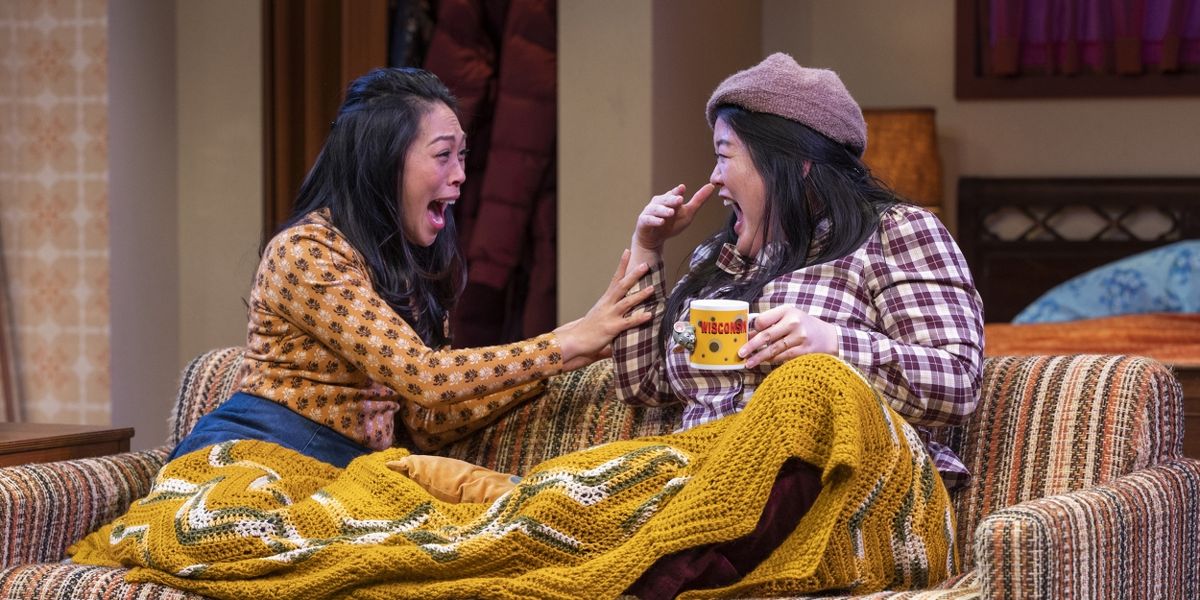
It’s a rare and wonderful thing when a director comes across a new play where the writing resonates with their artistic sensibilities and the story relates directly to their personal history. Jennifer Chang found both of those things in Lloyd Suh’s The Heart Sellers, so it makes perfect sense that she’s been happy to spend a significant portion of the past two years directing productions of the play. After its 2023 world premiere at Milwaukee Rep, she moved on to a Northern California co-production that has its final mounting this month at TheatreWorks Silicon Valley following runs at Berkeley’s Aurora Theatre and Sacramento’s Capital Stage.
The humorous and heartwarming play by Pulitzer Prize finalist Suh (The Far Country, The Chinese Lady) takes its title from the 1965 Hart-Celler Act which paved the way for thousands to become U.S. citizens. Set in 1973, The Heart Sellers centers on two Asian women navigating their first American Thanksgiving. Luna is from the Philippines and Jane from South Korea, yet they find common ground in their shared experience, including often-absent medical resident husbands, missing loved ones back home as they discover the joys and challenges of life in America.
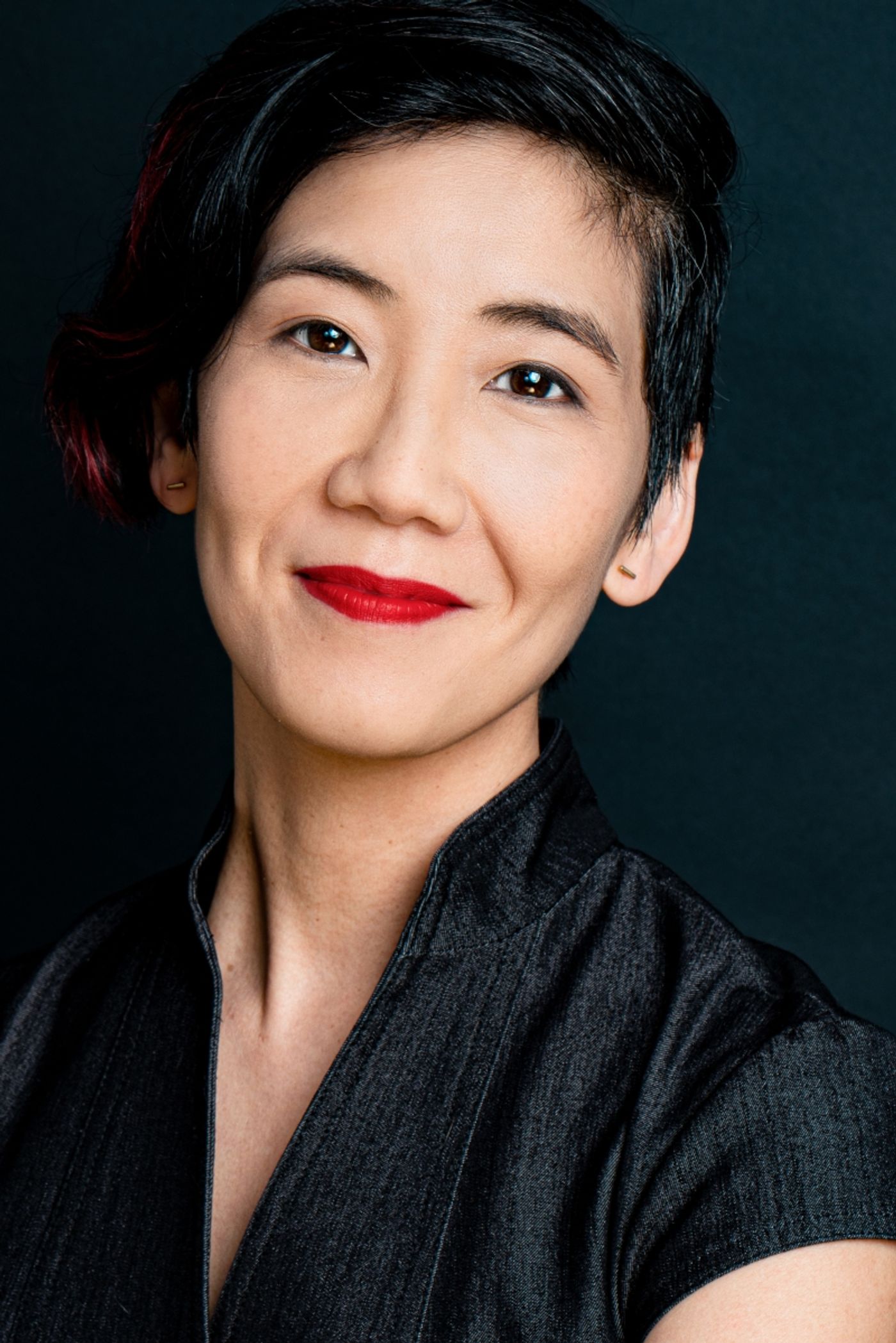
Chang is a multi-disciplinary theater artist who has directed at prominent companies across the country, including Atlantic Theatre Company, Berkeley Repertory Theatre and Primary Stages. She is known for developing new work at such renowned institutions as Williamstown Theatre Festival, National Playwrights Conference at the Eugene O’Neill Theater Center, and Center Theatre Group. As a playwright, she was the recipient of the Beatrice Terry Residency for the Drama League for Matter, and is currently writing a musical in the Geffen Writers Room. As if that weren’t enough, she is also an Associate Professor at UCLA’s School of Theater, Film and Television. To say she has a lot on her plate is an understatement.
I spoke with Chang last week by phone while she was regrouping at her home in Los Angeles between work-related trips to Connecticut and the Bay Area. We talked about how she connected with Suh and why his plays resonate so strongly with her, how her own family benefited from the Hart-Celler Act, how she approached directing The Heart Sellers for such disparate theater companies and performance spaces, and the challenges of being an in-demand theater maker while also raising a family. In conversation, Chang is thoughtful and engaging, and clearly someone who loves her job(s). The following has been edited for length and clarity.
Since you directed the world premiere of The Heart Sellers at Milwaukee Rep as well as this Northern California three-theater co-production, the play obviously speaks to you. What do you especially love about it?
Oh my goodness, so many things. What I really love about the play is the beautiful, quiet activism that Lloyd Suh undertakes in his writing with such specificity. These two women are Asian immigrants, but there’s such a specific place that they’re from, they’re speaking with a specific accent. And the theatricality of it, while it is seemingly on the page very simple because it’s two people, it’s one set, there’s not any fireworks or other pyrotechnics that happen. [laughs] But it really getting to the roots of theater here where it’s beautiful writing, beautiful acting, and you’re with them in the duration of time that the play takes. If it were real talk in real life, the women would probably be speaking in much shorter sentences, would be given a much shorter space of time to be listened to, and here we’re with them for these 90 minutes and we hear them speak quite eloquently about what they’re going through. And that feels to me like such a beautiful thing that Lloyd has done.
And my family immigrated in the 70s to the Bay Area, so I'm very directly connected to the Hart-Celler Act, which prioritized families being re-unified and skilled laborers.
It’s pretty appalling how little most Americans know about the whole history of anti-Asian legislation in this country. I certainly don’t remember being taught anything about it in school. Did you know much about the Hart-Celler Act before being approached to direct this play?
I knew about it, but definitely not as in depth as I know about it now. I had a cursory knowledge of it because it affected my family, but I didn’t really know how it was so connected to much of the other legislation that specifically targeted Asian groups. And also - fun fact - that it was not so altruistic in its creation. It was made simultaneously to the United States understanding that there was a need for a specific kind of labor (and it’s all over the news again now), recognizing that for Medicare, Medicaid and Social Security they needed more people to take care of us. And in order to do that, the solution was to open up immigration to this specific kind of labor.
My mother was a nurse, that’s how she came, and that’s why we have so many Filipino nurses is that we need these people to help take care of us. Another kind of fallout is the strengthening of this model minority myth. We think of Asians as being incredibly hard working and smart and you know white collar-ish, or elevated in collar I think I would say, when we think about nursing and medtech and those skills. But it’s a direct connection from this Anti-Asian legislation that makes a lot of Asian groups kind of hide in plain sight so as not to be picked out for violence.
That’s so interesting. I’ve sometimes wondered why nursing assistants are so often Filipina.
Yeah, and there’s also the connection to the fact that English is spoken in the Philippines so that’s a reason to prioritize that. Almost everyone in my family is in the medical field - medtech, pharmacists nurses, and then very recently with the next generation my sister is a doctor and I have a cousin who is a doctor, as my family got their legs so to speak. The other component is my uncles all served in the military, and one who was in the navy was able to immigrate really early on and petitioned my grandparents who petitioned their other children, so they were also beneficiaries of the Hart-Celler Act that way.
The Heart Sellers isn’t the only play you’ve directed by Lloyd Suh. How did your connection with him come about?
It’s funny – so I was an actor, you know the gateway drug for everybody! [laughs]
I know! It was my gateway drug to what I’m doing right this very minute. [laughs]
See? But I was an actor and my graduate degree is in acting, and I met Lloyd in New York because his now-wife, Jeanie, did some graphic design on a show I did for the National Asian American Theatre Company. So that’s how we first met, and we were sort of in similar circles, but we didn’t know each other in that configuration.
It was actually The Heart Sellers in Milwaukee that was the first time we worked together. Lauren Yee recommended me to Lloyd and said, “Well, Lloyd, you know Jen’s a director now. You should really talk to her about this.” So we met and he picked me and the rest is history. I tease him, I really do, that I feel like I could spend the rest of my life directing Lloyd Suh plays and it would be a very fulfilling career trajectory, and his response is always like “Oh, come on, now!”
The only play of his that I’ve seen is The Chinese Lady, but your description of his writing in The Heart Sellers could apply to that play as well. There’s such an elegance to his language even though he includes a lot of historical information.
Yeah, it’s like Chekhov and Shakespeare at the same time. There’s so much deep character work in the bone structure of the characters and so much personalization and specificity that Lloyd invites into the creation of the characters from the entire creative team. And then at the same time the heightened nature of the language really wants skilled people to be able to speak that language.
I can’t imagine directing a production for multiple theater companies and their unique spaces. How did you approach that challenge?
There has to be a redesign in each of the spaces to kind of play to both the weaknesses and the strengths of each one. So you work very closely with the set designer because the set dictates so much of the blocking The characters must come from point X, they need to go to the bathroom, there needs to be a kitchen, there needs to be a couch. And you’d be surprised how much thought goes into where you put a couch. Anne Bogart, who teaches at Columbia, says that the act of creating in theater involves violence, cause once you make a choice you kill all the other choices. [laughs]
I like to think that I’m very bespoke to the actors I’m working with and their energy, and so I’m really thinking about “What are they good at?” in terms of, “Oh, this actor I know once I give them this blocking, they’re so physically-minded that they’ll understand what to do with that.” And another person needs to be walked through it much more deeply, with psychological reasons and why these moves need to happen this way so they’ll remember that.
And then it’s thinking about what the audience needs in terms of being able to understand story, and it’s a consideration that these two women will speak in accents that may not be familiar to all of our audience members. That’s always tricky that they’re speaking in two different accents, and so what does that mean in terms of lining up the intention of the actor with the gesture and the direction that they’re speaking in, and how to strategize the direction for maximum intelligibility?
I’m familiar with both the Aurora and TheatreWorks spaces, and they are so different from each other.
So different!
I can imagine the production at the Aurora with its smaller auditorium and thrust stage felt very intimate. How do make the same production at the much larger Mountain View Center for the Performing Arts not feel a little remote in comparison?
I’m hopeful that it won’t be. There are certain things we’re trying to create texture, and while we have two very skilled women who we knew would be to fill the theater and are highly trained, we are mic’ing them in Mountain View just to make sure that everyone can feel in an aural sense that they’re very intimately connected to the story.
When we knew that we were going to Mountain View, we wanted actors who could fill that space. I knew that the original company could, and so the invite for them was to do all three runs. But Narea Kang could only do the Mountain View production so TheatreWorks wanted to lock her in, and we did that prior to finishing casting for the other two theaters, then we were lucky that Wonjung Kim was available to do the other two. So TheatreWorks was cast first before the other two runs, even though it's coming in last.
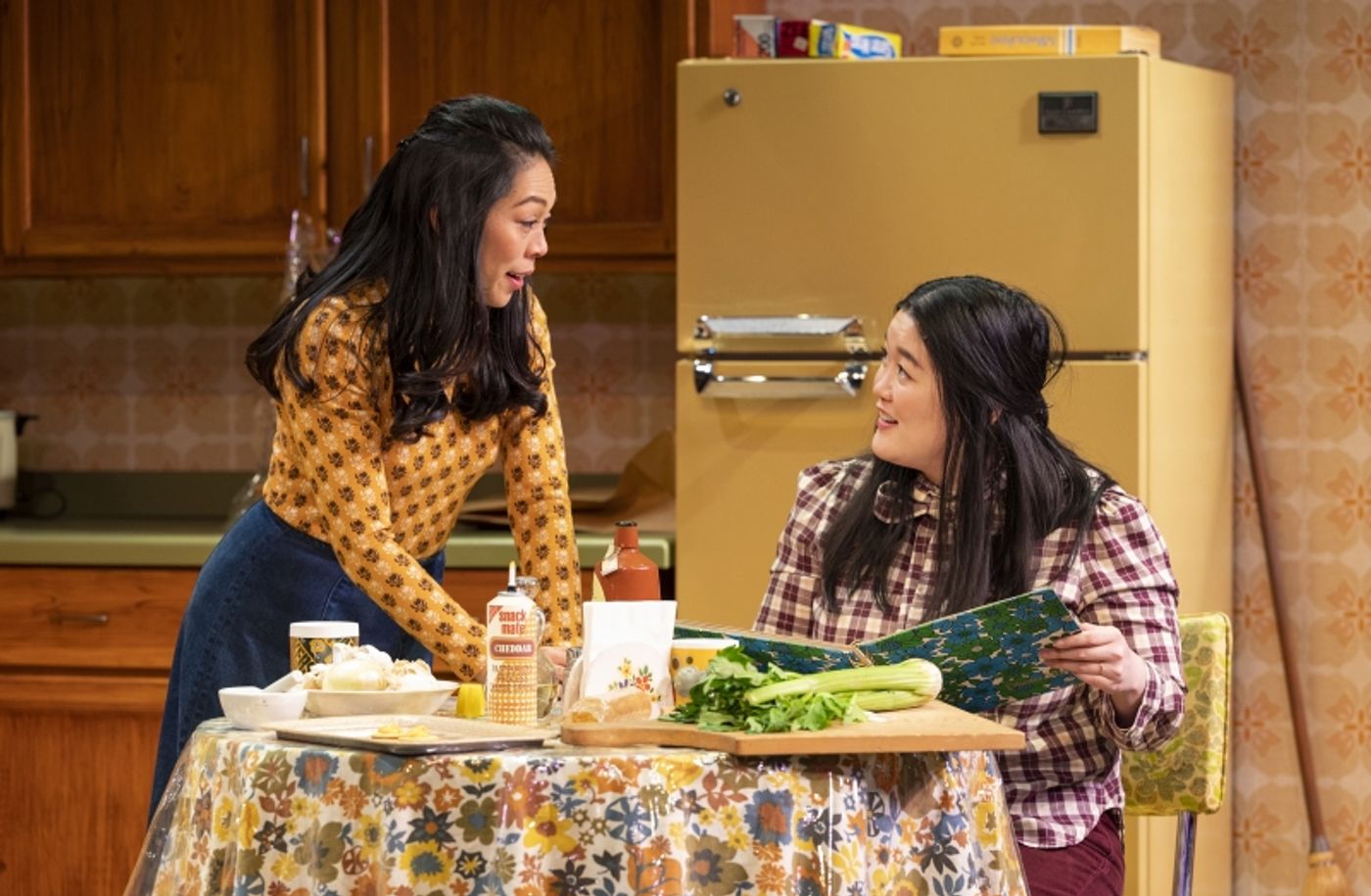
of Lloyd Suh's The Heart Sellers directed by Jennifer Chang (photo by Michael Brosilow)
Since the TheatreWorks mounting will be your last go at this play –
For now!
Is there anything you are especially looking forward to with this final run?
Well, Wonjung was wonderful [in the role of Jane] and I don’t want to take anything away from her performance at all, but I am excited two work again with Narea, who originated the role in Milwaukee. We are different people two years later and we’re a different country two years later (we’re a different country from week to week, I feel like!) and so it feels exciting to see how it resonates differently with a different actor, who I’m already familiar with, you know as we re-meet each other.
You are quite the theatrical multi-hyphenate. With all the directing you’ve been doing, are you currently able to devote much energy to either acting or playwrighting?
Not much to acting. I think half the job of being an actor is being available, and I’m very blessed that I’m not available. I feel like my directing career has been extra busy of late, but I love acting and if someone were to just ask me to do a reading, which sometimes happens, I’m so happy to do that. But I don’t have time right now. Like usually if I get sent an audition, they’re like “You must be available these dates.” And I’m like “Well, I’m not available.” So all the trouble that an agent has gone to to try to get me an audition that I can’t actually do!
I am actively writing right now, which is a tricky juggle while I’m in process with the other things. And I joke that when I’m a director I get to play all the parts, in some ways. As I think about how an actor is approaching a part and I’m collaborating with them and trying to help them navigate really difficult passages or throughlines with the acting, I feel like I’m still getting to satisfy that creativity.
And without having to be onstage eight times a week.
Yes! I have a family and I find that when you’re the director you’re the first person to get asked to do a project, and scheduling when you’re the first person is a much easier juggle with your family than when you’re the last person. Actors are usually the last person on a creative team and have to change their whole lives on a dime, so it has felt like it’s been something really great where I can have my cake and eat it, too, and continue to be creative. Of course, I have Mom guilt, traveling and leaving family, but it’s a shorter time away than acting in a play and I get to set the schedule so if I need to make a trip home or leave for a day I can.
I’m really glad you mentioned the exigencies of maintaining a career in the theater as a mom. I talk to directors all the time and no one has ever brought up that aspect of it before. But maybe I speak to a lot of directors who don’t have families because they can’t figure out how to make that work?
Yeah, it’s kind of a dirty open secret that in terms of directing, the reason why so many people of privilege are directors (and I mean monetary privilege and also that they don’t have families) is it’s a tough thing to navigate. My agent jokes that you can make a killing, but you can’t make a living as a director. And I find that that is true, so you have to figure out how to be independently wealthy or have a job that’s incredibly flexible or supportive of what it is you’re trying to do. Which I do. I’m a professor at UCLA and it’s part of my research to be able to go direct, and for that reason my department is supportive of me figuring out a way to balance the teaching and the doing.
But I think it’s a vital perspective, and other more famous people than I have talked about it. Even in England, they have this problem where the working class perspective from acting is getting lost because even to be able to afford drama school you usually have to come from means. So I do feel like it’s kind of an act of activism to just keep going. It feels important to have the point of view of mothers, and yet it’s so hard to have mothers direct. It’s so important to have working class values and viewpoints in the American theater, and yet it is so difficult to be from a background that doesn’t have connections or monetary privilege to set you up to be able to do the things that allow you to direct in this industry. And yet somehow I’ve been able to put the pieces together to do that.
I remember talking to a friend who’d studied acting at A.C.T. and he said what he noticed in the years following graduation was that the actors who had made it were by and large the ones that had come from wealthier families, because they could afford to fail for a while.
Yes, that’s correct, and that I think is not a luxury that many of us have. Like my father is an electrician, my mother’s a nurse, and they have no connection to the industry whatsoever so I did not have the option of failing
Since you seem to be working everywhere all the time these days, what other projects do you currently have on your plate?
Well, I’m simultaneously working on this play and on a production of Primary Trust at TheaterWorks Hartford (no relation). Then I walk into a production of A Doll’s House, Part 2 at Pasadena Playhouse in April, and this summer I’ll direct Yankee Dawg You Die by Philip Kan Gotanda, who’s a Bay Area playwright and a professor over at UC Berkeley. Lloyd Suh has written about Philip as somebody whose work many of us stand on, so it feels like a real honor to direct his play at East West Players.
Looking at your resume, it’s notable to me that you only seem to direct really good plays. For instance, Primary Trust has been at the top of my list of plays I’ve been dying to see, and that’s just one example. How is it that you’ve managed to only get hired to direct top-notch work?
[laughs] I know! Maybe it’s luck and maybe it’s that I’ve done a lot of new play development. I think of working with plays as two parallel metaphors. One is like a locksmith who’s listening very closely to the pings and the dings of the lock to be able to unlock the play. And then also I feel like a play doula, where I’m here to catch it and let the play be what it wants to be, and really listen for what is the playwright’s intention.
I love to listen to my playwright and take care of their intention and get at the heart of what they’re trying to accomplish with the play. It’s like I listen to them for the music, and then I take that music and translate it into something that we’ll see in three dimensions. And so maybe – this is just me supposing – it’s that people feel like they can trust me with their words? That’s a very inarticulate answer! [laughs] But I do love plays so much. I love what plays do in real time with a live audience.
I can easily see why playwrights are lining up to work with you. At the same time, I wonder if that kind of approach will get you a lot of work but won’t make you famous because you don’t seem ego-driven in a way that puts your personal “stamp” on a play.
Well, you know, I love not being looked at! [laughs] In terms of the transition from being an actor to a director, the young artist in me that had so much ego and ambition in a specific way, that was so wrapped up in the acting. And with directing I feel like I have walk-away power. (I think Chapell Roan might recently have talked about this.) My directing career found me in this roundabout way that I hadn’t intended and so it feels like this place that I can be in collaboration with rose-colored glasses. I can approach it with artistic purity because I feel like at any point that this is no longer fun or not the kind of thing I want to be doing or doesn’t work for my life and my creativity, then it’s like “Okay, cool. Bye!” [laughs] That gives me clarity and bravery to make big choices based on the script. But it’s always about the script.
(header photo is by Michael Brosilow of Nicole Javier and Narea Kang in the Milwaukee Repertory Theater’s world premiere production of The Heart Sellers.)
--
The Heart Sellers performs April 2-27, 2025 at Mountain View Center for the Performing Arts, 500 Castro Street. For tickets and more information visit TheatreWorks.org or call 877-662-8978.

|
Julius Caesar Marin Shakespeare Company (8/14-9/13) |

|
Pickleball Hillbarn Theatre (8/20-9/13) |

|
Good Night, Oscar Hillbarn Theatre (3/04-3/28) |

|
Lauren Mayer’s I Didn’t Come From Your Rib The Marsh Berkeley (8/21-8/23) |
|
Divorced: The Musical! The Marsh Arts Center (8/27-8/29) PHOTOS |

|
Dev Cuny’s Assigned at Birth: My Funeral Part 1 The Marsh Berkeley (8/19-8/22) |
|
Once Upon A Mattress Saratoga Civic Theater (9/26-10/17) |

|
DRACULA ORINDA STARLIGHT VILLAGE PLAYERS (9/04-9/26) |

|
Robyn DeGuzman’s Enough Free The Marsh Berkeley (8/28-8/30) |

|
Catherine Debon’s Lullaby of a Partisan The Marsh Berkeley (8/22-8/23) |