


Interview: Nadia Ra'Shaun And Brendan O'Leary are Orlando Shakes' ROMEO & JULIET
How do Trader Joe's, pre-show Celine Dion, and 16th-century "mic drops" come up in this star-crossed sit-down with the production's leading players? Read on!
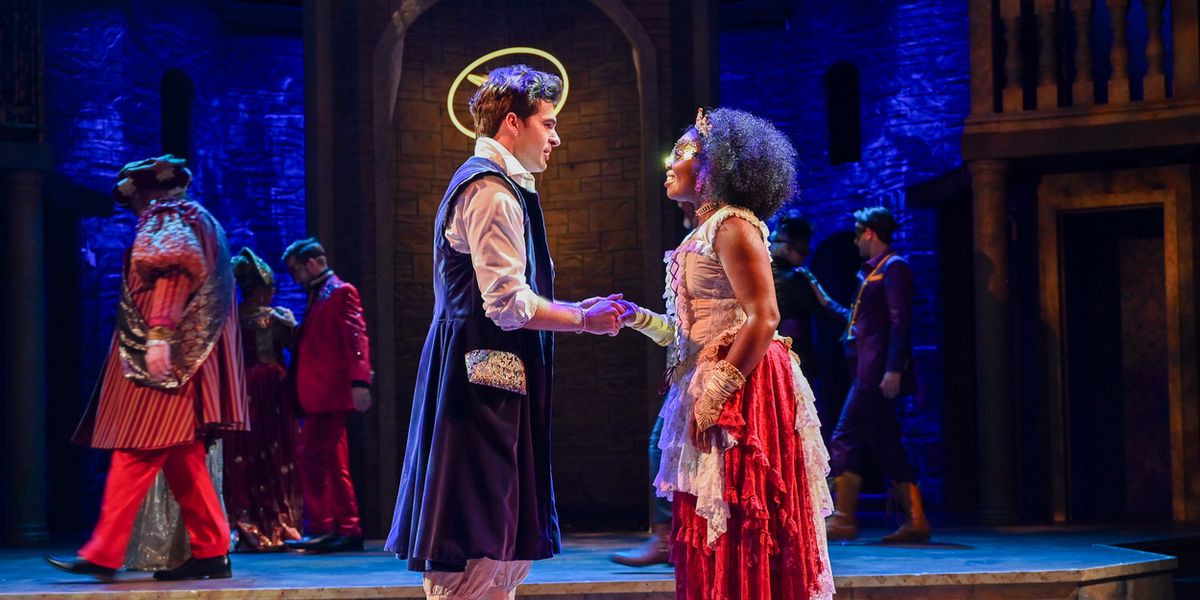
In a world of centuries-old feuds and high-stakes drama, sometimes the best way to bond is over a grocery run and some barbecue. As the Orlando Shakes’ latest production of ROMEO AND JULIET takes the stage, lead actors Nadia Ra'Shaun and Brendan O'Leary are proving that bringing Shakespeare’s most iconic teenagers to life requires equal parts technical precision and modern-day sanity. From the intensity of four-day memorization "boot camp" to the literal struggle of not moving a muscle while spiders crawl about, Nadia and Brendan offer a refreshingly human look at the "star-crossed" experience.
Thank you so much for sitting with me, you guys!
So, I know you guys have both worked on Shakespeare before. And actually, I think I saw that both of you guys have actually touched this specific piece before, right? You both also have lots of experience in musical theater, film, and other performance mediums.
I want to start by asking you how your preparation and your process changes based on that sort of material that you're working on. What kind of differences do you look at here with Shakespeare?
BRENDAN: I guess, like, 90% of working on Shakespeare, for me, is just knowing what you're saying. And part one is literally just “what does this word mean in this context?” Because, for example, when I say, “in sadness, cousin, I do love a woman,” if you go to the lexicon and look up what “sadness” means at that point, that really means that I'm not in love with a woman. It means it's seriousness, not sadness. So even words that you think you know can be misleading sometimes. So it just changes completely how you play that line or just what you're doing. Then I think the other part of knowing what you're saying is how can I make, "oh, she doth teach the torches to burn bright” mean something to me. How can I put that in my own words so it doesn't just feel like I'm reciting something poetic and larger than life? You know what I mean? Then I think, after you have that down, the process for me is just the same as it is with anything else — character work and knowing what you're fighting for and personalizing it.
NADIA: I think I focus a lot on the text. I’ve played Juliet before, so it was really helpful that some of the text I already had a good handle on. But in our production, we've got different cuts. Once I figure out exactly what I'm saying, like Brendan was saying, it's super helpful to inform how I'm saying it. But Shakespeare also gives us so much in the text. He'll add extra letters if he wants you to stretch out the sound. “I beseeech.” There's not three E's in beseech, you know? And so focusing on what he's giving us and then going from there is really helpful.
Speaking of the text, like you guys both mentioned, that's obviously one of the most predominant things that people associate with Shakespeare: the language and the density of it, but also the infamy of some of his phrases, right? So do you have a favorite phrase or line from this show?
B: It’s not even my line, but there's something about Tybalt's, “now by the stock and honor of my kin, to strike him dead, I hold it not a sin.” It's just like such a mic drop moment and it kind of encapsulates the stakes of the world they live in. Of honor and fighting to the death to protect that honor. It's just such a — oh, it gives me chills. Tybalt's such a horrifying person, but it's like he encapsulates the feud.
N: I have a line, “my bounties as boundless as the sea, my love as deep”. The vowels, there's something so warm in like the vowels, and Juliet loves her vowels. There's lots of consonants, but she loves to live in her vowels.
And that alliteration at the beginning, too.
N: Oh, yeah. Yeah, it's just so nice. It's so sweet.
Oh, that's wonderful. So as we were talking about your process, like getting the words in your head: given that it is so different from how we speak colloquially nowadays, what does the memorization process look like?
N: Typically, I would start, as Brendan did, months in advance knowing I've got the contract. But I was hired four days before rehearsal started, so we were digging deep into the depths. With the way that our rehearsal schedule was set up, we had three days off for the week of Christmas. We had one day of rehearsal that Monday, and then we had Tuesday, Wednesday, Thursday off and came back Friday. And I put myself through Juliet boot camp, going and writing the text without punctuation, and just making it into a rambling. That’s typically how I memorize things, because it's in your brain. It's in your hand, and then it moves to your brain. And then I just read it a couple of times. But yeah, I did that for three days straight. Then I went and had Christmas dinner at my grandpa's house.
B: I had an opposite process, because I had months to prepare. So I kind of would go to it, leave it, put it down, and then come back to it throughout that time. I kind of focus primarily on what I was talking about earlier, just doing all of the “knowing what you're saying” kind of work. Just through that, if you have enough time, you naturally, through osmosis, naturally memorize it a little bit. I actually find Shakespeare, sometimes, to be easier to memorize than contemporary text, because the words are so poetic that they're kind of irreplaceable in a way. “But soft, what light through yonder window breaks." It's like, how many other ways could you say that intention? You know what I mean? They're so grand and heightened that it kind of locks itself in place a little bit quicker for me. And then once I've done that work, and the things that I don't know, similar to Nadia, I just will just speak over and over again until I got it in my head, without trying to put too much intention on it when I do that. Because it's very easy to get locked into a pattern of the way you speak if you do that.
Because the muscle memory could lock you into something.
B: Yeah, absolutely.
N: Another super important thing for me is walking around. It's one thing to sit down on the couch with my script and go over things, and I can be like, “oh, I've got it so memorized,” while I'm in the car driving. Then I get on my feet, and I'm like, “what are the words? Oh, where'd they go?”
B: I think what also helps with “memorization" is really not memorizing, but really knowing what the person before you just said. Because it kind of makes your next line make more sense because of what was just said.
So obviously, Romeo and Juliet's been around for a long, long time. Do you guys, other than this production, have a favorite adaptation or a favorite production that you've seen or you're familiar with?
B: I love the Franco Zeffirelli movie, 1968, I believe, with Olivia Hussey and Leonard Whiting in the title roles. I personally like Shakespeare set in the time that it was written or the way it was intended. That's just a personal thing for me. That's not to say I don't like modern adaptations; I kind of prefer the Renaissance world. That movie captures that world so beautifully, and the performances are so great. And especially for that time period, we didn't see a whole lot of teenagers playing teenagers. And so that's a cool thing, too.
N: I'm very partial to the [Baz Luhrmann] 90s version, Leo DiCaprio, because it was my introduction to Romeo and Juliet. We watched it in school when we read the play. And I was like, “wait a second. You mean I could do it this way if I wanted?” But also, on stage, I don't love modern adaptations. I think it only works in my head for a film. On stage, I'm like, “give me a sword! Give me a corset! Let's go!”
So, given that this story has existed for so long, how do you find a way to make these characters real people, rather than cogs in the hundreds-of-years-old wheel of this story? How do you find a fresh take on it?
N: I've found it very helpful to focus on how young they are. I feel like a lot of productions that I've seen, they kind of like jump over the fact that Juliet is 13 years old. She's not even 14 yet. Her birthday's in two weeks. And we get the chance to breathe really young energy into them, which just like - the urgency is just upped. And everything just so much more important, because when you are a young teen, everything is the most important thing in the world. And we've got these big emotions. So I think the direction that Monica [Director] wanted to reiterate is that they are children, and they have big feelings. And that just keeps you going.
B: I think I consciously make an effort to not think about that, because I think it just, well — that’s just a lot of pressure. So I try to veer away from, “oh my god, this is so iconic”. I just try to meet it where I'm at and just try to connect to it as personally as I can. Otherwise, I'll get very overwhelmed, and then I would start living in a world of generality and not be specific to me.
So Nadia, you mentioned that you've played Juliet before. I'm sure, like you said, the familiarity with the language helped a little bit. Did you find that your prior characterization was something you had to unlearn to move into this version of Juliet? Or did it assist as well?
N: There is a book called Searching for Juliet. I can't think of the author's name right now. [Sophie Duncan] But our dramaturg, Robin, she introduced me to the book. And in the book, the author writes, “once you are old enough to understand Juliet, you're too old to play her. You've aged out of the character.” I'll be 27 soon. The last time I played her, it was pre-COVID. And everything felt very general. But I've gotten to really dig into her emotional journey, but also her mental journey. She grows so much. We meet her as a 13-year-old girl, and she is a woman by the end of the show. She's a little girl making really big decisions. She's making really grown up decisions. And as someone who has grown since then, mentally, emotionally, physically, it's been much easier to connect to her in that way because I understand what having a crazy journey is like. Also, I'm a Cancer. I'm emotional. So being able to just allow her to exist however she wants to exist that day is great.
B: Can you repeat the thing from the Searching for Juliet thing?
N: She said, “once you understand Juliet, you're too old to play Juliet”.
B: I love that because, not to call this person out, but someone asked me in the talk back that we did a couple of days ago, “What did Romeo learn from this journey through this play?” And it's like, he didn't really learn anything! Because he's so locked in on it being Juliet or death from the moment he meets her. And there's nothing else to learn because he follows through with that intent of like, "oh, Juliet's dead, I guess I’ve got to die too". And I think that quote from that book, it just really speaks to a way that I don't really understand Romeo that well, intellectually or perhaps psychologically. Because it's very simple. It's like, he's youthful and full of this kind of "all or nothing" passion. I don't know if that makes sense.
N: I think it makes sense. I think it's so interesting because with Juliet, we've talked so much in rehearsals about how she grew up. She's an only child. She's got her cousin. And they were raised as siblings. But she spends all of her time with her nurse. She doesn't really go out of the house other than to go to shrift. She's at her first ball. And she meets this guy, Paris. And she's like, “OK, this is cool”. And then she meets Romeo. And she's like, “this is what I've been waiting for. Paris holding my hand didn't feel like this”. It's literally “A Whole New World” from Aladdin. She's like, whoa. Juliet spends all of act one on her toes, running around on my tippy toes. It's not until the end of act two where she's fully grounded and sinks in. But they're just dreamers. And they just want to be in love.
So you guys really do play into that youthfulness of the characters.
B: Well, they truly represent the idea of heaven and God in the literal sense of the way that we think of heaven and God. Just the greatest possible thing that you could have in your life, like the highest ideal. It's taken quite literally when I say, you know, being without her is purgatory, torture, hell itself. That's not the way people say today say, “go to hell” and it’s just like a metaphor. I'm earnestly saying that, without her, I am living in hell. Because she is God to me.
N: And she literally refers to him as the God of ideology. She's like, “you are all I see”.
B: That’s why I keep referring to her as “dear saint”, “heavenly angel”. And why I call myself a “pilgrim” — because a pilgrim is someone that would go on a spiritual journey to find God. And I'm the pilgrim because I have been on that journey and I finally found it.
N: Oh my God, Brendan.
So romantic! So given that your relationship is, of course, the crux of the play, how did you two go about connecting as Nadia and Brendan when rehearsal started?
B: It was tough.
N: Oh, shut up. Just kidding. You know, I think we bonded over a grocery trip to Trader Joe's.
B: We did.
N: On the first day.
B: We got some barbecue.
N: Yeah, we got barbecue. Right before.
B: We were so tired from our flights, we didn't really say anything. We just kind of sat there in silence, like, “so, yeah. You excited?”
N: “We’re going to work tomorrow? Have you unpacked?”
Was there a moment when you guys remember thinking, “oh, I'm in good hands with this other person” or “this is going to be good”?
B: Well, I don't think they would cast someone if they didn't already decide that for themselves. So when I heard that Nadia's going to be playing Juliet I'm like, “oh, she must be cool”, because, you know, there's an interview audition process. And they’re not going to hire some a—hole.
N: I think that in rehearsal, that first week, we didn't do any intimacy. And so we were able to just talk. And by the time we got into our first intimacy rehearsal, we were like, “what's up, brother?” And I think it's so much easier to trust each other physically when we trust each other emotionally. And in terms of conversation, I’m like, “you're chill”.
B: Yeah. We're pretty open, easy personalities. We're also neighbors, so we see each other doing laundry and stuff.
I don't think it is a spoiler at this point to say that you guys both ended up dead. That's pretty heavy to end the show with. What are we looking at post-show to transition out of that and back into Nadia and Brendan?
N: I love this question! I'm a big advocate for releasing a character. It's so important for your mental health and your physical health to just let go and leave her at the theater. I have a Juliet playlist that I listen to like before the show, and I make sure that I don't listen to any of that music after the show. So there's Juliet's music, but then there's Nadia's music. Or I listen to an audio book, or I call my partner or my mom. Something that's gonna bring me back to the real world. “Okay, shake it off. Go drink some water. Sit in silence for a while.”
B: Yeah, I guess for me, I just kind of let whatever energy is there just kind of do its thing. So I try to, you know, push it away. If I'm like, “I'm gonna be happy now”, it'll just make it worse for me personally. So I kind of usually after the show don't say much to anyone, I kind of just leave.
N: He gets out of here!
B: I just kind of go straight for the door and leave. But we do eight shows a week. And the beauty of Shakespeare is that, not that you fake it, but if you're not in that heightened state internally of like, oh, “I'm dying for my love right now”, which isn't always easy, you can lean on the text.
N: I will say, we lay there for a while. And so I do use that time. Like once I'm done, I'm like, “oh, thank God. Okay. Let's just listen to Jim [Friar Lawrence] say his lines.”
B: No, I'm always having like such a panic attack when I'm dead on stage because I have a brain that's just never stopped. It never turns off. So, it’s always like, oh, what is this? What is this? What is this? It's just like complete anxiety of like, “don't move your finger. Oh, you almost moved your finger. Oh, you’re moving your finger.”
N: The other day, I started counting. Jim Helsinger, who plays the Friar, he started his final monologue and I was like, one, two, three. And I got to like almost 200 by the end. And I was like, “wow, I'm gonna keep my brain active so I don't fall asleep”.
When I come see the show tonight, I'll be watching you guys. I'll be like, all right, that's Nadia and Brendan dead on the stage. They've transitioned out of Juliet and Romeo.
N: Souls? Gone.
B: It's hardest for the school shows too, because I know that when I was 13, I'd be staring at the dead bodies. Like, “He's about to move! Oh, he moved!” And so you just kind of feel the eyes, these young eyes on you, just kind of watching your every breath. So I'm like, don't freaking move.
N: For sure. I've also given up on like trying to like shallow breathe. I'm just like — I can't breathe. If I take too many shallow breaths then I feel like I'm gonna die.
B: Yeah, oh my God.
N: I always have to wait until you finish, like until you die. And then I'm like — (takes a deep breath).
B: And [the scenes] are long. Like this, what? 10, 15 minutes after we're dead. I mean, poor Blake is playing Paris. He has to be dead for 20 minutes on stage.
N: He’s not dead that long.
B: No?
N: No. I'm dead for 16 full minutes.
B: That is true.
N: Including my fake death.
B: But you get a break, though. You get to wake up and be like, “oh!”.
N: I get a break, I see. Yeah, I get to come out. Whatever! (Laughs)
B: I played Paris in an outdoor theater one time. So there were mosquitoes all over me. So I have PTSD from that experience.
N: Well, he [Blake] had a spider on him the other day.
B: Yeah, it went down his pants, he said.
Oh no!
B: Well, there are moments, you know? I have the dagger that I use to kill him [Paris]. It's what Juliet uses to kill herself later. And so I really need to have that dagger because Nadia needs it later. And when I put his body down after I killed Paris, I put the knife under his body by accident, and then I lost it. I didn't know what I did with it. So I was like, “in faith I will…” and I'm literally like moving his body around as I'm saying the lines. And I finally found it. I'm like, here we go. Where’s my poison?
Well, I appreciate you guys sitting with me so much - now, I do have a lightning round for you guys.
N: Great.
B: I’m really bad at these. All right. Okay.
Nadia, what is Romeo's red flag?
N: His red flag is being obsessed with Rosaline.
B: You [Juliet] didn't know that.
N: He didn't ask Juliet. He asked Nadia!
B: Oh, okay.
Brendan, what’s Juliet's red flag?
B: It’s not her fault, because she's very young. She's a little too young for me. I'm not going to lie.
In your work bag, when you're heading to the theater, what's your must have item?
N: iPad.
B: My water bottle.
I know you mentioned your Juliet playlist that you're listening to. Anything else we're listening to pre-show?
B: I don't play my stuff that much now, because we're like 20 shows in or whatever. So I feel like a lot of my playlist has kind of lost steam. And so now I'm just listening to whatever podcast before [the show].
N: “Car Radio” by Twenty One Pilots, “Ballad of Mona Lisa” by Panic at the Disco, “Lover Girl” by Laufey.
B: I will say sometimes, backstage, if I'm not like feeling there emotionally, I'll listen to like, “My Heart Will Go On" by Celine Dion or something.
Oh my God, that is so funny.
B: That does work, it works!
Post-show snacks?
N: Oh, tater tots.
B: Ice cream if I'm really feeling it. If I'm feeling bad and sad, I'll have some ice cream.
What are we watching? TV shows, movies, any recommendations?
N: Bridgerton season four came out yesterday and I've already watched all four episodes.
B: I just started this movie last night, I intend to finish it tonight: The Man Who Shot Liberty Valance with John Wayne and James Stewart. It's really cool.
Since we are in Orlando — Disney or Universal?
B: I haven't been to Universal yet, but I'm going next week.
N: I’m going to Universal next week. I want to go to Disney. I just want ears! So I'm gonna say Disney.
B: I did go to Disney last week and I only went to Animal Kingdom and Hollywood Studios and I really wish I'd went to Magic Kingdom for the nostalgia. I just want to be in front of the castle. Yeah, I can't believe I skipped Magic Kingdom. I wanted to see the Peter Pan ride.
Do you guys have a favorite theme park attraction? It doesn't have to be here in Orlando, just in general.
B: Oh, I think my new favorite one, because I'd never been on it before, was Avatar: Flight of Passage. Oh my God! It's like you're truly in that movie, flying one of those dragon things. I was literally was like screaming on there. I'm like, yeah! I'm like, I'm an avatar!
N: I get motion sickness, so I'm not like a ride person, but I do like meeting characters. I think it's fun.
And then, lastly, since you guys both are from New York - any recommendations for shows or something that you've loved recently?
B: Shows or anything in New York?
Anything in New York is fine, yeah.
B: Just by chance, I was in Prospect Park, and I was like, oh, Brooklyn Botanical Gardens, this might be cool. I went in there and it was like truly heaven on earth. And you never expect it — like, you don't think of Brooklyn as this “heaven on earth” place. So I went there and I was like, ooh.
N: If you're in Manhattan, Upper West Side, like 108th, 110th, if you walk into the forest, there's this really beautiful waterfall. So when I lived up there, I would like always do a little hike in there.
B: In the Upper West Side?
N: Yeah.
B: Really?
N: Yeah.
B: A waterfall?
N: Yeah, a freaking waterfall.
B: In Central Park?
N: I’ll show you a picture. It's like a little oasis. I would like go, I'll take my books, I'll take a snack, and I'm upset if someone's on my rock. I have a specific rock that I like.
B: It’s romantic. That'd be Romeo and Juliet's like date spot.
N: For sure. Find them in the bottom of the water. Like Ophelia.
B: Yeah, I know. They'd drown themselves. Now we're doing Hamlet.
ROMEO AND JULIET runs through February 8. For tickets, visit the link below or call the box office at (407) 447-1700.
Photos courtesy of Orlando Shakes.
|
THE PROM Theatre at St. Luke's (8/06-8/16) |
|
DELORIS SCRUD MOVIN' ON UP Starlite Room @ SAVOY Orlando (9/10-9/12) |
|
Candide Dr. Phillips Center for the Performing Arts (2/26-2/28) |
|
Disney Finding Nemo, Jr. Athens Theatre (1/22-2/07) |
|
Death Trap Little Theatre New Smyrna Beach (8/27-9/06) |
|
Disney's Finding Nemo Athens Theatre (1/22-2/27) |
|
Hadestown (Non-Equity) King Center for Performing Arts (4/20-4/21) |
|
Never Can Say Goodbye: The 70s Beehive Musical The Winter Park Playhouse (8/07-8/30) |
|
Songs for a New World Dr. Phillips Center for the Performing Arts (8/28-8/30) |
|
Havana Hop Orlando Family Stage (9/19-9/19) PHOTOS VIDEOS |