


Review: THAT BASTARD, PUCCINI!, Park Theatre
Two great composers lock horns in 19th century Italy
 Mozart and Salieri; Paul McCartney and Brian Wilson and er… Blur and Oasis - the list of enemies and frenemies in music is extensive.
So it’s no surprise that in the ever-febrile world of Italian opera, such a rivalry flourished in the 1890s, as the alpha males jostled to take Verdi’s soon to be vacated throne. In one corner was Ruggero Leoncavallo, who had recently had a Number One hit with his tale of the sad, murderous clown, Pagliacci; in the other, Giacomo Puccini, whose Manon Lescaut had packed them in. When Leoncavallo, slow and meticulous in his work, gets wind of the mercurial Puccini working on what would become La bohème, an idea on which he had been working for months, the prospect of a gazumping makes sparks fly.
James Inverne takes this promising set up and spins up a comedy marked by willy-waving oneupmanship, wisecracks and the tortuous workings of the business of Putting On A Show. Inevitably, there’s quite a lot of exposition at the start - “So you, the great Puccini, is so keen to wear Verdi’s crown in opera-mad Milano that you’re going to steal my idea for a production about art and artists, life and death, love and redemption”. That sort of thing.
.jpg?format=auto&width=1400)
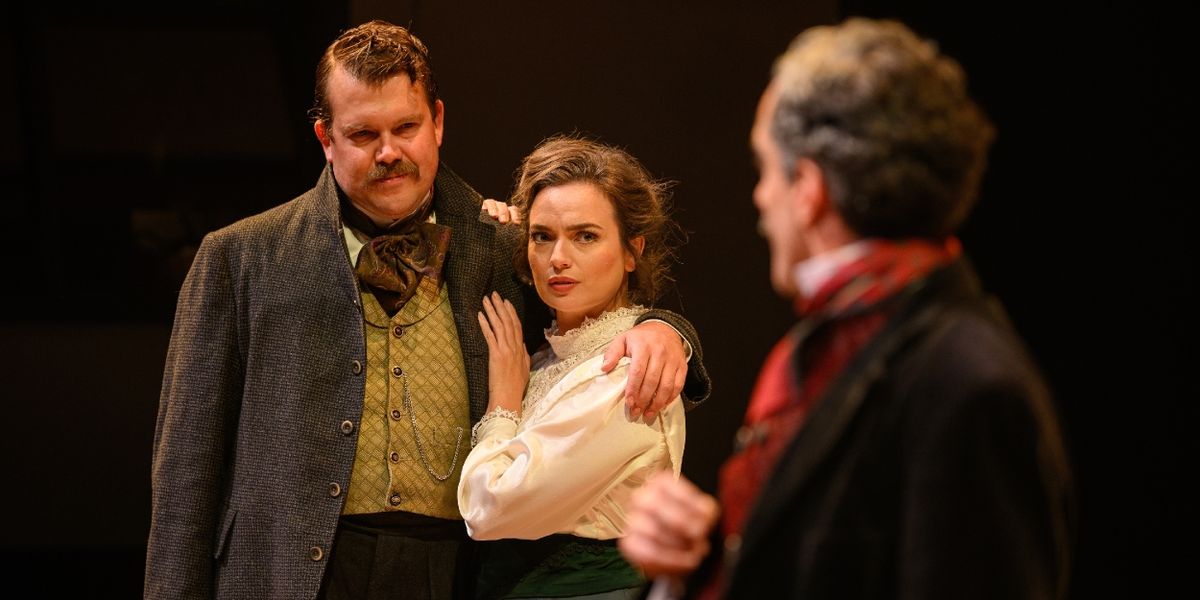
Once we’ve established who’s who and the nature of the stakes, a two-and-a-half hander gets going with Alasdair Buchan all righteous anger and jealousy as Leoncavallo, shouting as he swigs the Scotch. Director, Daniel Slater (an opera man himself), seems strangely insensitive to the fact that Buchan is twice as loud as he needs to be, even playing the role as broad as this. It makes for a one-pitch performance, Buchan permanently on the edge of losing his temper so, when poignancy is called for when it becomes clear that history will be kinder to his rival, he seems like a different man altogether. Broken sure, but hard to square with the pompous loudmouth we’ve grown to know, if not to like.
Sebastien Torkia also delivers something of a turn as Puccini, but is more continually raised eyebrow than angry shouting. He can afford to be, since, in this meta-production, he knows that his La bohème is the one that goes into the repertoire of the great houses, his the name that succeeds, even surpasses, Verdi’s, his the aria that unforgettably introduces Italia90 on the BBC and earns Pavarotti superstar status. That knowledge, along with some wink-wink, “You be Mahler and I’ll be Puccini” pulling back of the curtain, makes for a few decent in-jokes but, as meta always does, it outstays its welcome pretty swiftly.
Lisa-Anne Wood delivers the highlights of the evening with a couple of truncated arias in a rare instance of us being privy to what all the name-calling is actually about. Otherwise, she’s very underused as Berthe, Leoncavallo’s wife, whose main function lies in telling her husband to calm down and in scolding his brass-necked rival. She also plays out a curious scene as Puccini’s aloof wife, Elvira, which feels a little added on, as if somebody said that, apart from the eye-catching title, the composer’s heartless womanising was going largely uncondemned. But, as the works attest, Puccini had his er… shall we say ‘issues’ with women, so it was certainly needed.
There’s much about masculinity, music, politics, relationships, marriages, rivalry, fame, entitlement and theatre in this play. but little of it is really explored. Perhaps the least interesting element, the playground spat between frenemies who only hurt themselves with the bile they spout, is dialed up to 11 and there’s neither enough comedy nor enough tragedy, nor even enough specificity, in that to sustain the two hours.
Like Sharpless in Madama Butterfly, somebody missed a chance to set things back on an even keel and rescue a show that could have been very successful before it lost its way.
That Bastard, Pucinni at Park Theratre until 9 August
Photo images: David Monteith-Hodge





Reader Reviews
To post a comment, you must register and login.