


Review: STING, Young Vic
This one-act play has its world premiere at the Young Vic's Maria Theatre


|
|
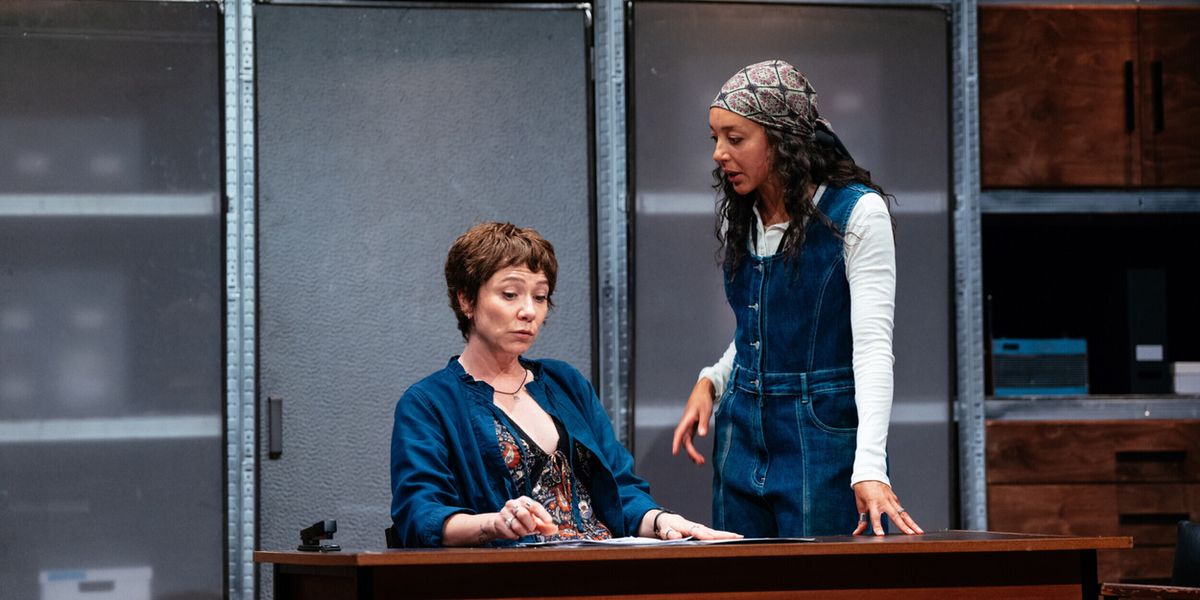

The protagonist of Sting, a postdoctoral student named Ash, lives in a divided world. Half of the set is taken up by the flat she shares with her boyfriend Dom, and the other half by the archive where she works as an assistant to researcher Lily, whose academic work focuses on historical accusations of witchcraft and ritualistic murders of alleged witches.
This new play by Sophie Swithinbank shows these two spaces becoming intertwined, starting with Ash (Adelle Leonce) experiencing a miscarriage at work. We learn she is a survivor of domestic abuse prior to the events of the play, and that she treats both her relationship and her work as ‘saviours’ from her troubled past. It will eventually take an act of arson, a destruction of a safe space, to totally liberate Ash from needing to be rescued.
As Dom’s treatment of Ash becomes more coercive and physically abusive, Nick Blood is skilled at capturing the tiniest shifts in movement that imply violence with plausible deniability. Meanwhile, as Lily (Phoebe Ladenburg) begins to work as a consultant on a modern case involving missing women, the parallels between history and reality – including Dom’s complicity as a police officer – become ever more unsettling.
It’s an intriguing premise, one that hints at a broader system of institutional blind eyes turned to abuse, without losing sight of the individual relationships at its heart. Director Nancy Medinais subtle in her approach, with every musical cue and slammed door sound effect deployed at just the right moment. Her use of physical movement is striking and disturbing – Ash dancing in the club feels like a defence mechanism as well as a release, and Dom and Ash’s rough sexual dynamic is tender as well as violent.
%20Helen%20Murray.jpg?format=auto&width=800)
Photo credit: Helen Murray
As the frustrated voice of reason brave enough to question the system, Lily ought to be an integral part of the show. Too often, though, she is an uncomplicated, almost maternal figure towards Ash, or she is used for expository purposes. Some threads that might make her motivations a little less saintly, like her upbringing in a cult or the hint of her and Ash having romantic feelings for one another, are never pulled quite as much as they should.
A crucial moment in the plot revolves around Lily showing Ash the notes she has taken about Ash’s visible injuries and other warning signs of abuse. It’s a choice that feels illogical for a woman who has thus far been depicted as level-headed and informed about how to handle victims who may not be ready to leave their partners.
This heavy-handed narrative device causes a loss of momentum from which the play never really recovers. With Ash and Lily’s friendship sidelined, the play becomes more straightforwardly about Ash’s attempts to leave Dom, and hurtles towards a conclusion straight of a B-movie revenge fantasy. Still, this is a showcase for Leonce’s acting; her portrayal of Ash throughout the play, her descent from defensive exuberance to vacant terror, is heartbreakingly well-observed.
Swithinbank’s writing is at its strongest when it’s directly engaging with how historical misogynistic dynamics manifest in the present day, and for this reason we probably could have spent more time in the archives with Lily, learning more about her character and the play’s broader historical background. Still, this is a script and production with immense compassion for Ash and other victims, and for this alone deserves praise.
Sting plays at the Young Vic until 18 July
Photo credits: Helen Murray

Sign up for all the news on the Fall season, discounts & more...
.jpg?format=auto&width=300)





Reader Reviews
To post a comment, you must register and login.