


Review: Reginald Rose's 12 ANGRY MEN Opens the Tampa Bay Theatre Festival
One of the great plays of the last century, still so pertinent after nearly seven decades.
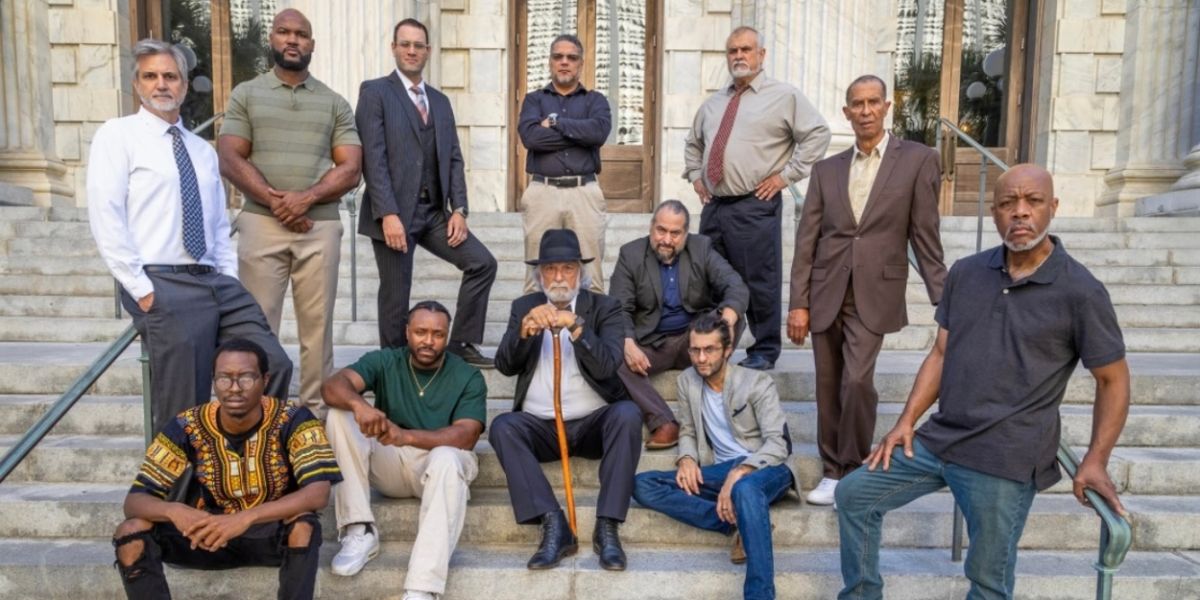
I have seen Reginald Rose’s 12 Angry Men more times than I can count. Not only have I experienced community theatre productions of it as well as professional performances (including one immersive interpretation), and not only have I watched the original 1957 Sidney Lumet film numerous times (and the 1997 version only once), and not only have I witnessed a comedy based on it (12 Angry Villains) and missed out on the musical version at the Asolo last year, but I have taught 12 Angry Men to middle schoolers since 1988. It is one work that absolutely engages the youth, makes them all want to become lawyers; it will always stand as one of my favorite plays, which helps when teaching it. When students read it aloud, I have them sit in their respective places at a long table. Interestingly, when getting volunteers to read, the students all want to read for the part of the Foreman at first, thinking it’s the lead role, unaware that the actual lead (Juror 8) doesn’t show his importance until the first jury vote.
As many times as I have seen the show, I have never seen a bad production of it. It always works, even when the cast is not up to snuff (as was the case in one community theatre performance a decade ago where various jurors were still reading from their scripts on opening night). The written material is so blazingly good, so on-point with its highs and lows imbedded in the material, that Disney animatrons could make it work.
Last Friday night I got to experience the show once again, this time at the Jaeb Theatre for the sold out opening night of the annual Tampa Bay Theatre Festival. The brilliance of the script is that, although first written in the 1950s, it still has so much relevance to our world today. The audience at the performance I saw was one of the most robust, vocally supportive and emotional audiences I have ever seen. They cheered, groaned, sucked in their collective breaths, leaning forward on the edges of their chairs. It was also one of the more explosive versions of the play I have ever experienced, which is not necessarily a good thing if you’re seeking levels and contrast.
As terrifically entertaining and pertinent as the show is, this particular production, though quite successful, suffered from too much yelling for no reason early on. Voices are raised so loudly near the start that the actors (and the show) had nowhere to go. (Remember Spinal Tap’s “11” volume control? This show starts at “11” and stays there for the next two and half hours.) A chair was literally thrown in the first ten minutes by a character who isn’t even one of the angriest of the lot (Juror 5). And when the meek milquetoast Juror 2 starts getting up and raising his voice in Act 2, I thought it was an epidemic where every juror was competing with Juror 3 for Hot-Head of the Year award. In fact, all of their yelling took away from the show’s actual blowhards (Jurors 3 and 10).
The play’s title is 12 Angry Men, not 12 Yelling Men. The production needed more contrast here, more shading. Anger doesn’t always have to be loud; sometimes it just has to smolder to be effective.
In its tainted view of humanity and of mankind at its most base, 12 Angry Men is sort of like Lord of the Flies, but instead of a group of schoolboys lost on an island, we have a group of adults trapped in a jury room. They must decide the fate of a Hispanic teen that is charged with the murder of his father. (Although in the original it is not clear what the boy’s ethnicity is, in this version it is made apparent when one of the characters calls him a derogatory term, a word added for this particular production.) In the first vote, eleven jurors vote the kid “guilty,” while a lone man (Juror 8) bravely goes against the tide and votes “not guilty.” For the next two and a half hours we see how these men, one by one, start changing their votes to “not guilty,” even the ones so entrenched and immovable in their opinions that they would risk a hung jury rather than admit they have reasonable doubt and change.
Jeff Sheppard plays the unflappable Juror 8 just right. Because he stands calmly and appears level headed throughout the show, and doesn’t resort to ever screaming at the other jurors, he is rightfully the standout in this production. We welcome his calm demeanor, his methodical way of looking at the case. Juror 8 may be an architect, but it’s obvious that he missed his calling as a born lawyer. And Mr. Sheppard does an outstanding job.
The other non-yeller who does well is Rick Stutzel as the elderly Juror 9. Cane in hand, he speaks slowly, stoically, always measuring his words. The world has left him behind, and he alone understands what the flawed mindset of the elderly witnesses whose testimonies have come into question. He and Sheppard's Juror 8 are the much-needed anchors of the show.
As the foreign-born Juror 11, Cornelio Aguilera has the best facial reactions to the madness around him. You feel his impatience with the other jurors (especially obnoxious Juror 7), but you also feel the dignity and honor of a good man who is looked down on by the others simply because he was born in a different country.
Rohan Pandya is a hoot as the flashy, jittery Juror 7. He brings out the comedic elements to the part and gets quite a lot of laughs from the audience. But underneath the flash is a man without convictions, a man who doesn’t really care about the case, a man who only cares about the baseball tickets burning a hole in his pocket. He sits, slumped in the chair, like he just doesn’t give a damn. My main qualm is that Mr. Pandya doesn’t look like a well-off marmalade salesman and baseball fanatic here (who made $250,000 last year and openly mocks Juror 6, a Pittsburgh Pirates fan who only makes $70 a day). With his long hair and casual attire, Mr. Pandya appears less like a Yankees fan and more like a Dead head.
Gabe Flores is spot-on as the rational Juror 4, an intelligent Wall Street stockbroker who only wants to deal with the facts of the case. Mr. Flores specializes in slick characters, and he’s quite strong here.
Lance Felton is a volcano as Juror 10, the racist juror who wears his hate on his sleeve. It’s an interesting choice casting a black man in this role (just as the 1997 movie did, with Mykelti Williamson—yes, Forrest Gump’s Bubba Blue--in the part). Mr. Felton is such a fierce presence, and he is winningly entertaining in such a hateful part. The only thing missed is his deflation near the end after giving his racist rant against “those people.” During his venomous speech, the other jurors stand up and turn their backs on him, one at a time. It’s as if the world has passed him by and he has suddenly turned into an anachronism. I miss the utter defeat seen in Juror 10; it’s there in the script, when Juror 4 shuts him up and tells him to sit down and not say another word, but I don’t think that’s enough to stop this juror from talking. We have to see the defeat before he is quieted down, as if he is slowly losing grip of the world he knows. It’s certainly a strong moment here—how can it not be?—but we never truly get to see the knock-the-breath-out-of-him defeat that ultimately withers him.
Damien Pepe is good as Juror 3, the angriest of the group and the one who takes everything too personally (he has major issues with his own son and wants the teenage kid on trial to pay with his life for it). Mr. Pepe gets quite heated throughout, and he grows stronger and stronger. But as previously noted, with so many jurors yelling louder than the true yeller—Juror 3 should be the most vocal—then the part gets somewhat de-fanged.
Ashaad Ferebee is lots of fun to watch as the quieter, gum-chewing Juror 6. And Angel Larrieux has his moments as Juror 12 (though he's often hard to hear and we never sense him being a Madison Avenue ad man).
Juror 1 (Jay Washington), not usually one of the high-strung jurors, gets into the yelling mode, as do Juror 2 (Len Jackson) and Juror 5 (Demetri Taylor). The show should be like a slow-moving time bomb; any explosions that come too early take away from the more powerful explosions later on. For instance, at one point, we miss some key information because the lines are yelled and a chair thrown by Juror 5. Mr. Taylor is certainly a colossus onstage, but because the lines are yelled seemingly out of nowhere, we do not know that the character comes from the slums and is quite poor (this becomes key later in the show, when discussing the use of a switchblade). It’s not an accident that Juror 5, the poorest juror, and Juror 4, possibly the richest, sit next to each other. Juror 5 should feel rather uncomfortable in these surroundings, but Mr. Taylor is towering onstage and, lacking nuance, comes across more confident than necessary. It also doesn’t help when Juror 5 is dressed too nicely for the part.
A popular local attorney, the likable Jack Gordon, has a cameo as the judge at the start of the show, staged in a way I’ve never seen—with the judge actually invading the jury room and giving his jury instructions there.
I have seen 12 Angry Men staged in various ways, either in the Leonardo da Vinci Last Supper pose (the entire cast, behind a table, facing the audience) or in the Giotto Last Supper way (staged the way people actually sit at the table, with some backs to the audience). The da Vinci method, used in this production but with two tables instead of one long one, is a bit too stagy for my tastes, but it works here.
Director Rory Lawrence, who also runs the Tampa Bay Theatre Festival, has guided a wonderful production. He certainly knows how to stage a show, and though the fireworks go off way too much and too early during it, he keeps this locomotive of a show running quickly. There’s never a dull moment. I only wish he didn’t interrupt the play with foreboding background music that is unnecessary. It happens three times—at the end of Act 1; during Juror 10’s speech in Act 2; and in Juror 3’s meltdown at the very end. The show doesn’t need this directorial flourish; the power is already there, in the words and on the stage. The cliché “less is more” certainly should have been heeded here.
As previously noted, the audience was all-in during the performance, reacting, laughing, groaning, biting their fingernails. They rose to their feet with a standing ovation. It was the perfect kick-off for the Tampa Bay Theatre Festival, which has become a favorite weekend for local theatre lovers.
12 Angry Men’s brilliance is in its ability to mirror whatever era it’s performed in; written nearly seventy years ago, it seems so true today, frighteningly so. The anger, the prejudices, the grievances, the knee-jerk reactions to any slight are all still here, maybe now more than ever. We haven’t outgrown them as a society; we haven’t evolved nearly as much as we’d like to think. But such heat and wrath make for great onstage drama. There’s a reason the title of the play is 12 Angry Men and not 12 Chill Men.
12 ANGRY MEN opened the Tampa Bay Theatre Festival and played for a single performance on August 29th at the Jaeb.
|
Conscience Powerstories Theatre @Stageworks Theatre (8/14-8/16) |
|
The Last Unicorn The Tampa Fringe Theatre (8/13-8/23) |
|
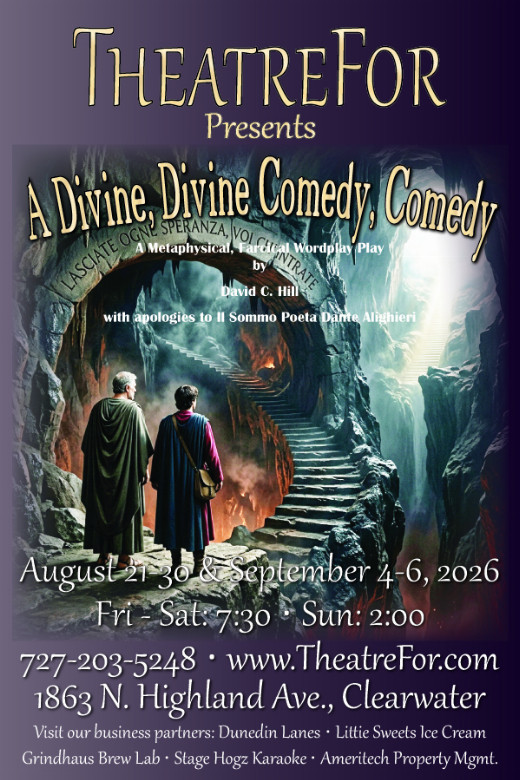
A Divine, Divine Comedy, Comedy TheatreFor (8/21-9/06) |

|
Big Fish Eight O'Clock Theatre (4/30-5/09) |
|
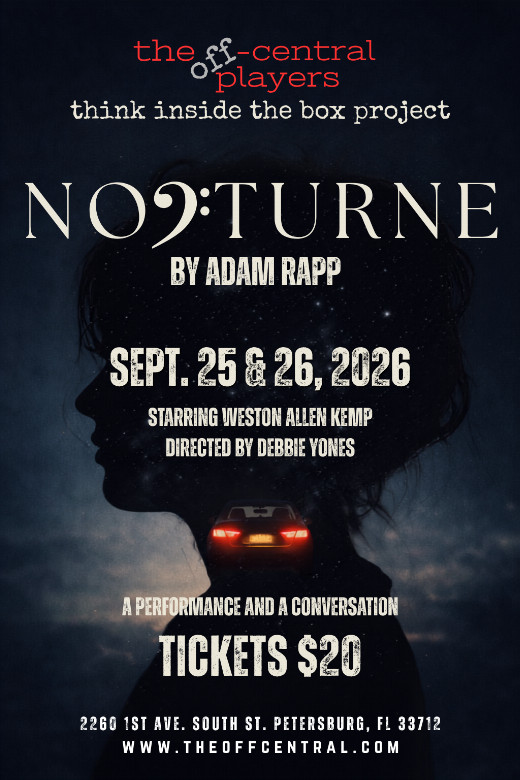
Nocturne The Off-Central Players (9/25-9/26) |
|
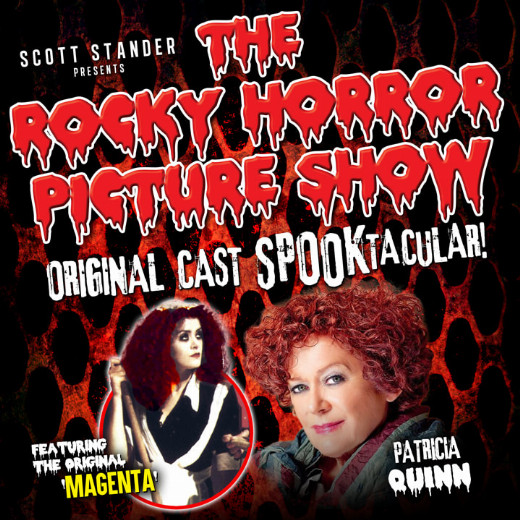
The Rocky Horror Picture Show Spooktacular Tour with Patricia Quinn Straz Center Ferguson Hall (10/22-10/22) |
|
Come From Away Eight O'Clock Theatre (9/04-9/13) |
|
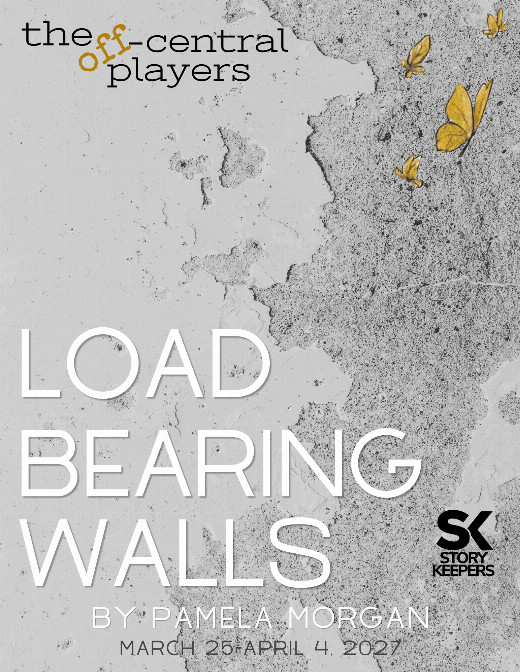
Load Bearing Walls The Off-Central Players (3/25-4/04) |
|
Rush at Hard Rock Live Hard Rock Live (11/05-11/06) |
|
Hamilton (Angelica Company) Straz Center [Carol Morsani Hall] (10/21-11/08) |
Reader Reviews
To post a comment, you must register and login.