


Review: & JULIET at Dr. Phillips Center For The Performing Arts
"& Juliet" serves as a compelling case for why Fan Fiction may sometimes have legitimate literary merit

I say this with all the seriousness one can muster, but the musical "& Juliet" serves as a compelling case for why Fan Fiction may sometimes have legitimate literary merit. I don’t particularly mean “& Juliet” as the specific case of a fan fiction with literary merit, although its valiant efforts at continuing the story of one of the greatest tragedies ever put to pen should still be commended. Sequelizing Shakespeare hasn’t been this delightfully unhinged since 2008’s Hamlet 2 – a Steve Coogan comedy that features a song titled “Rock Me, Sexy Jesus” – but it’s also as messy as one would expect a jukebox musical to be. It relies on nostalgic millennials’ recognition of pop songs of the last thirty years than it does on fully examining the entire what-if of its premise. It re-interprets the beauty of a 16th century tragedy into a modern recontextualization based on today’s progressive views rather than try to deconstruct gender roles of yesteryear. Its entire libretto has lines of dialogue more suited for a two-hour “Saturday Night Live” skit than for live theatre.
And it’s a hell of a lot of fun.
By the end of the show, I texted a couple friends about the “& Juliet” experience and summed it up as such: “I don't love it, but I love watching it.” Musical theatre doesn’t always have to be jaw-droppingly amazing in its nuance and themes. It shouldn’t always be intellectually stimulating with richly developed characters conveying complex emotions through song. Sometimes, we just have to allow ourselves to sit back and indulge in the absurdity that’s unfolding on the stage. Even if it means watching a sequel to “Romeo & Juliet” that’s essentially a self-insert fan fiction come to life. And I mean that in the greatest of respect to both “& Juliet” and to fan fiction in general. Although most will turn their nose up at the genre, fan fiction allows any burgeoning writer to play in a creative sandbox of their own design with characters and worlds already familiar to them. The true joy in the existence of fan fiction isn’t in sifting through mountains of bad writing to find a good story. Rather, it’s in knowing that a story was good enough to inspire someone else to create their own out of pure love of the material.

“& Juliet” pays respect to that by serving its audience, in all sincerity, a fan fiction approach to how one could sequelize “Romeo & Juliet.” And it does so with no concern for what would make sense or what would be true to its time period or how it would fit within the canon of Shakespeare. Far from it. Audiences need to be familiar with “Romeo & Juliet,” but not expect anything slavishly faithful to it for “& Juliet.” The entire premise of this musical is that Anne Hathaway (Crystal Kellogg) is upset with how her rock star husband William Shakespeare (CJ Eldred, understudy Daniel Tracht in Tuesday’s performance) chose to end “Romeo & Juliet.” Upon seeing how his audience loved his latest play (“Larger Than Life”), she expresses disappointment that all his plays have depressing, tragic endings, so she asks him to rewrite the end of “Romeo & Juliet” for her (“I Want It That Way”). Will acquiesces to his wife’s demands, and we see how a possible alternate ending could unfold: Juliet (Fabiola Caraballo Quijada) awakens, finds her lover Romeo (Joseph Torres) dead, and does not plunge a dagger into her heart. Instead, she laments on the tragedy of her life (“Baby One More Time”), then her own anger at discovering Romeo’s romanced plenty more women than she expected (“Show Me the Meaning of Being Lonely”). When her parents (Jared Alexander and Cayla Primous) decide to send her to a nunnery for her insolent behavior, Juliet runs away with her nurse Angélique (Kathryn Allison), bestie May (Nico Ochoa), and Anne Hathaway herself, self-inserted into the narrative as “April.” The foursome end up in Paris, hoping to find new lives and new loves (“Domino”). Shakespeare follows, as the meta-fiction now casts him as their carriage driver to the city of love (“Show Me Love”).
It is in Paris that the four fair ladies of Verona meet François du Bois (Noah Marlowe), the youngest son of night club owner Lance du Bois (Joey Fatone), who orders that he marry or join the army. At a party thrown specifically for François to meet young women (“Blow”), he instead May, Juliet’s non-binary bestie, and sparks fly. But May the way of this world, as a non-binary, finding love is not written in the stars for them (“I’m Not a Girl, Not Yet a Woman”). Surprisingly, Juliet and François bond over their own limited lives and overbearing parents (“Overprotected”), with attraction developing, albeit not of the romantic variety (“Confident”). Meanwhile nurse Angélique unexpectedly reunites with former lover Lance (“Teenage Dream / Break Free”), questioning if she should even pursue romance in the second act of her life. Soon after, Lord and Lady Capulet find Juliet in Paris and insist on taking her to the nunnery, so Juliet impulsively asks François to marry her.
At this point, April’s mostly been playing Supportive Bestie #2, but gets angered that her husband’s continued the story with yet another impulsively-decided marriage. He thinks she’s against the marriage trope in his stories; she clarifies, she’s against the irresponsibility of marriage in his stories, as well as the general unhappiness of every married couple in his plays. So Will decides to be maliciously compliant to her desire for a happy marriage by finding a way to separate François and Juliet. He instead decides to set up François and May with an unexpected romance (“I Kissed a Girl”), then continues to stir things up when – like any good soap opera – a former lover gets brought back from the dead: Romeo Montague, alive and well, and wanting to reclaim his wife (“It’s My Life”).

To borrow a term from improv, Fan Fiction is the “Yes, and…” of creative writing. A fanfic can go in any direction, can lose the plot, can introduce a deus ex machina just to get their version of a character where they need to go. Romeo, the love of her life, is dead? No problem, we’ll rewrite the ending so that Juliet wakes up and decides not to kill herself, too. Her parents want to send her to a nunnery? Nah, girl, let’s send her off to Paris to Eat. Pray. Love. herself into becoming who she wants to be. She accidentally proposes marriage to a closet homosexual to avoid that convent again? Sure thing, it’ll solve both their problems and let her stick it to her parents once more. All these “Yes, and”’s literally happens in Act 1 of “& Juliet,” with plenty more that follows in Act 2. And it’s all done intentionally, I hope, as a fitting nod to why a fan fiction lens is the proper way to view “& Juliet”’s narrative arc.
It took about twenty minutes into the show for me to realize this story was not going to be a conventional one. And once I decided to view it as Anne Hathaway’s fan fiction approach to “Romeo & Juliet,” a lot of it began to make more sense. Every plot point decided by the whims of Anne or Will, every character turn done to suit their desires for the character rather than what that character inherently was. Even if Juliet Capulet is a fictional character, she deserves the dignity of authors who understand her. The libretto by David West Read (“Schitt’s Creek”) gets that aspect of the character correct. Through this ping-pong approach of how to best write Juliet – strong and independent by Anne, wife material by Will – we see how fan fiction itself can reframe even fictional characters based on the author’s projection of their own neuroses onto the characters. And the frustrations of Juliet, under either Will or Anne’s pen, shows that even on a further meta level, fictional characters have “feelings” too about how they’re defined. The creative voice every writer strives to find by getting down and dirty with a fan fiction? A fictional character goes through that same ordeal when a writer tries to write for them.
.jpg?format=auto&width=800)
All that goes to show that, even though I did not love “& Juliet,” I loved watching it unfold. I loved recognizing the “Yes, and” of its plot. I loved how it treated fan fiction not as something to scorn or scoff at, but as a legitimate form of writing. And yes, one that can have literary merit. Just not in this show. But the practice of fan fiction can lead to superior original work, as practice, practice, practice is what every good writer needs to find their creative voice. “& Juliet” serves as a shining example of a great practice playground, a way to have fun with Shakespeare without trying to equal it, and a way to look at these centuries-old characters with a 21st century lens without ever saying it’s canon to William’s words.
But did it have to be a jukebox musical?
Yes… and I’m kind of glad it was. Mainly because I wouldn’t be able to take this material seriously otherwise. When a musical is a jukebox musical, it can either be a boring biopic or it can attempt to tell an original story. Either way, a jukebox musical never is as good as an original musical because of its one fatal flaw. I hadn’t reviewed a jukebox musical since 2021’s “Head Over Heels,” where I lamented the fatal flaw of this particular styling of musical theatre: When the audience already knows what songs are coming and how they are supposed to feel, whatever dramatic tension the narrative might have held could conceivably be lost. Songs that already suggest joy or happiness basically prescribe such feelings to the audience within the opening notes. It's Pavlovian in a sense, as soon as they hear certain chords, they perk up and expect a musical treat.
The same applies to “& Juliet,” trading in the discography of The Go-Go’s for a large swathe of pop songs penned by Max Martin (and friends). For millennials, this means that the collected works of Backstreet Boys, P!nk, Brittney Spears, and NSYNC are sprinkled liberally through the libretto. It means Katy Perry, Adam Lambert, and Ellie Goulding share a musical playlist with Jessie J, Bon Jovi, and Celine Dion. It means Demi Lovato somehow is still relevant. And like any good 2000s entry on Fanfiction.net, it means that the story will find ways to shoehorn in a song regardless if the scene needs it or not. “& Juliet” will go for the obvious ways to tie a song’s lyrics to the plot (“I Want It That Way” or “Teenage Dream”) while others are done merely for the indulgence of including the song (“Everybody (Backstreet’s Back)” or “It’s Gonna Be Me”). The audience can sense it from a mile away each time. They cheer for it, they applaud. They sometimes sing along because that’s part and parcel of the jukebox musical experience. It doesn’t often matter what the story is, half the fun is when a familiar song comes on.
As a result, even if the material as a whole is subpar and pandering, it’s still a hell of a good time for everyone on and off the stage. And, honestly, we need more good-time musicals. Popcorn show tunes rather than heavy hitting eleven o’clock numbers. A lighthearted farce instead of a two-act catharsis. A sitcom episode instead of a therapy session. Musical theatre allows for a wide range of emotions, and sometimes I just want to sit back and laugh in delight at what’s happening on that stage. That is where “& Juliet” delivers the most. Their talented cast and crew know how to turn the experience of “Romeo & Juliet” a full 180 to make a timeless tragedy feel like it’s always been a comedy. And their infectious energy on the stage translates to a receptive audience eager to cheer at every whimsy thrown at them.
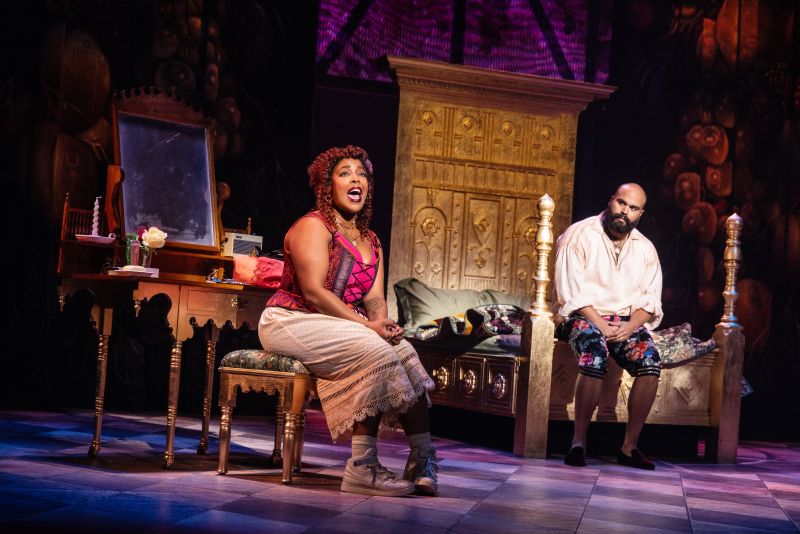
You see it, almost immediately, when the show begins as various members of the ensemble make their way onstage one at a time, setting up their playground with the expected Theater Kid Energy. And by the time we actually meet some of the core characters – Will and Anne, Juliet, May and François, et al – we’re already pulled into the hyperactive choreography serving serious lewks with every hip thrust and pop-and-lock. With a wide ranging ensemble of sixteen strong, it keeps that stage busy at almost every scene. It helps sell the hilarious “you loved him, too?” revelation at Romeo’s funeral, it helps make Lance du Bois’ night club come alive, and it helps make the shocked wedding guests all collectively gasp at every dramatic revelation (“Days of our Lives” could never…). Shows need more large ensembles to help keep that large, bustling community feel to their material. “& Juliet” thankfully makes every scene feel packed and every ensemble player more than justly earned their spot on that stage.
May (Nico Ochoa) and François (Noah Marlowe) serve as the show’s most original romantic pairing, partly because their arc feels less like fanfic mischief and more like an earnest attempt at writing a new chapter for two characters Shakespeare never bothered to imagine. May, a non-binary character written with all the familiar GBF shorthand baked into the libretto, could have easily been reduced to decorative queer commentary in any lesser production. What makes Ochoa’s performance so compelling is how consciously they pull back from that temptation: no wink-wink camp, no flamboyant “Birdcage” caricature, no elbowing the audience for recognition. Instead, Ochoa suggests that if the text insists on queering the GBF archetype, then the performance ought to queer it further by giving it depth. Meanwhile, Marlowe approaches François as the lone straight man in a sea of theatrical chaos, grounding every scene he enters with an understated panic that cleverly masks his own closet door rattling just a bit looser with each interaction. Their courtship becomes the show’s most unexpectedly poignant thread – not because it subverts Shakespeare, but because it quietly writes its own tiny fanfic about two characters who finally get to choose each other on the page.
Lance du Bois, played for the Orlando run by hometown hero Joey Fatone (yes, that Joey Fatone), operates as the show’s most delightfully meta casting choice. Fatone leans into the role with the exact kind of comic self-awareness audiences secretly hope for when a former boy band member shows up in a jukebox musical written in the 2020s. He is no longer thirty, but he performs as though gravity never came for him, still tossing off the charm, the goofiness, and the signature armography that once made him a TRL-era deity. When the choreography cheekily detours into a “Bye Bye Bye” motif – clearly held a beat longer after the audience predictably erupted – it didn’t feel indulgent so much as communal. Orlando claimed him as one of its own, and Fatone graciously played along. Opposite him, Kathryn Allison’s Angélique proves a formidable scene partner: sharp-witted, vocally confident, and every bit as buoyant in movement. Together they sell the Lance/Angélique second-chance romance with surprising sincerity, transforming a barely-sketched Shakespearean footnote and a newly invented character into a fully realized fanfic B-plot. It is exactly the kind of “Yes, and…” narrative flourish that makes “& Juliet” work because, of course, the Nurse would get her own romantic subplot if given to the right author with enough room to play.

For all the chaos being authored around her, Juliet is the one character most acutely aware that she is trapped in someone else’s narrative whims. Fabiola Caraballo Quijada leans into that meta-frustration with an earnestness that borders on heroic. She has the most Theater Kid Energy of the entire company – and I mean that with absolute admiration. She performs as though she’s fully “in” on the fan fiction reading, which in turn restores dignity to a character the material frequently treats as a narrative prop. Every impulsive decision, every pop anthem, every eye roll at yet another twist in her life feels true to her Juliet, not Shakespeare’s nor Will’s nor Anne’s. This is why her Act Two “Roar” landed so powerfully: both performer and character finally claim authorship over Juliet’s voice, prompting a well-earned standing ovation that had less to do with Katy Perry’s song and more to do with Fabiola’s triumph.
If Juliet is the beleaguered heroine of someone else’s story, Romeo is the manic pixie dream boy who barges back into it for the sheer sport of it. Joseph Torres has a blast subverting four hundred years of literary branding that insists Romeo is a tragic romantic. Here, he plays him as a high-status heartbreaker – a bona fide f---boi with legs for days and the swagger of someone who knows it. His soap-operatic return from the dead is the most delicious “Yes, and…” of the entire first act, and the ensuing Act Two antics only prove how much fun Romeo is when treated as a comedy character rather than a symbol of doomed teenage love. It’s a small tragedy of its own that Torres only gets one act’s worth of stage time; his gleefully repentant lothario could have easily fueled another fanfic subplot if Anne had felt so inclined to write it.
Daniel Tracht, also an Orlando native, played William Shakespeare in Tuesday’s performance and absolutely ate. Whether he was turning up the wattage for a hometown crowd or that swagger is simply baked into his interpretation, Tracht strutted onto the stage like the rock star playwright he believes himself to be. It’s a characterization in conversation with other contemporary pop-Shakespeare treatments: equal parts TNT/Baz Luhrmann’s “Will,” Christian Borle’s “Something Rotten!” Shakespeare, and a dash of self-sponsored mythmaking for good measure. Yet what keeps the portrayal from tipping into cartoonish excess is Tracht’s ability to soften, to allow a quieter Shakespeare to emerge whenever Anne steps into the light. In those scenes, the golden quill becomes less of a gimmick and more of a communication device between two writers trying to make sense of the life they are rewriting for each other. It’s sweet, it’s funny, and it’s just grounded enough to let us believe Will might actually want to listen for once.
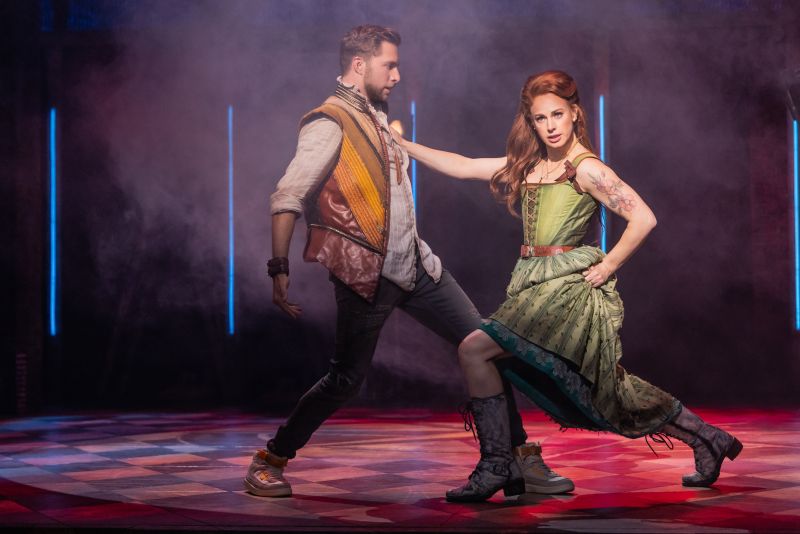
Anne Hathaway, on the other hand, has rarely been afforded that same cultural oxygen. Historically, she is the woman overshadowed, marginalized, or outright ignored in the telling of Shakespeare’s life. I admit I had barely considered her myself until seeing Chloé Zhao’s Hamnet last November. Through that prism, the Anne of “& Juliet” gains unexpected dimensionality. She is, inevitably, the woman waiting – waiting for her husband to return, waiting for the world to stop chasing him, waiting for the scraps of a life she never quite got to author. Crystal Kellogg approaches Anne with the same psychological texture Jessie Buckley brought to Hamnet, and the symmetry is startling: one dramatic, one comedic, both arriving at the same emotional conclusion. This is a woman who has lost her husband to the world, and who clings to whatever pieces of him remain when he briefly remembers to come home. That she chooses fan fiction as her battleground only makes the conclusion sweeter because – for once in her life – Anne gets to write the ending.
If “& Juliet” works at all, it’s because it commits to the premise without apology: a Shakespearean remix told through the lens of pop music, meta-theatre, and a general belief that stories never really die, they just get re-written. This touring production of the still-running Broadway musical leaned into this ethos with a cast that understood the assignment – treating the material with enough sincerity to make it land, but enough wryness to make it feel like commentary. There is a strange joy in watching characters who have been canonically dead for centuries belt out Max Martin’s jukebox hits as if they were always part of the First Folio. It’s not Shakespeare, at least not in the traditional sense, but it happily lives in that liminal space between adaptation and imaginative mischief. What ultimately made this production of “& Juliet” work was its willingness to embrace both melodrama and meta-commentary. It refused to treat Shakespeare as brittle or sacred; instead, it treated him like what he arguably always was: an adaptable text meant to be reshaped, re-performed, and reimagined for whatever moment we find ourselves in. In that way, the show was far less a jukebox musical than an act of participatory storytelling – one that invited us to see how many centuries of readers have wrestled with the stories they’re handed and dared to ask, what if?
.jpg?format=auto&width=800)
I say this all, for full disclosure, as a fan fiction apologist and former writer of them myself. In high school, I indulged in honing my creative writing skills by churning out “General Hospital” fan fiction stories as it let me play with characters I already knew fairly well from daily, after-school viewings of the soap. I became invested in the characters – even when I hated the story – and when the writers paired the wrong people or veered in narratives I found unbearable, I began writing my own. I’m not afraid to say, I also went the self-insert route and created “Cristofer Cassadine,” cousin to the Cassadine Prince, Nikolas. His sole purpose in life was to waltz through Port Charles interacting with the characters I adored. Was that writing good? No. I’m not afraid to say it now: they were objectively terrible, structurally incoherent, and driven entirely by teenage longing – but they were also how I learned to love character, voice, and narrative possibility. I learned, through fan fiction, a discipline of writing regularly and writing with intent to rewrite. It’s through the trial and error of fan fiction that I began to discover my own creative voice, eventually substituting “General Hospital” characters for original creations of my own. Fan fiction may not always be legitimate literature, but it prepares you to appreciate and occasionally even create legitimate literature.
So no, “& Juliet” is not great theatre in the dramatic sense, nor does it claim to be, and nor does it need to be. It is loud, messy, narratively thin, and at times more concept than execution. And yet, it reminded me of something I had quietly forgotten: that there is joy in taking a story we’ve inherited and twisting it toward the world we wish existed. That rewriting is not a betrayal of canon, but a new conversation with it. And that one of the most enduring romances ever put to paper can survive a pop jukebox refit, a meta rewrite, and a teenage feminist uprising can still be fun. If this musical is fan fiction, then so what? Fan fiction has always been the place where readers take pen to paper to assert their own agency over the narrative. And as it turns out, that is not only a valid literary impulse – it may be one of our oldest.
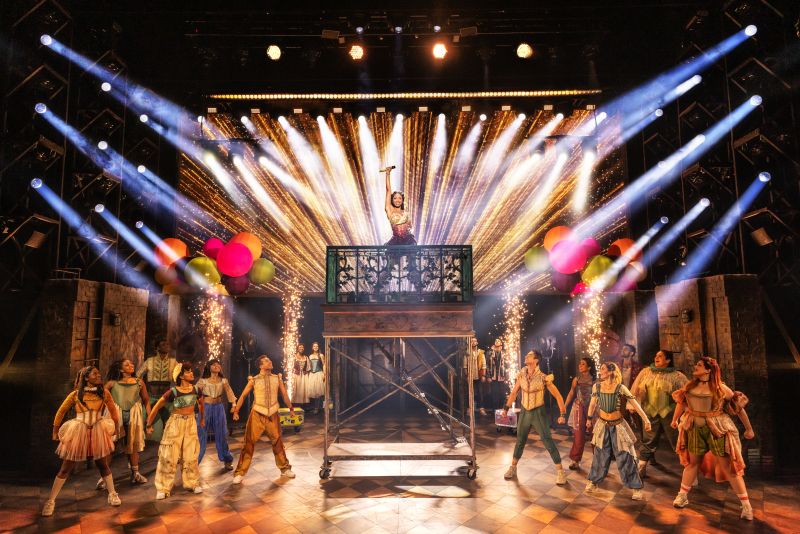
& JULIET plays at Dr. Phillips Center January 6 through 11. Tickets can be acquired online or at the box office, pending availability.
Prefer BroadwayWorld in Google Search?
Add us as a preferred source so our stories show up more often in Top Stories and Google’s AI answers — for you.


Sign up for all the news on the Fall season, discounts & more...

|
THE RAT PACK LOUNGE Winter Park Playhouse (9/24-10/18) |
|
The Best Halloween Ever Orlando Family Stage (10/10-11/01) |

|
Feltman: World's First Hot Dog Orlando Family Stage - Black Box Theater (10/23-10/23) |

|
Ted Swindley’s Honky Tonk Angels Athens Theatre (2/26-3/21) |

|
Madame Butterfly Dr. Phillips Center for the Performing Arts (10/02-10/04) |

|
Disney's Finding Nemo Athens Theatre (1/22-2/27) |
|
Evil Dead: The Musical Dr. Phillips Center for the Performing Arts (10/02-10/04) |

|
The Mouse & The Mustache Riverside Theatre (1/28-2/21) |

|
Right in the Eye Open Scene at the Maitland Art Center (10/17-10/17) |

|
Ted Swindley’s Honky Tonk Angels Athens Theatre (2/26-3/21) |

Reader Reviews
To post a comment, you must register and login.