


Review: TURANDOT, Opera Holland Park
A semi-staged centenary production of Puccini's tale of the infatuated prince and cruel princess
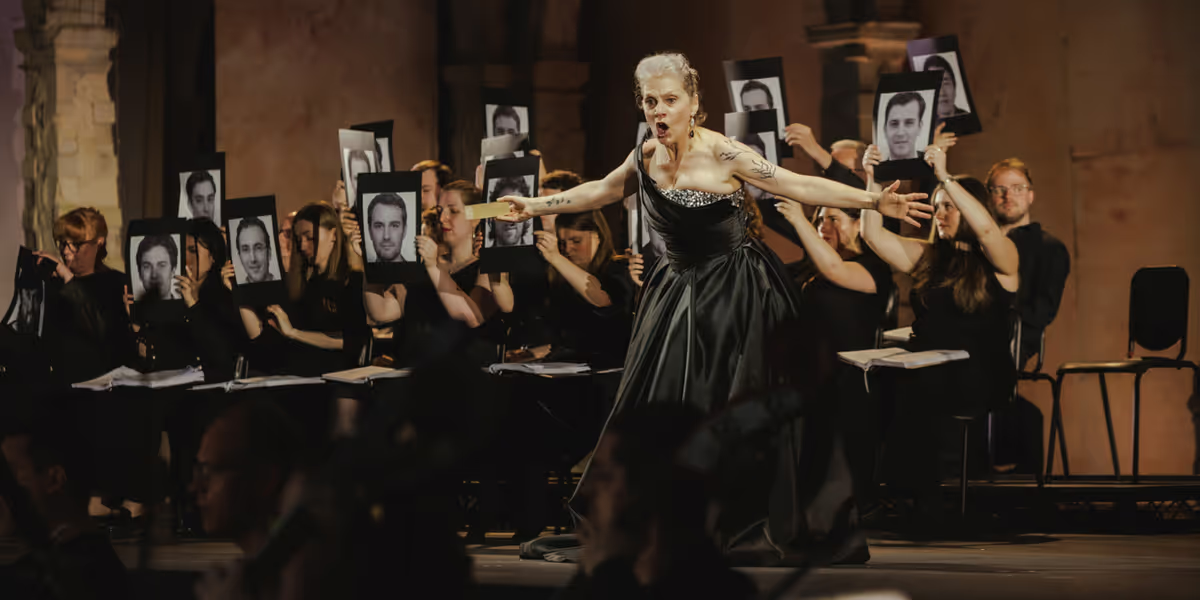
 This art form is always about compromise - it’s simply too big to contain without it, the adjective ‘grand’ very much earned in Grand Opera.
At Covent Garden, one sees the big sets, the well-stocked orchestra and the international megastars. But one looks at the ticket price, stares at a sometimes cavernous stage and settles into the role of spectator. In the boutique opera boom of the last couple of years, the spectacle is barely discernible, but the passions are (sometimes literally) in your face and it’s all you can do not to trip up the odious Pinkerton as he walks past and give him a dressing down after his cruel neglect of Butterfly.
Opera Holland Park tilts to the former, but it also carries a relaxed intimacy, a route into worlds often very different to our own, carried there by music and singing as if on a magic carpet. But, at least since Edward Said’s book Orientalism was published in 1978, the exoticism of The East, a real pull for audiences 100 years ago, has become problematic, at its worst manifest in Yellowface but, even when embraced with sensitivity, the showy othering can feel crass, unnecessary and offensive. The fact that cultural reproduction is both of its originating time and vitally present in the moment of experience is a challenge and an opportunity. That tension a lure for casts and creatives.
It’s always present in Turandot, Puccini’s last (and unfinished) opera, which celebrates its centenary in this inaugural production at OHP. It’s a fairytale of the kind collected by The Brothers Grimm, but refracted through the lens of an Imperial Chinese culture in which human lives counted for far less than the whim of a psychopathic princess. But it’s also staged in multicultural London with a multicultural cast in a country wrestling with what multiculturalism really means.
It’s a heady mix on a hot night, but opera’s compromises come to our rescue, the concert staging requiring no sets, no costumes, no references beyond the music and the libretto. That takes some of the problems away, though, if you do want to play the cultural appropriation card, you’ll find orientalism pushing up through the music. It does allow space, physically and psychologically, for more music, with an expanded City of London Sinfonia and both the OHP Chorus and its Youth Chorus prominent throughout. And the music really is transformative.
The scales do tilt back though, because what we gain in the music - and I’ve never heard it better at this venue than it was played under Naomi Woo’s baton - we lose in the storytelling, as the singers must shoulder work done by those missing elements of the operatic toolbox.
%20Pablo%20Strong.jpg?format=auto&width=800)
It’s here that director, Eleanor Burke, could get more from her company. Fflur Wyn as Liù sings her third act demise beautifully, but its poignancy is diminished because her besotted worship of Calaf was diluted in the first act. She never really gets close to Josè de Eça’s crazy-in-love Prince, physically or emotionally, the two often separated by significant distance on a big stage. He, despite looking a bit too much like Andrew Tate for it not to be distracting, delivers a marvellous “Nessun Dorma” (we were warned not to sing along - rightly so) and Calaf gets his reward after some manipulation that might not pass a #MeToo test.
The star of the night is Anne Sophie Duprels’s Turandot, an ice blonde angel of revenge for ancient wrongs, a deeply damaged woman who kills off suitors one by one by setting riddles - Calaf surprising her by solving all three. Often furthest from us, marooned upstage, she has the air of a Hitchcockian antiheroine, Grace Kelly or Kim Novak perhaps, and, despite the ending (not Puccini’s), one wonders if she’s really changed.
You’re never quite sure what you’ll get at this wonderful venue and, as Liù was sacrificing herself in acknowledgement of Calaf’s commitment to Turandot and teaching the princess a lesson about love and forgiveness, a crow cackled overhead. I couldn’t help thinking if it were possessed by the great composer himself, amused by how so many are still transfixed by his beautiful doomed women dying, yet again, for love.
Turandot is at Opera Holland Park until 27 July
Photo images: Pablo Strong
Sign up for all the news on the Fall season, discounts & more...
.jpg?format=auto&width=300)
.png?format=auto&width=365)





Reader Reviews
To post a comment, you must register and login.