


Review Roundup: PUNCH Opens on Broadway
Punch is playing now at Broadway's Samuel J. Friedman Theatre.


|
|
 Click for Tickets
Manhattan Theatre Club's American premiere of Punch, by James Graham, opens on Broadway tonight at the Samuel J. Friedman Theatre. Read the reviews!
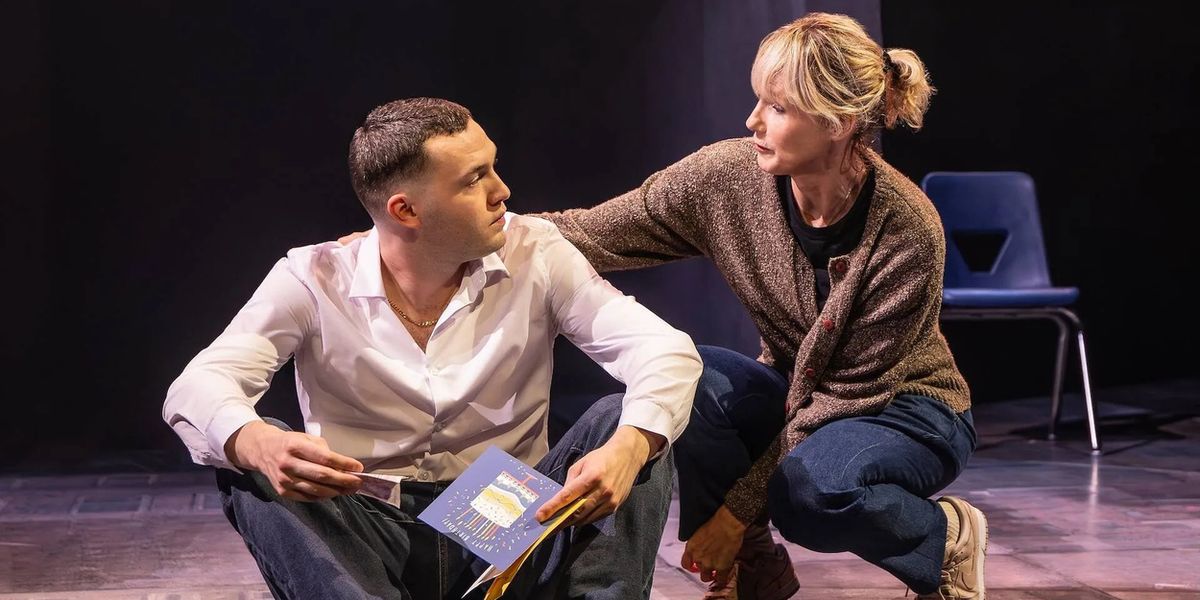
Punch centers around Jacob, a young man who makes a fatal mistake that lands him in prison. But as he struggles to accept the consequences of his actions and build a new life, he finds an unusual source of salvation: the parents of the boy he killed.
The cast features Camila Canó-Flaviá as Clare/Nicola, Will Harrison as Jacob, Sam Robards as David/Raf’s Dad, and Lucy Taylor as Mum/Wendy. Two-time Tony Award winner and five-time Tony nominee Victoria Clark will star as the victim’s mother, Joan, alongside Cody Kostro as Raf/Sam and Piter Marek as Tony/Derek/DS Villers.
The creative team for Punch is Anna Fleischle (Scenic and Costume Design), Robbie Butler (Lighting Design), Alexandra Faye Braithwaite (Original Music & Sound Design), Leanne Pinder (Movement Director), Ben Furey (Dialect Coach), Charlotte Fleck (Dialect Coach), Caparelliotis Casting & Kelly Gillespie (Casting), and Richard A. Hodge (Production Stage Manager).
 Elisabeth Vincentelli, The New York Times: “Punch” comes up short in capturing the exchange between the victim’s family and the perpetrator because it always leans on Jacob’s perspective, down to an ending that shows him happily moving on in his life as if James’s death had been a positive in terms of his personal life’s arc. But are we meant to think that meeting Jacob was enough to give Joan and David closure?
Sara Holdren, Vulture: The tempo of Punch slows and the performances sharpen and deepen. Though the air is thick with anguish, three people start to grope their way through it toward each other. One can only imagine that these were the scenes that made Graham want to write the play. They are its finest and—in a moment where truth and reconciliation can feel like utopian fantasies—its most radically hopeful.
Adam Feldman, Time Out New York: But while story itself is inspiring, some central emotional focus seems missing from the way it unfolds in Punch, which winds up feeling less like a full-blown play and more like a digressive PSA about the dangers of street fighting and the value of restorative justice. Harrison’s performance aside, the play’s blows are hit and miss: connecting here, grazing there but not quite landing a proper hit.
 Emlyn Travis, Entertainment Weekly: Still, Punch's moving message about the true power of connection and understanding in the wake of unthinkable tragedy is one that is desperately needed these days. Grade: B
 Robert Hofler, The Wrap: There’s something else that Penford does that’s really grating. Even though he has 10 actors on stage, he relies on leads Clark and Robards to play minor characters with a mere switch of a hairdo or a shirt. It’s especially unfortunate to see Clark, a fine actor, resort to cheap tricks to go from playing the levelheaded mom to the cute grandma to some rowdy young street urchin.
Greg Evans, Deadline: Still, Punch doesn’t lack power, and that in large part is due to a fine cast. Playing on a mostly bare stage over which an arched bridge bares witness to all, Harrison (Daisy Jones and the Six, A Complete Unknown) convincingly morphs from dangerous, out-of-control terror to hollowed-out shell and, finally, a man who only gradually begins to take responsibility for himself. It’s a tremendously affecting performance.
Chris Jones, Chicago Tribune: Not all of the members of the cast feel or sound like they are from Nottingham or its environs (I spent my childhood not far from there), especially when it comes to humor. That said, Harrison certainly does and, more importantly, this very capable young actor captures what often lies behind that bespoke British-bloke blend of aggression using different parts of the body but all too little of the brain. The progressively morphing reaction of the excellent Robards’ bereaved, wound-tight dad, sometimes a million miles away from a kid he wishes had never been born and sometimes not far away at all, is deeply moving. I could have watched those painful scenes all night.
David Finkle, New York Stage Review: Affectively supporting him, the cast members often shift from one character to another by nothing more than shucking a pullover—say, Jacob’s mum to a probation officer and back (Lucy Taylor). Two-time Tony winner Victoria Clark, not singing a note, and Sam Robards lift the second act as James’ parents Joan and David. Alongside Harrison, they touchingly play their individual struggles to find forgiveness for Jacob, just as Jacob struggles to find forgiveness for himself. Does he? That’s the point of the reach-for-the-Kleenex finale. No description here, other than to say that its like may not be equaled on any stage this season or possibly for a few seasons to come.
Frank Scheck, New York Stage Review: Punch dramatizes the circumstances surrounding the fateful moment when a drunk and stoned 19-year-old Dunne, itching for a fight, accidentally killed a man with one punch. The play delivers a message of forgiveness that we desperately need right now.
Tim Teeman, The Daily Beast: The point perhaps is to emphasize the change we shall see in the second act, but it still plays as a straight glorification of mindless arrogance and violence, as we watch him and his group of friends stalk and swagger around the stage, setting their menacing exploits to a butch, staccato rhyme. Both the settings and direction feel queasily framed and dismally flat.
Juan A. Ramirez, Theatrely: James Graham’s play Punch, as directed by Adam Penford, is a very, very British work: it’s sturdily acted, choreo-directed within an inch of its life and shot through with a sense of community only a country with a hearty pub culture and universal healthcare could achieve. It is also, despite the production’s evident desire to land with the force of its title, a surprisingly tender and unpretentious story at odds with its battering ram approach.
Jonathan Mandell, New York Theater: Since “Punch” is based on Jacob’s memoir and thus his perspective, it is somewhat hamstrung from giving equal weight to all three characters. I would have preferred a more streamlined play with a greater focus on the three of them. But at one point, Joan explains that they took James off life support because three of the five vital organs required for human life had shut down. Later, Jacob asks what are the five vital organs. And Joan points to each part of her body (with Jacob copying her) as she explains: “a working brain that thinks our thought. Liver that protects us from poisons, bad things. A kidney to clean us up. Lungs, to help us breathe. And a heart, that beats.” If the play isn’t perfect, there is enough in “Punch” to make it feel vital.
Caroline Cao, New York Theatre Guide: After the blistering meeting, the epilogue threatens to package the tale as an inspirational story. It doesn’t stick the landing, but it leaves one last thought: Forgiveness isn’t a clear-cut route for everyone.
Howard Miller, Talkin' Broadway: Accept if you can, even if you can't forgive. Forgive if you can, even if you can't forget. That's the idea behind restorative justice, a systematic supportive approach to seeking healing for victims of criminal acts and at least some degree of redemption for the perpetrators. The logic of it is clear. But the heart has a mind of its own, and healing and redemption follow their own careful path in James Graham's gripping docudrama Punch, opening tonight at the Samuel J. Friedman Theatre.
Brian Scott Lipton, Cititour: Whether running around the stage with kinetic, barely pent-up energy or cowering on the floor, seemingly terrified of having to find the rights words to explain himself, Will Harrison makes one of the most impressive Broadway debuts in recent history as the troubled Jacob Dunne in James Graham’s new play, “Punch,” now at Manhattan Theatre Club’s Samuel J. Friedman Theatre. Commanding a mostly bleak stage for almost all of the play’s two-and-a-half hours, shifting colors with the quicksilver ability of a chameleon, Harrison is (pardon the pun) a knockout – and well worth your time and money to see him!
Jacob Dunne, One-Minute Critic: As the victim’s parents, Victoria Clark and Sam Robards walk a fine line, avoiding pathos and instead leaning into the urgency of trying to understand and eventually accept the outcome of a senseless crime. Beyond Harrison, whose riveting performance expands and contracts with teetering abandon, ensemble members embody multiple roles with physical fluidity, vocal inflection, and dialects.
Average Rating: 71.9%
- To read more reviews, click here!
- Discuss the show on the BroadwayWorld Forum









Reader Reviews
To post a comment, you must register and login.