


Review: LOVE YOU FOREVER AND MORE MUNSCH at Young People's Theatre
Show celebrating Munsch stories a fun fantasia for kids and nostalgia trip for adults
I grew up with Robert Munsch stories. If you grew up in Canada, it’s likely you did, too—or you’ve read them to your children, or grandchildren. A member of the Order of Canada and bestselling children’s author of over 50 books, Munsch is a relatively ubiquitous figure at story time. His works, many of which are developed based on conversations with children, are exaggerated, anarchic escapes grounded in the reality of what it’s like to be a kid wanting more agency in a world with strange rules.
Young People’s Theatre’s LOVE YOU FOREVER AND MORE MUNSCH is a stream-of-consciousness rendition of five Munsch stories adapted by Stephen Colella and Sue Miner, a sort of bedtime fantasia that captures the joyful spirit of the tales, their surreal nature amplified in being represented as a nesting doll of dreams. While the freewheeling structure means that children may benefit from reading the stories with their families in advance of seeing the charming show, it’s perfectly delightful on its own, full of fun for kids and some emotion for the adults in their lives.
Directed by Colella and Karen Gilodo, LOVE YOU FOREVER packs five Munsch books (Mortimer; The Paper Bag Princess; Murmel Murmel Murmel; the titular Love You Forever; and ZOOM!) into about 45 minutes, all experienced in one epic night by Mortimer, the child who wants to make clang-clang-rattle-bing-bang noise all day instead of sleeping. Portrayed with absolute glee by David Andrew Reid, Mortimer is an agent of chaos who refuses to be tamed by his beleaguered mother (Amy Lee, who manages to broadcast deep frustration while still being sympathetic) or annoying sister (Megan Murphy).
Kids love watching other kids get the last word, and the audience roared when Mortimer arose from his bunk time after time to make merry; for an adult who’s recently embraced the phrase “revenge bedtime procrastination,” it’s pretty cathartic as well.
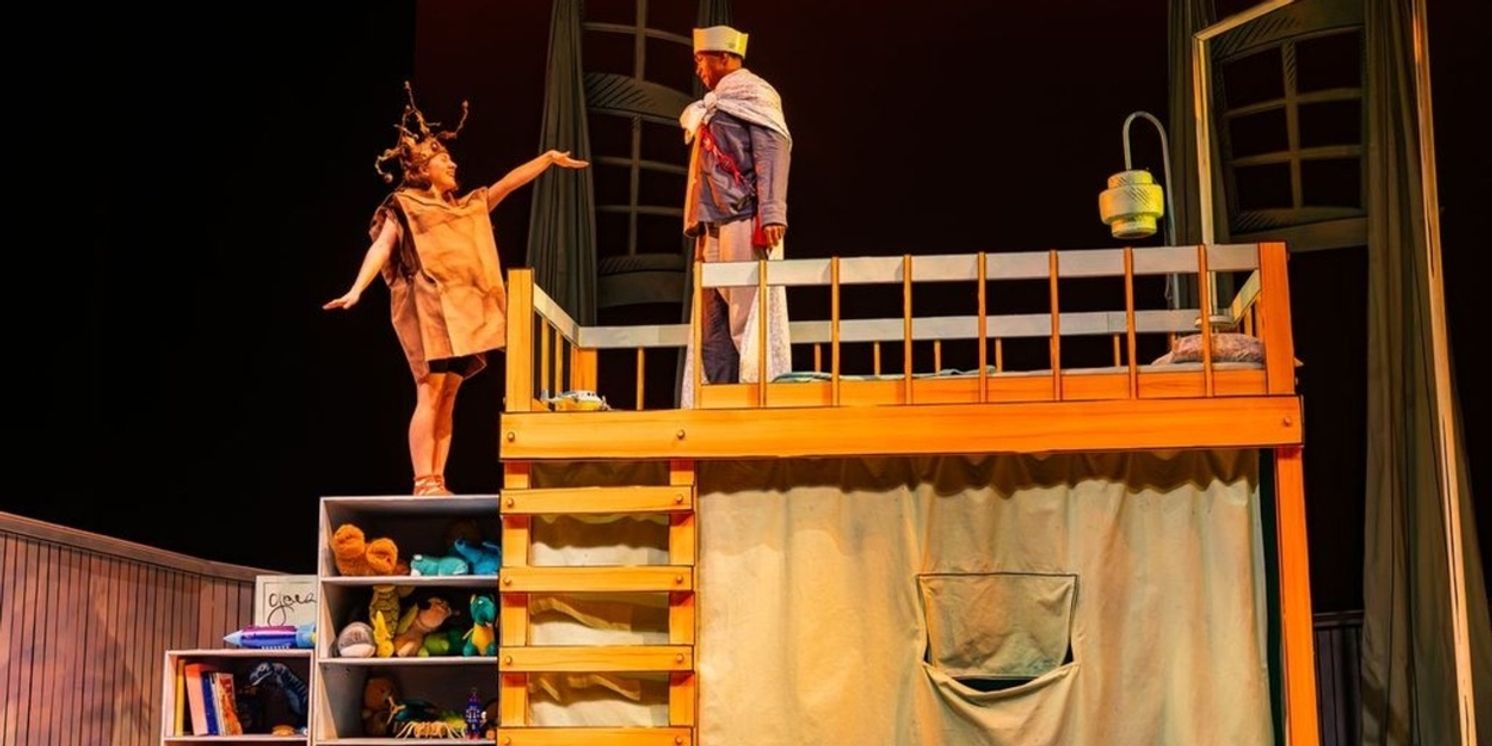
Reid’s exuberance captures the spirit of childhood, aided by effective large-scale design by Robin Fisher and Jareth Li, which makes the world around him seem bigger by comparison. Reid scampers up the steps of a tall bunk-style bed with a playing chamber underneath, using a pole at the foot of the bed to gracefully slide down to the young audience’s obvious delight.
There’s also a wardrobe that leads to the most stories this side of Narnia, and a set of storage cabinets that double as stairs, wheeled around the stage and then locking down with a dramatic hiss for both safety and theatricality. Keeping the set largely to blue hues with black outlining makes the pieces pop like an illustration.
Mortimer is often the main character, but also takes smaller roles or acts as an observer to the swirling chaos. In the Paper Bag Princess section, Murphy takes centre stage, swapping a regular-sized paper bag for a full-body covering and engagingly delivering the tale’s feminist message of the importance of cleverness and self-reliance in a feisty contest with Lee’s dragon; the dragon is perhaps the most impressive of the striking costumes by Jung A Im, with a geometric head, light-up eyes, and shiny red wings. Lee and Murphy also play mother-daughter pairs in the Love You Forever segment and in Zoom, a particularly chaotic section about a girl with an insatiable appetite for speed in a souped-up wheelchair.
The title story, Love You Forever, is a necessary inclusion as Munsch’s signature work; however, it’s always felt to me as being more for the parents reading it, acutely aware of their own mortality, than the children absorbing it, and it changes the energy in the room here as well. Its message about the inexorable passage of time and the inevitable change in roles between parent and child will likely make adults cry (I did), but also might leave them wishing it had a more explicit impact on the play’s arc.
For instance, Mortimer’s observation of the story could have helped him come to a satisfying understanding of his mother’s actions, adding cohesion to the show’s framing device, rather than the section’s tonal change emphasizing the separateness of the anthology.
There are glimmers of that cohesion, though, particularly when Mortimer finds an expressive puppet baby in Murmel Murmel Murmel and comes to the frightening realization that he must care for the child if he can’t pawn it off on a nearby adult. In portraying one of Munsch’s weirdest tales, the segment’s rhythmic parade of exhausted adults successfully uses well-paced repetition to show the other side of the story.
LOVE YOU FOREVER AND MORE MUNSCH satisfies at a fast-paced 45 minutes, even though you might want to watch Mortimer make his noise all day. It’s both a nostalgic hug for adults and an exciting voyage of discovery for kids new to the cycle of Munsch, who may one day read their own children Love You Forever with tears in their eyes.
Photo of Megan Murphy and David Andrew Reid by Dahlia Katz
Reader Reviews

Videos