


Review: EUREKA DAY at Coal Mine Theatre
Satire on the vaccine debate is both cutting and compassionate
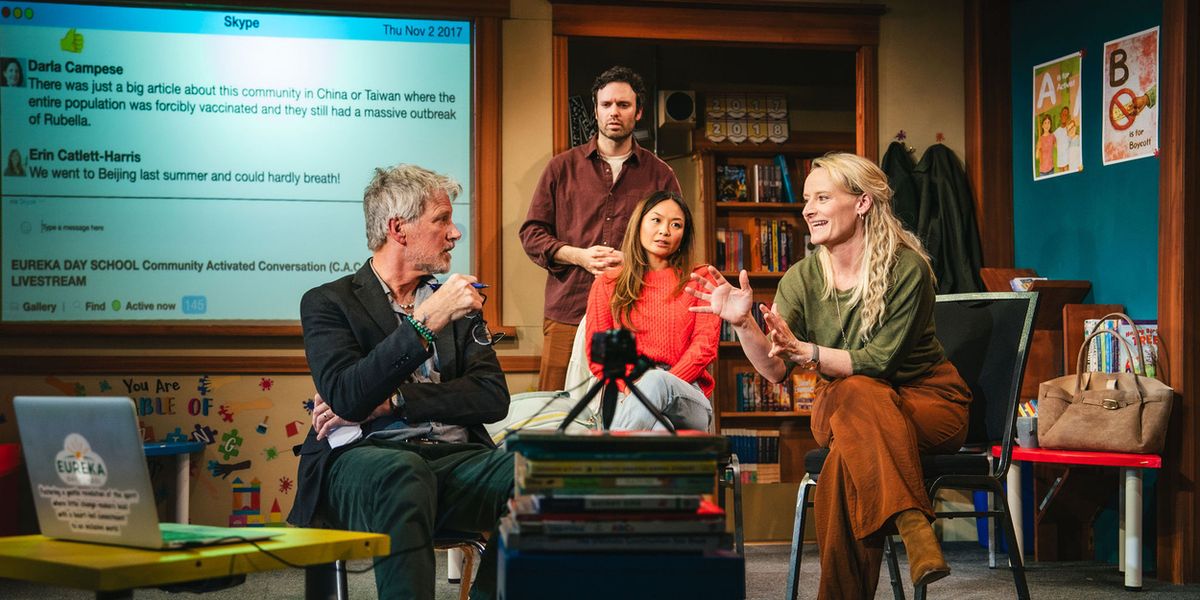
We’re all in this together, until we’re not.
Many of us have, at some point in our lives, operated on the basic assumptions that our chosen communities, particularly those aligned by basic ideology, had our best interests at heart and would look out for each other. Instead, it’s become abundantly clear in the past few years that we live in a post-truth world where both the overly suspicious and overly credulous can be exploited in dangerous ways, and that it’s a Herculean task to get groups of people to agree on the most general of facts, let alone to form a consensus on the big issues.
Jonathan Spector’s Tony-winning EUREKA DAY, directed by Mitchell Cushman at Coal Mine Theatre, was first performed in 2018, but its exploration of what happens at a liberal California private elementary school after a mumps outbreak has only become more prescient and painfully relevant after years of pandemic, increased division between neighbours and friends, and an upsurge in vaccine denial resulting in outbreaks of diseases that we’d before considered largely under control.
Cushman’s energetic production mines the concept of “consensus” for all its worth, as Spector’s play explores whether that state is even possible in a community holding such diverse opinions. It follows a series of school board meetings and their aftermaths, where harmony is seen as more important than actually making a decision or having a hard conversation, and where discussions range from painfully considerate to all-out war. Its satire, too, ranges from the touchingly humane to laugh-out-loud acidic.
In many ways, EUREKA DAY is reminiscent of Larissa FastHorse’s The Thanksgiving Play, which premiered in Toronto last year, in how it incisively puts front and centre a group of people so desperate to be at the vanguard of social justice and avoid offending or harming anyone that they wind up circling back around again to revealing their own deep-seated prejudices and flaws.
Both shows have pointed things to say about the prioritization of language over actions, the nearly pathological tendency of white characters to talk over marginalized characters while professing their desire to do anything but, and the impact of attempting to shave off the edges of every interaction as though one’s entire life can be filtered through a focus group. But while the Toronto production of The Thanksgiving Play suffered a loss of momentum from some pacing issues, Coal Mine’s take on EUREKA DAY heightens its gleeful skewering with a relentless rhythm.
Eureka Day’s school board is a microcosm of its larger population. One of the school’s founders, Suzanne (Sarah McVie), is a domineering, well-off former flower child proud of how she once kept the school afloat using her own library. Don (Kevin Bundy) who runs operations and seems almost physically allergic to conflict, is currently trying to keep the school afloat, as a closure might spell disaster; Bundy plays Don’s pathological avoidance as increasing mania, seemingly convinced that he can fix things if he just locates the right piece of brainstorming chart paper.
Eli (Jake Epstein) a generous donor from his technology startup fortune, is not-so-secretly dating Meiko (Stephanie Sy) in a polyamorous arrangement that he seems far more comfortable with than does his offstage wife. And new member Carina (Sophia Walker), initially the only person comfortable with questioning procedure, fills a diversity niche and is parent to a child with special needs which weren’t met in public school, it’s implied, partially due to resources and partially due to racial bias.
They present a range of opinions on vaccination, Carina a firm believer in the process, Eli vaccinating on a delayed schedule, Don remaining neutral at all costs, Meiko preferring “natural” medicine, and Suzanne an anti-vaxxer touting personal freedom.
From the very beginning, a torturous discussion about which options are appropriate to serve as identity labels to choose from on an intake form, it’s clear what kind of world we’re entering.
Steve Lucas and Beckie Morris’ classroom set also contributes to the atmosphere, with elementary school chairs and a raked stage unbalancing things effectively, making adults seem consistently awkward and out of place. The walls are covered with social justice alphabet posters (D is for Decolonize) which appear to be at least partially AI-generated, perhaps in a nod to Eli’s tech fortune or the program’s hypocrisies (or the show’s graphic design budget). Between scenes, flashing, colourful fluorescent lights over the audience almost seem to dance like an interstitial Sesame Street cartoon, keeping things bopping along.
And boy, do they bop; a perfect scene where the committee holds a virtual town hall online to discuss the school’s closure and plans to deal with the health threat may be the some of funniest minutes you’ll witness in a Toronto theatre. Exquisitely timed projections of chat responses intersperse with the committee’s horrified reactions as everything spirals out of control and the frightened parents online devolve into a breathless chatroom slugfest that looks like every awful Facebook or Zoom comment war you’ve ever seen, taken to the nth degree.
Even as Spector’s work brutally reveals the characters’ myopia, everyone here is sympathetic in their honest belief that they’re doing the right thing; Epstein seems to age a decade in grief, while Walker effectively balances Carina’s righteous anger and quiet compassion. Even Suzanne, the most irritating character in her constant hijacking of the discussion, assiduously policing marginalized people’s right to use certain vocabulary when referring to their own communities, becomes fully human in a surprising monologue that’s a breakout moment for McVie.
When things finally slow down a bit, the magic of EUREKA DAY is that it manages to treat opposing viewpoints with sympathy and respect for the people who hold them without treating these viewpoints as equally valid or informed. It holds space for the fear and rage that motivate potentially dangerous choices while ultimately arguing that you can’t treat fear as fact, and that there are some issues where compromise or making everyone happy is impossible.
In the game of herd immunity, you either win or you lose.
Photo of Kevin Bundy, Jake Epstein, Stephanie Sy, and Sarah McVie by Elana Emer
Sign up for all the news on the Fall season, discounts & more...

|
The Call Centre of Cthulhu Red Sandcastle Theatre (10/28-11/08) |

|
BODIES OF MATTER Terminal Theatre (3/05-3/06) |

|
The Hobbit Stratford Festival (4/21-10/23) PHOTOS |

|
SYMPHONY UNDER THE STARS Collingwood Music Festival (7/11-7/11) |

|
BE MORE CHILL Terminal Theatre (2/02-2/20) |

|
PREDICTABLE HOLIDAY ROM-COM: THE MUSICAL Terminal Theatre (12/17-1/03) |

|
The Rainbow Fish Musical Wychwood Theatre (9/19-10/18) |

|
Battles Young People's Theatre (4/26-5/06) |

|
Smileys: A New Play Reading Wychwood Theatre (9/25-9/25) |
|
So Now You Know: Personal Stories in Motion Harbourfront Centre (10/03-10/03) |

Reader Reviews
To post a comment, you must register and login.