


Review: YOU, ALWAYS at Canadian Stage
Shields' portrait of sisterly love is intimate, detailed, and memorable
I never wanted a sister.
Growing up, I enjoyed my status as an only child, maybe a little too much. I didn’t have to share my space or the attention of my parents with anyone. My cousins, three brothers whom I loved, were at the same time a mystery to me—loud, bickering, playing games that only they seemed to understand. As I’ve grown older and seen their bonds deepen into something truly special, I admit that I’ve wondered what it must be like to grow up with someone who shares your exact DNA and knows you well enough to care for or wound you more deeply than any other.
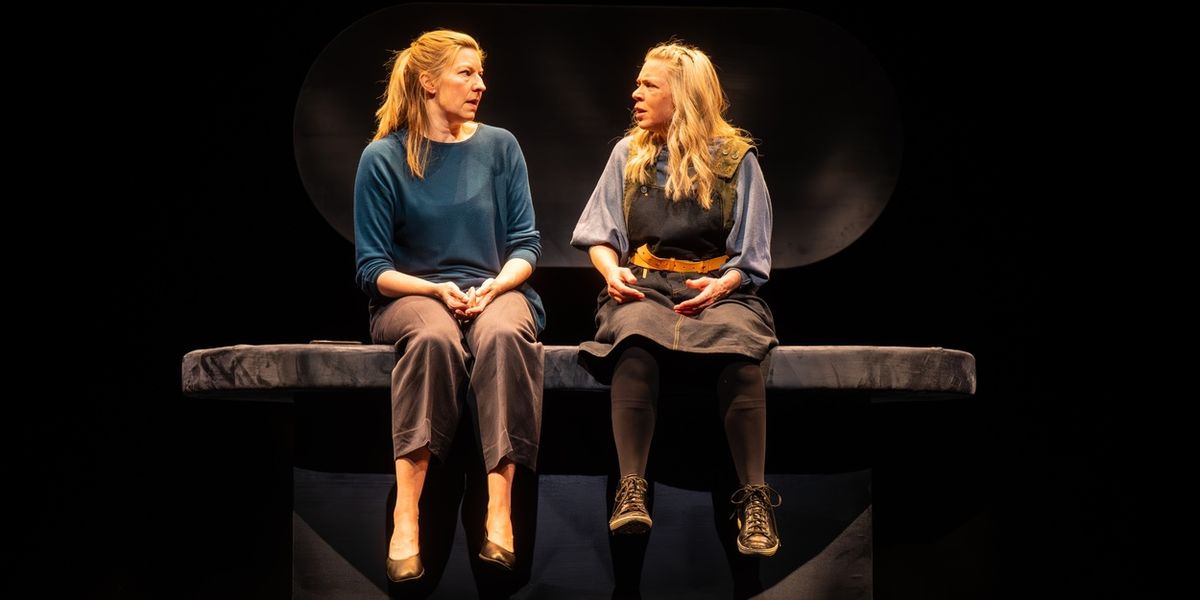
Erin Shields’ YOU, ALWAYS, directed by Andrea Donaldson at Canadian Stage’s Berkeley Street Theatre, is a kaleidoscopic, fragmented look at all moments of a sibling relationship, from childhood to maturity and everything in between. It’s a beautiful, heartrending exploration of how siblings change each other forever, for better and for worse, anchored by two stellar performances by Maev Beaty and Liisa Repo-Martell. I enjoyed every one of its 90 minutes, and it made me—if only for those brief minutes—wish I’d had that sister I never wanted.
YOU, ALWAYS has two very different connotations in the mouths of sisters Liz (Beaty) and Delia (Repo-Martell). One is sweet and touching—“[it’s] you, always,”—speaking to the bond between the two and the fact that they’ll always eventually be there for each other, even after a decision by Liz makes Delia want to run away for good. The other is the tinder of arguments, words that presage a conflagration: “You always [do this]!”
We see these habitual behaviours throughout the show, which thoughtfully juxtaposes scenes from several eras to show us how a person’s essence never completely changes, and how themes of conflict and reconciliation between the sisters crop up again and again. Older sibling Liz is driven and domineering, whether it’s making sure she gets good grades or the remote control, or that she feels in charge of her own body. She’s constantly helping out flightier younger sibling Delia, a budding musician with a penchant for running away from the hard stuff, including commitment to her various girlfriends.
If you have an ounce of foresight, the conclusion of the tale is no surprise, despite Shields’ slow seeding of the purpose of the mysterious opening argument between the siblings. And yes, if you were churlish, you could impatiently wait for the production to catch up and get there. But even if you understand where it’s headed early on, the joy is in the journey, the inevitability only reinforcing the emotion.
Shields’ strength is the specificity in her writing, which quickly sketches and then fills in two recognizable characters that are at the same time entirely their own. Instead of general themes or grand declarations of meaning, she makes both theme and meaning clear by focusing down on specific moments, whether it’s a shared bath, a stoned discussion of the Quebec separation referendum, or one of the sisters’ games of pretend where both try to control an increasingly ridiculous narrative. Ultimately, that narrative is one of vulnerability—would you know me anywhere, no matter what I looked like? Would you love me? Would you save me? Would you choose me over anyone else?
Beaty and Repo-Martell are utterly believable as sisters, instantly establishing an easy rapport with each other that makes one think they’ve known each other forever. Under Donaldson’s direction, their pace never lets up. Whether they’re curled up in the dark discussing Christmas wishes to fix their broken family, doing a silly choreographed dance to the 1956 Mickey and Sylvia duet “Love is Strange” with the extreme concentration of an 8th grade talent show, or doing some cross-bubble, socially distanced catching up during quarantine, they’re in sync. Even when having a vicious argument, they’re caught in each other’s orbit.
Ting-Huan 挺歡 Christine Urquhart’s set provides a fittingly monochrome liminal space for the constant time shifts in the play, though it’s easy to tell when we’re in the present from André du Toit’s bright white lighting. The set almost resembles a child’s toy designed for developing spatial relations, with inviting shapes and depressions one might match together if one could find the missing piece.
The surface carpeting the set starts out smooth, but we can see the sisters’ tracks all over it by the end, another symbolic gesture to the marks which carve out a lifetime.
I’ll never fully know what it’s like to have a sister. But it’s a privilege to ride along with Shields, Donaldson, Beaty and Repo-Martell and get a glimpse into that singular relationship that lasts for always.
Photo of Maev Beaty and Liisa Repo-Martell by Dahlia Katz
See more BroadwayWorld in Google
Our stories show up more often in Top Stories and Google’s AI answers.
Breaking Broadway alerts by text
Get the biggest stories sent straight to your phone.

Sign up for all the news on the Fall season, discounts & more...


|
The Rocky Horror Picture Show Spooktacular Tour with Nell Campbell Roy Thomson Hall (10/26-10/26) |
|
Disney and Pixar's Finding Nemo Young People's Theatre (11/26-12/27) |
|
ProArteDanza Fall 2026 Season Betty Oliphant Theatre (10/29-11/01) |
|
LA BOHEME Terminal Theatre (11/27-11/29) |

|
HYPROV: The Hypnosis & Improv Comedy Experience – Live in Ottawa NATIONAL ARTS CENTRE - SOUTHAM HALL (11/12-11/12) |

|
Raised by Women Canadian Stage (3/27-4/11) |

|
THE PIRATES OF PENZANCE Terminal Theatre (6/18-6/20) |

|
BE MORE CHILL Terminal Theatre (2/02-2/20) |
|
ELEGANCE AND IMAGINATION Flato Markham Theatre (10/17-10/17) |

|
An Improv Halloween - A Spooky Improvised Comedy! The John Candy Box Theatre (10/09-10/30) PHOTOS VIDEOS |

Reader Reviews
To post a comment, you must register and login.