Exclusive: Deirdre O'Connell on Finding Francis in THE PENGUIN, Working with Ari Aster, & More
The Penguin is now streaming on HBO Max.
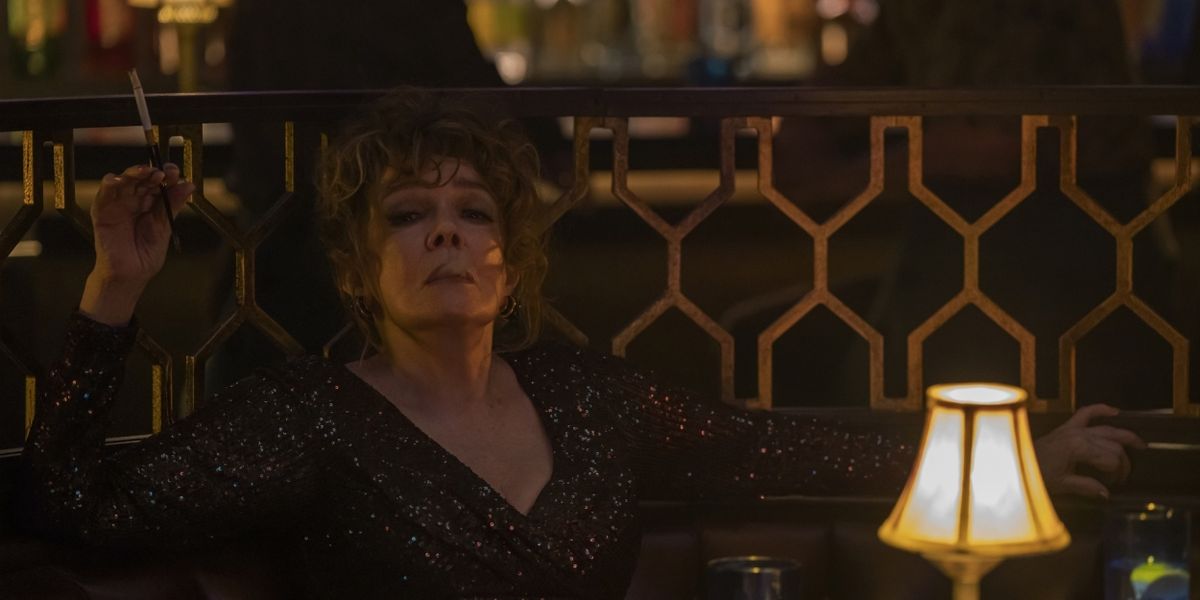
It's Deidre O'Connell's world; we are all just living in it. Following her Tony Award win in 2022, the performer has remained busy, starring in high-profile projects for the big and small screens. A continuous presence in the world of movies, television, and New York theater, she made her debut in the DC Universe in 2024's The Penguin.
As the mother of crime boss Oswald Cobb (played by Colin Farrell), her character, Francis Cobb, is a force to be reckoned with. Her scenes with Farrell are electric, the two characters go head-to-head, all while Francis grapples with the harsh reality of living with Lewy body dementia.
Even so, O'Connell didn't expect The Penguin to take off the way it has. It was director Ari Aster who predicted its monumental success during the filming of Eddington, which arrived in theaters this summer. In that film, O'Connell takes on another rich character: Dawn, the mother of Emma Stone's Louise. Set during the height of the COVID-19 pandemic, Dawn finds herself in the midst of swirling online conspiracy theories and a local mayoral campaign that changes the course of her life.
The Penguin has since garnered a striking 24 Emmy nominations across categories in performance, writing, directing, and more. For her performance, O'Connell was also nominated for an award- the first in her career of nearly four decades.
Ahead of the ceremony in September, BroadwayWorld caught up with the performer to look back on her time on the set of the HBO series, working with Ari Aster on Eddington, and the pains and joys of losing herself in the dark world of Gotham.
Note: Spoilers ahead for The Penguin and Eddington
This interview has been condensed for clarity and length.
I was so delighted to see that all three of you- Colin Farrell, Cristin Milioti, and you- were nominated together.
I want Rhenzy Feliz to be with us! But yes. The pleasure I took in working with the two of them: I can't even describe how inspiring it was, how fun it was, how terrifying it was. It was a very fiery and pleasurable time, and I think we all held each other up and took care of each other.
I know you were not given all of the scripts for The Penguin ahead of time, but when you read a script for a series like this, how much does your idea of the character change between that time and getting to set and beginning the work with the other actors and the directors?
I think it changes enormously. I think I always feel way outside of it. I knew intellectually who the lady was, and I knew that I liked her a lot. She reminded me a lot of my great-grandmother and my great aunt. There was a whole side of my mom's family that was those kinds of very tough, glamorous New Yorkers. So I knew the kind of lady, and unfortunately, I knew about dementia from my own family. But in terms of the distance that you feel between you and the time when you're actually going to leap into it, I felt like it was impassable, as it always is. Like I'll never get there, and I'll never feel like this is truly mine. I think I always put myself through that quite a bit.
Do you recall a shift when that changed?
I had to work so technically on the Lewy body dementia, on the dialect, on the look of the lady. I had some great meetings with the designers, and building her clothes helped a lot. But I think I still felt a distance. It changed utterly during the camera test that Colin and I did.
Somehow, when I saw him in his full regalia, I felt like something came over me, and it seemed to come over him, where we were just like kids in a candy store, and we dove right in. It was being in a corner doing all of your warmups and watching that boxer work, so you knew all his moves, but not knowing whether you were going to actually be able to take the hit until you got there. And I got there.
Immediately after that camera test, I felt like I was on fire. Whether we were going to be able to pull it off, whether I would be so shut down by self-consciousness at any point: all those questions remained all the way through. It's so extreme in many ways, and operatic as a story, that it took my whole pitching arm to do it.
It was scary because it felt like, "Are we really getting away with this?" And I would just have to be like, "Don't ask that question. Don't think about it. Just keep going forward." I was having so much pleasure. I didn't want that pleasure taken away from me.
You mentioned it took some time to get into it. Once that happened, how then did you work to back away from some of those dark places to keep yourself sane?
I don't know. I have to say that Francis's toughness, her sense of humor, her refusal to be a victim- finding that lady kind of led me to stay sane. I think she was refusing to be driven inesane, so that helped. But taking care of myself while I was doing it was hard. I think the hardest stuff was always the homework. If I had time off, I had to be like, "Oh, you better go back and look at all your homework that you did about the kids and this disease. Look at all your thinking about your dad going through it."
I would always be filled with dread, and then I would make myself do it, and I would get really sad. But then, when we would get to the set, there were really hard scenes, but there was also a real pleasure in being taken care of by that crew and by the other actors. Colin would laugh at me every time because when they were like, "Okay, I think we have it." I was like, "We can stop? We can stop now?" I was never the one who asked for another take.
I know I’m far from the only person who hopes to see a second season of The Penguin. Is this a character that you feel you could return to in some capacity? Is there more to mine there?
In my spirit, I feel like I would love to play Francis more. I don't have in my mind the way that story would work. However, I do know that we are in a parallel universe and we're in Gotham, and so all kinds of medical advancements could occur. Could they possibly wake Francis up? Yeah, they could wake Francis up. Would I be happy? Yeah, I would be happy to play her more. I'd be happy to be with those actors more. It was a rarefied pleasure doing it, and I don't always feel that way. I love that lady, and I feel like you could put her in a lot of situations and she would land on her feet.
Because of the writer's strike, there were only a few months between The Penguin and the beginning of the Eddington shoot. Were there elements of Francis that you felt creeping into Dawn as you were thinking about taking on that new role in Eddington? Do you see a connection between those two characters?
I felt like they would respect each other, and I remember thinking it would be interesting if they met. But I don't think I did. I felt like I was dipping in a very different pool inside myself in a funny way. I remember having a conversation with Ari where, when I read the end of Eddington, I said, "It's interesting, my friend, that you have me being the caregiver of someone who's paralyzed. I don't think it matters at all, but just so you know, I'm paralyzed at the end of Penguin. I'm in bed, helpless at the end of that."
And Ari was like, "What?" And I said, "But it doesn't matter, Ari. I mean, nobody's going to put that together." And Ari was the one who said, "Didi, do you have any idea what a big deal The Penguin is going to be? Everybody's going to watch it." And that was kind of my first wake-up call. He was like, "Maybe I should change the ending. And I was like, "No, your ending is too perfect. You can't change your ending. Everybody's going to have to be able to handle that."
One of the things I found fascinating about your character in Eddington was how, in many of her scenes, she is chattering around in the background. Was any of that improvised? Did you have a sense when you were filming what pieces of dialogue would be really clearly heard and which weren't the focal point?
I didn't know that. Ari is a very precise and gorgeous writer. He's also a very fast writer, and he likes to change things. He likes you to be off your game a little. I like to know my lines way in advance and then let go of the reins on the set. Because Ari knew that about me, he would give me new stuff on the set. And I would just be like, "No, I hate this." And he'd be like, "That's okay. You can handle it."
I think everything that he wrote in the original script is in the movie, but he also threw a lot of new stuff at me. And then sometimes he would say, "Just start talking." So it was a combination of the three. Ultimately, I appreciated every single different thing he threw at me. I know why he wanted me to be off-kilter, and I appreciate it. It's just when it's actually happening, you're like, "No, let me stay on kilter."
In the last few years, you won a Tony Award and now have received this Emmy nomination. What is it like for you at this point in your career to be honored in this way?
It's incredible. I don't think I saw it coming. I think I had let go of whether it mattered that much in a funny way. I have gotten such a bang out of getting to do this for as long as I have, and I'm so surprised by the fact that they're still writing for me. When I was younger, the way the culture of writing worked, in television, particularly, but theater and movies as well, was that as you got older, there was going to be no work for a woman. It was very cut and dried. And of course, it is still a struggle, but it has changed as I've aged. I've been very lucky that I didn't feel that awful, slow despond.
With Dana H., you wouldn't have seen that coming. You wouldn't have seen anybody ever producing that play on Broadway. A lot of the reason was because of the pandemic, and there was this openness for experimental theater on Broadway, and the audience was actually there for it. That's being proven over and over again more now, but we were sort of at the beginning of that. I was just the luckiest person in the world that all that came together at the same time.
And then for The Penguin, I wouldn't have been able to imagine any of this ahead of time. The fact that it grew into this gorgeous thing that has so much lived-in subtlety, and at the same time this operatic madness, and that I get to be involved in that. It also had to do with the marvelous coincidence of Colin being a great guy. There was a welcoming that I think made it possible for me to have a kind of courage that I would never have had otherwise. I could have easily been thrown if he had been the slightest bit allergic to me. I think, especially with television, you work so fast that it's very instinctive. And if I had walked on that set and felt him to be a little bit, like "Where did you find her? Why is it her?", I think I could have easily been intimidated.
Instead, he just threw his spiritual arms open, and I felt unleashed in a way. I credit that ferocious love he gave me with the fact that I had the courage to do it. I was lucky that it was just a room filled with love. It's a delicate word, but that's what it really was.
You were recently in a collection of Caryl Churchill plays at The Public. Is there a chance we could see you back on Broadway anytime soon?
Nothing I know about. If it exists, it doesn't exist yet. There's nothing I'm being secretive about. I actually have no idea what I'm going to do next.
Photo credit: Macall Polay/HBO