


Review: THE GREAT GATSBY, Starring Jamie Muscato and Corbin Bleu
Visually stunning, but lacking any heart
 There's a party going on at the London Coliseum this summer. Unfortunately, it's one of those parties that you eagerly look forward to, only to wish you had stayed at home and read an improving book instead.
2025 marks the centenary of one of the greatest American novels ever written. During F Scott Fitzgerald's lifetime, his novel The Great Gatsby achieved very modest success, but now his character of Jay Gatsby is more recognisable than ever, a century after he was created.
And so to West Egg. Narrator Nick Carraway recalls a fateful summer with elusive millionaire Jay Gatsby, who longs for married socialite Daisy Buchanan. Adaptations of this novel have to capture the glitz and glamour of the roaring twenties, while also exposing the dark heart of the quest for wealth, success and the American Dream. Director Marc Bruni's show features a highly talented cast, struggling with substandard material. The show is high on visual opulence, but low on heart and soul.
%20Johan%20Persson_494.jpg?format=auto&width=1400)
Photo Credit: Johan Persson
Jamie Muscato and Frances Mayli McCann each have incredibly strong vocals; musical theatre fans know what they can do, but both have been miscast as Gatsby and Daisy here. There is no discernible chemistry between the pair, making it hard to believe in either of their stories.
Muscato is almost stalker-like in his obsession with Daisy, stiff and awkward as the role might suggest, but not suave or charming enough to capture the audience. His American accent may be off-kilter, but his singing voice is wonderful, particularly in "Past Is Catching Up to Me".
Mayli McCann captures some of the bored vacuousness of Daisy, but fails to show the hidden hurt and bitterness caused by her husband's indifference and infidelity. Oddly, Daisy is given a quasi-feminist ballad ("Beautiful Little Fool") towards the end, implying that she is a more sympathetic figure with hidden depths, rather than the careless and selfish person of the book. They are all villains-that's the point.
%20Johan%20Persson_7584.jpg?format=auto&width=1400)
Photo Credit: Johan Persson
More positively, Amber Davies has great fun as a sassy Jordan Baker, a role that seems to really fit her comic talents. Corbin Bleu is hugely likable and convincing as Nick Carraway and Rachel Tucker gives a typically incredible performance in her solo track “One Way Road” as the brash and ill-fated Myrtle Wilson. Jon Robyns is chillingly believable as brutal Tom Buchanan, but woefully underused and Joel Montague illicits real sympathy as the cuckolded George Wilson.
The main issue lies with Kait Kerrigan’s book, which often sounds like it was written by ChatGPT. Occasional direct quotes from the book jar Fitzgerald's poetic prose against bland phrasing. Kerrigan focuses more on the love story, rattling off the odd reference to class issues and the American Dream, but never delving deeply enough to engage or scrutinise.
Fans of the novel will question certain choices, such as the much greater focus given to the relationship between Nick and Jordan. The gangster Meyer Wolfsheim, who is a fleeting character in Fitzgerald’s book, is transformed into the musical’s villain, threatening Gatsby and revealing his secrets to Tom. Most fatally, Gatsby’s back story is cut, thereby removing much of the impact of his tragic downfall and, arguably, the whole point of the story.
Despite having a brilliant orchestra, the show also struggles musically. The novel was published at the height of the Jazz Age, with huge influences from blues, Big Band and swing, but Jason Howland’s music fails to make the most of this rich material, relying on too many bland tunes and formulaic ballads. Gatsby's love lament "For Her" should pull at the heart strings, but is overly sentimental and far too long. Nathan Tysen’s lyrics are expositional at best and fail to create anything memorable.
%20Johan%20Persson_665.jpg?format=auto&width=1400)
Photo Credit: Johan Persson
The one exception is “La Dee Dah With You”, sung in a brilliant performance by Aimée Fisher as club singer Gilda Grey. Its genuinely infectious energy and gorgeous sultry brass make you realise what the rest of the musical is missing. It also shows the pinnacle of Dominque Kelley’s slick choreography, with some breathtaking tap dancing included. Unfortunately, one captivating track does not a successful musical make.
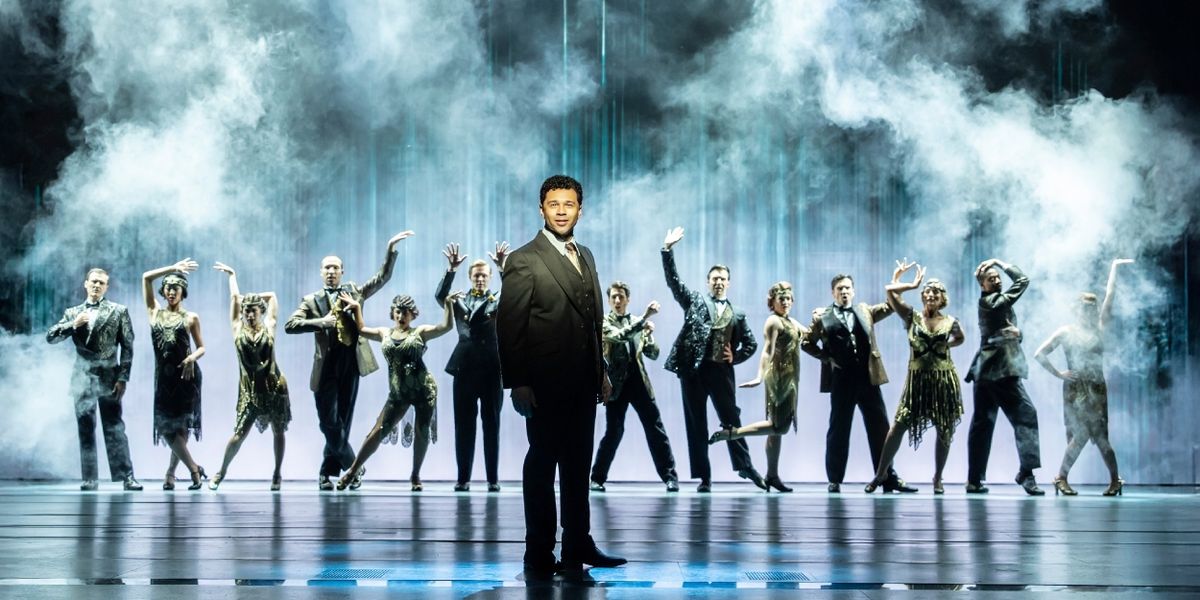
Visually, the production does look spectacular, using the full space of the Coliseum’s vast stage. Paul Tate DePoo III’s scenic and projection design is expertly done, with a multitude of moving flats that smoothly transform scenes innumerable times. The projections are particularly effective, from lapping water to a firework display, with an impressive scene where a static car seems to drive over a bridge as the projections whizz by.
Cory Pattak’s lighting design is thoughtful and clever, particularly in using the orchestra pit as a swimming pool. Linda Cho’s costumes are sublime; sharp tailoring with gorgeous use of colour and texture. New money is dripping in brightly coloured sequins, old money more muted elegance.
The Great Gatsby looks fabulous, but ultimately there is an emptiness underneath the excess. With tickets going for up to £300 a pop, I’m not sure if the producers will see the irony of that.
The Great Gatsby runs at the London Coliseum until 7 September
Photo Credits: Johan Persson

BroadwayWorld Merch
Shirts, mugs, phone cases & more
|
Powered by

|



Reader Reviews
To post a comment, you must register and login.