


Review: CHRISTMAS DAY, Almeida Theatre
Big ideas, bruising performances, and too much on the table.
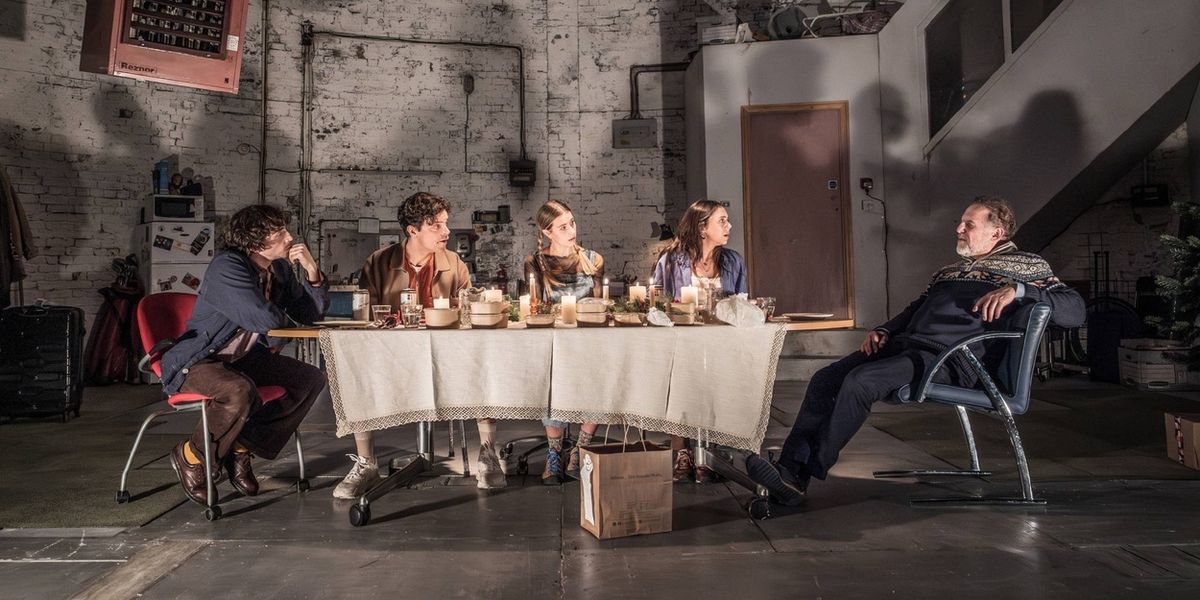
 There is a particular kind of contemporary British play that believes proximity to the dinner table equals profundity. Or human connection. Or a direct line to our stomachs, if not our hearts. It’s never ever clear. Sam Grabiner’s Christmas Day (his first play since his Olivier-winning Boys on the Verge of Tears) is delivered under James Macdonald’s taut but ultimately overburdened direction and both fulfils and interrogates that tradition.
What begins as a sharply observed Jewish family gathering curdles into something far messier: a play about time, space, inheritance and Israel that wants to be forensic, funny and furious, but ends up padded, uneven and occasionally derailed by its own ambition.
Grabiner sets his stall early. This is a Jewish Christmas. Chinese takeaway, passive aggression, theological debate, and a family so articulate they weaponise language against one another. The dialogue is thick with Jewish phrasing and cultural shorthand. Some affectionate, some abrasive, some that land with a thud. Non Jewish audiences — especially those who watched the Netflix hit Long Story Short — will grasp the rhythm quickly. The jokes are clear even when the references are not. What is more interesting is how unapologetically Grabiner insists on Jewish specificity, even as the play strains to universalise its arguments.
At the heart of the evening is a debate about Jewish identity that crystallises around a familiar formulation. Post Second Temple Judaism, as argued by Tamara, became a religion of time rather than space. Ritual, memory, repetition. A portable homeland. It is an idea drawn from thinkers like American theologian Abraham Joshua Heschel and one that theatre rarely trusts its audience with at this length. Elliot, the patriarch, will have none of it. Israel, he insists, still matters. Physical land still matters. He repeats it, circles it, pounds the table with it. Not eloquently, but insistently. The argument is not resolved. Nor is it meant to be.
Nigel Lindsay plays Elliot with frightening conviction. He is blustering, bullish, often appalling, yet never a caricature. Lindsay understands that Elliot’s anger is not rhetorical but existential. Bel Powley’s Tamara, by contrast, is all sharpened intelligence and performative certainty, delivering long ideological monologues that feel thrilling in isolation but contribute to the play’s sense of bloat over its 110-minute running time. Their clashes crackle, though they often feel like essays colliding rather than people listening.
Callie Cooke’s Maud, the non-Jewish partner, is positioned as both mediator and audience proxy, a role the play relies on too heavily. Her outsider status is used to translate Jewishness for the stalls, sometimes elegantly, sometimes with the bluntness of a seminar recap. This tension between explanation and immersion dogs the play throughout.
Structurally, Christmas Day struggles. Subplots drift in from nowhere and leave no mark. Emotional beats are undercut by digressions that feel less like texture and more like indecision. Romantic entanglements and family revelations are handled with the deftness of mid-afternoon soap operas. The late arrival of a dead fox on the dinner table is a particularly egregious left turn, as is the use of its blood as bodypaint in a grisly and unearned finale. Intended, perhaps, as grotesque metaphors, they land closer to a shock tactic, a visual sledgehammer in a play already filled with shouting.
James Macdonald’s direction keeps the pace brisk and the performances grounded, but even he cannot disguise the sense that this has all the feeling of a work still in motion, an early draft that (perhaps due to its premise) has been forced out onto the main stage. Changes have already been made during previews with a final scene that featured Jessica Brindle as Gabz being cut; presumably unrelated, physical programmes were unavailable when I went. The Almeida’s intimacy works in the play’s favour, especially when arguments turn claustrophobic, but it also exposes every flabby transition and indulgent speech.
What Christmas Day does achieve, impressively and frustratingly, is a serious attempt to stage Jewish disagreement without sanitising it. This is not a play about consensus. It is about fracture. About how history is inherited unevenly, how trauma becomes doctrine, how family arguments become proxy wars for global ones. In that sense, its messiness feels almost thematically appropriate.
But theatre still requires discipline. Specificity does not excuse sprawl. Complexity does not require padding. Christmas Day wants to say something urgent about Jewishness, Israel, time and belonging. Too often, it says it three times, from three angles, with diminishing returns.
There is a sharper, braver, leaner play inside this one. What we get instead is a compelling, overstuffed argument that mistakes volume for clarity. You leave stimulated, provoked, and slightly exhausted. Which may, intentionally or not, be the most honest depiction of a Jewish family Christmas of all.
Christmas Day continues at the Almeida until 8 January 2026.
Photo credit: Marc Brenner
Prefer BroadwayWorld in Google Search?
Add us as a preferred source so our stories show up more often in Top Stories and Google’s AI answers — for you.
Sign up for all the news on the Fall season, discounts & more...

.jpg?format=auto&width=365)





Reader Reviews
To post a comment, you must register and login.