


Review: ARCADIA, The Old Vic
Tom Stoppard's masterpiece gets a heartfelt and hugely entertaining revival


|
|
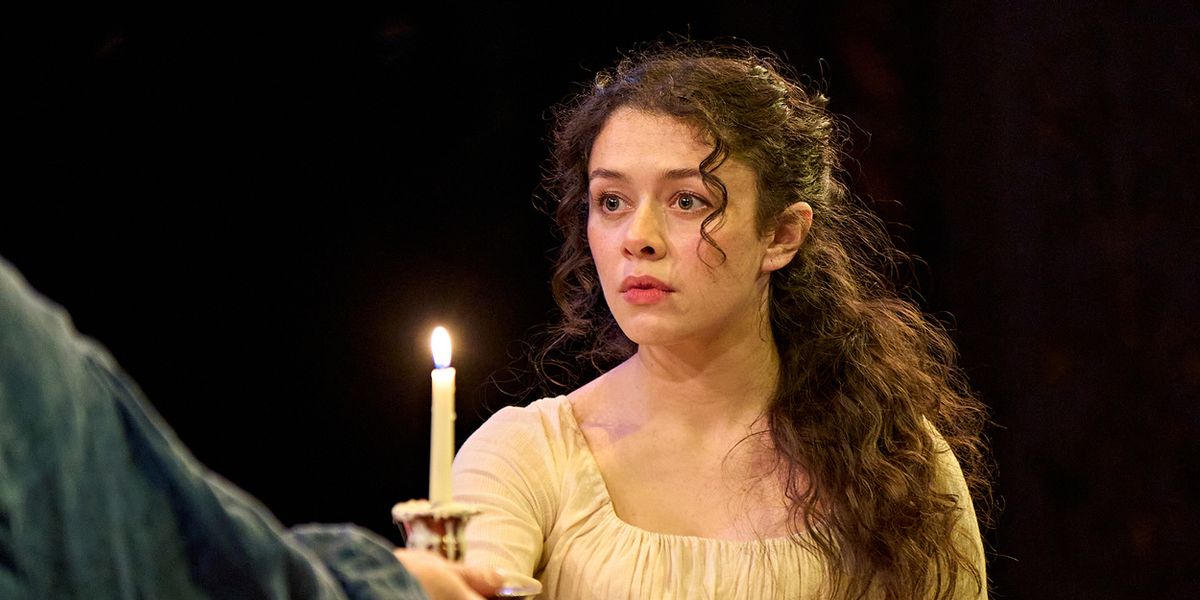

Of all Tom Stoppard's work, Arcadia has always stood out. Touching on sex, Fermat's last theorum, the second law of thermodynamics, landscape gardening with a detective story thrown in, it is a mixture of subjects that few playwrights could attempt to combine. Does it matter if you don't understand the complex scientific and mathematical theories? Not at all. Carrie Cracknell's magnificent revival has huge amounts of humour and heart, which is not always a given with Stoppard's work.
Arcadia covers two sets of events that take place in the same English country house, over two centuries apart. In 1809, teenage prodigy Thomasina makes astonishing scientific breakthroughs while under the tutelage of Septimus Hodge; closer to the present-day, a group of academics and descendants of the original characters try to determine the truth about the events that unfolded two centuries ago. It's a feast of both new discoveries and red herrings that combine to delicious effect.
%2C%20William%20Lawlor%20(Gus%20Coverley)%20and%20Angus%20Cooper%20(Valentine%20Coverly)%20in%20Arcadia%20at%20The%20Old%20Vic%20(2026)_%20Photo%20by%20Manuel%20Harlan.jpg?format=auto&width=800)
Photo Credit: Manuel Harlan
Director Carrie Cracknell skilfully directs an excellent cast, who play out the sometimes labyrinthine subject matter with clarity and conviction. Seamus Dillane is amiable and suitably mischievious as Septimus, with a glint in his eye and a wry smile. Dillane has a lovely chemistry with Isis Hainsworth, who is luminous as the brilliant teenage prodigy Thomasina. A precocious young woman, desperate to know as much as she possibly can about the world, Hainsworth is a perfect combination of innocence and knowledge.
In the present-day scenes, Prasanna Puwanarajah is truly brilliant as the preening academic Bernard Nightingale, with a beautifully realised, if misplaced, arrogance in this own thoughts and theories. Pitting her wits against him is a sparky Leila Farzad as Hannah, who is quietly self-assured.
Angus Cooper has some of the hardest work as mathematician Valentine Coverly; Cooper is fluid and methodical in the role, but is within his theorising that the play can become a little too dense.
%20in%20Arcadia%20at%20The%20Old%20Vic%20(2026)_%20Photo%20by%20Manuel%20Harlan.jpg?format=auto&width=800)
Photo Credit: Manuel Harlan
Set in the round, the pivotal landscape of Sidley Park within the plot is inevitably lost, with the audience left with Alex Eales's well thought out set. A central revolve is surrounded by another larger one, both of which rotate in opposite directions like clocks. A simple table sits in the centre while the outside circle has low benches piled with books, boots, a box of apples and piles of papers. Guy Hoare's lighting sets up an ethereal mass of spheres hanging from above, with two huge ellipses that pulse at pivital moments.
Its simplicity means we focus more upon the characters and the unfolding stories, which works to the production's advantage. Cracknell has the cast flit on and off the revolves, swooping round like time passing. The ending, where the two eras merge, is particularly poignant in its performance. The wonderfully romantic sadness is enhanced by knowing that Stoppard is no longer with us, even if a three-hour running time feels indulgent to his genius.
_%20Photo%20by%20Manuel%20Harlan.jpg?format=auto&width=800)
Photo Credit: Manuel Harlan
It is nearly 33 years since since Arcadia premiered at London’s National Theatre and its last big revival was back in 2009. In many ways, the world has changed beyond recognition since then, with attention spans shortened and seemingly never-ending race to the bottom in terms of what we choose to waste our time consuming. AI threatens to stop humans thinking for themselves.
Is it now elitist to be intellectual? There is no doubt that Stoppard makes the audience work, with a series of huge ideas and knotty concepts. Stoppard wants to convey that there is beauty in science as much as there is in art. Nothing is ever new and we can never know everything there is to be known. It's a cheering message that humanity will continue to find the brightness in life, even as the light fades.
Read our interview with Seamus Dillane, who plays Septimus Hodge, here.
Arcadia is The Old Vic until 21 March
Photo Credits: Manuel Harlan

Sign up for all the news on the Fall season, discounts & more...
.jpg?format=auto&width=300)






Reader Reviews
To post a comment, you must register and login.