


Review Roundup: Tom Stoppard's ARCADIA at The Old Vic
Carrie Cracknell's production runs until 21 March
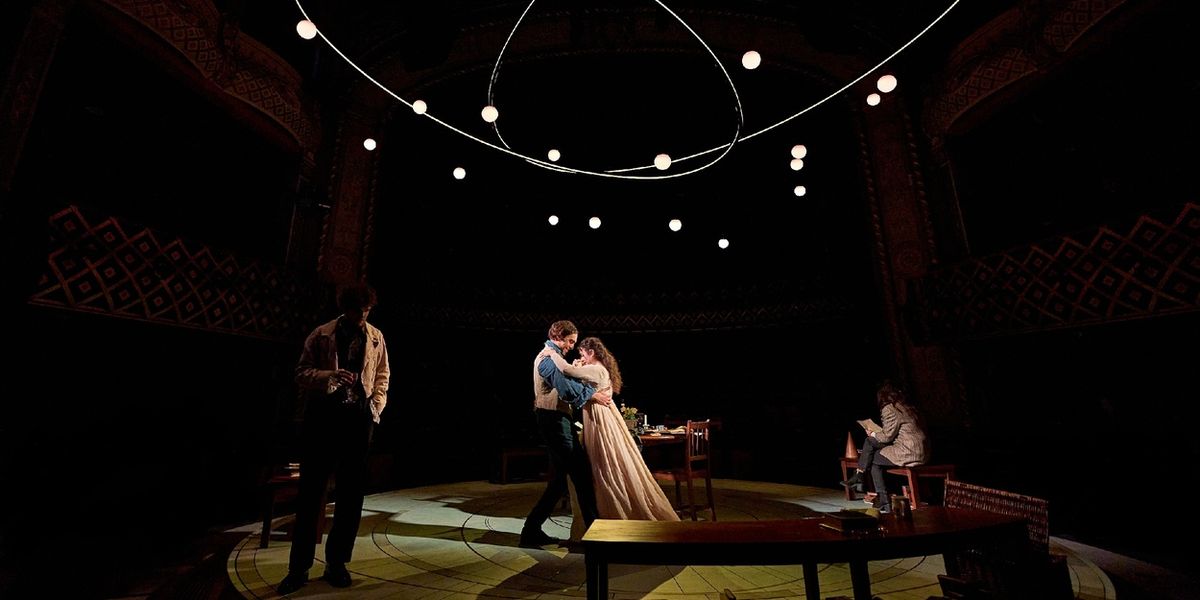
Arcadia is set in April 1809 in a stately home in Derbyshire. Thomasina, a gifted pupil, proposes a startling theory, beyond her comprehension. All around her, the adults, including her tutor Septimus, are preoccupied with secret desires, illicit passions and professional rivalries. Two hundred years later, academic adversaries Hannah and Bernard are piecing together puzzling clues, curiously recalling those events of 1809, in their quest for an increasingly elusive truth.
What did the critics think of Carrie Cracknell's revival?
Arcadia is The Old Vic until 21 March
Photo Credit: Manuel Harlan
 Aliya Al-Hassan, BroadwayWorld: Of all Tom Stoppard's work, Arcadia has always stood out. Touching on sex, Fermat's last theorum, the second law of thermodynamics, landscape gardening with a detective story thrown in, it is a mixture of subjects that few playwrights could attempt to combine. Does it matter if you don't understand the complex scientific and mathematical theories? Not at all. Carrie Cracknell's magnificent revival has huge amounts of humour and heart, which is not always a given with Stoppard's work.
Theo Bosanquet, London Theatre: At times it can feel like being given an IQ test in dramatic form, but don’t be intimidated by the jumble of scientific terminology (there’s a helpful guide to this side of things in the programme). There are plenty of laughs, many courtesy of Puwanarajah’s enjoyably pompous Bernard (“kiss my cycle-clips”), and tenderness too. Modern-day mathematics student Valentine (Angus Cooper) joyously explains the brilliance of Thomasina’s theories, while her relationship with Septimus celebrates the unknowable force of attraction, culminating in a waltz laden equally with chemistry and tragic irony.
 Clive Davis, The Times: It’s when the piece shifts to the present day, and the self-important academic Bernard Nightingale (Prasanna Puwanarajah) takes centre-stage that the pace begins to flag. The dominant yet unseen figure throughout the evening is that of Lord Byron, whose visit to Sidley prompts all sorts of speculation and theorizing. Continually misreading the fragments of evidence, Nightingale builds a house of cards.
Nick Curtis, The Standard: Alex Eales’s revolving, circular set deftly illustrates the idea that time cannot be unwound, or jam unstirred from rice pudding, and features two glowing ellipses and a host of celestial spheres above. Cracknell’s production is almost seamless and she has assembled probably the finest cast you’ll see on stage this year. Dillane is a saturnine and amused Septimus, while Hainsworth utterly convinces as a prodigy aged 13 and then 17. (The flirtation between the two could be deeply icky in this Epstein-filed era, but manifests as a chaste, and rebuffed, teenage crush.) Puwanarajah is resplendent as the swaggeringly cocksure, grizzle-maned Nightingale, whose opportunistic priapism – also somewhat jarring in a post #MeToo world - mirrors Septimus’s.
Sarah Crompton, WhatsOnStage: Hainsworth is wonderful in the way she registers all Thomasina’s longing, her mischievous cleverness and innocent love flashing across her face and Angus Cooper makes her latter-day heir, mathematical Valentine, full of awkward affection and anxiety. But the attractions between Puwanarajah’s odiously self-satisfied Bernard and Farzad’s gentler Hannah register less strongly. They seem a little self-consciously smart; the lines between them don’t always flex and fly.
Andrzej Lukowski, TimeOut: Carrie Cracknell’s revival is not an attempt to radically reconfigure Arcadia and I doubt anyone would be so foolish as to try – it’s an incredibly specific play. She and her team - notably designer Alex Eales - have however leaned nicely into the Old Vic’s current in-the-round configuration. A bit of furniture aside, they've forgone any serious attempt to make it look like the country estate on which the play is set, which we visit in the early 19th century and again in the present. Instead we’ve got a revolving circular stage and lights that look like a mobile of the stars – a specific allusion to some lines in the text but also a neat encapsulation of the text’s underlying sense of cosmic wonder.
Alice Saville, The Independent: Stoppard shows us the power of learning so clearly here, in passionate, ahead-of-their-time speeches on algorithms or the nature of time. But he also shows us all the things that hold us back from it: lust, arrogance, and the sheer randomness of fate. Spending an evening at Arcadia is sometimes like being educated by a brilliant, modestly conservative lecturer who uses the hot sauce of sex to get us eating up material that could be stodgy in other hands. Then, gradually, this play starts to feel as well as think, building to a heartbreaking ending that shows how easily passion and knowledge can burn away to nothing.
Dave Fargnoli, The Stage: Cracknell’s in-the-round staging adds some dynamism to the largely static piece, with actors sweeping in from all angles during the tighter, faster second act as events begin to repeat themselves and timelines start to overlap. The circular set by Alex Eales is kept necessarily sparse, but uses a sectioned revolve to gently waltz the actors around as their characters travel through space and time. A pair of elliptical lighting strips hang above, with bright points of light chasing each other around their perimeters like electrons orbiting a nucleus.
Average Rating: 82.5%
- To read more reviews, click here!
- Discuss the show on the BroadwayWorld Forum

Sign up for all the news on the Fall season, discounts & more...
|
Powered by

|






Reader Reviews
To post a comment, you must register and login.