


Review: DEBATE: BALDWIN VS BUCKLEY, Wilton's Music Hall
A fascinating 1965 debate about American civil rights is brought back to life.
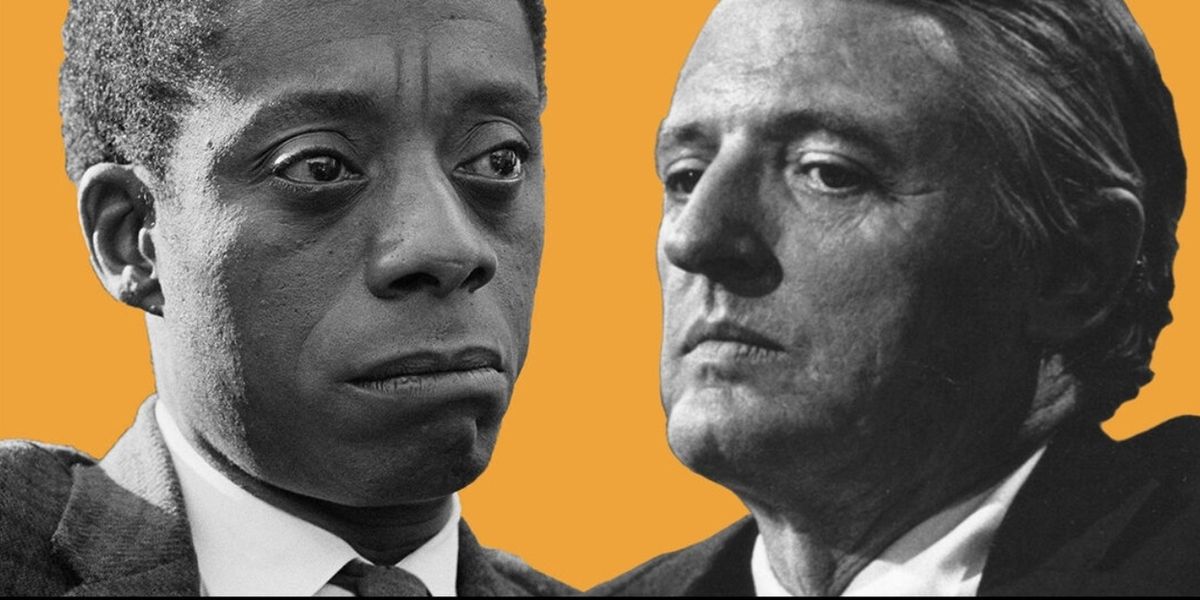
 Confronting issues that echoes down the decades, american vicarious resurrects the 1965 Cambridge Union debate between James Baldwin and William F. Buckley Jr at Wilton’s Music Hall.
The company are no strangers to these shores having already staged this show in 2023 at Stone Nest. They returned to that iconic venue last year with a very different proposition: Fight For America was a theatrical gaming experience centred on the events of 6 January 2021.
Arguing the motion "The American dream is at the expense of the American Negro" may seem a thankless task through a modern lens. Yet, at a time just over a year after JFK’s assassination and amid race riots hitting the headlines on both sides of the Atlantic, Buckley flew over here to do just that. It would be another three years before he took on Gore Vidal for the TV debates dramatised in James Graham’s brilliant Best Of Enemies but Buckley was already a charismatic personality, always ready to defend the conservative point of view in print or in person.
Baldwin, too, was a well known figure of the time and was in the UK to promote his third book, Another Country. The civil rights activist was a renowned novelist and orator. Whether on television and the college campus circuit, he had established as a familiar and formidable voice on segregation, voting rights, education and other areas in which African Africans were discriminated against.
Debate: Baldwin v Buckley is, at least on paper, a dry prospect. Directed and adapted by Christopher McElroen, it largely consists of the original speeches from that watershed encounter with some grainy black-and-white TV footage projected behind the actors. There are no connections to current events in the US, no dramatisations to flesh out these men’s lives and no insights into their personal challenges or how they came to be in front of over 700 students (most of whom - unlike the press night audience - would have been young white men). Even with a punchy running time of just over an hour, a show like this is a hard sell for a TikTok generation used to snappier content sandwiched between ads.
That said, this is a fascinating watch. McElroen strips back the staging to four chairs in which we find the two main combatants plus a pair of Cambridge students. The latter make their own attempt to justify each side of the debate before handing over to the Americans; their spoken efforts contain the only historical context we hear. That’s a shame as a rounder picture of the time and place of this debate would have really driven home its importance.
It is this precise lack of period-specific details that somewhat deflates the impact of Baldwin and Buckley’s points and even their presence here . In the eyes of Buckley and the readers of his right-wing National Review, Baldwin (alongside Martin Luther King and the Black Panthers) presented nothing less than an existential threat to the United States and the American way of life.The death of George Floyd and the worldwide impact of the Black Lives Matter movement is the closest we’ve come to that era; while riots raged across the US, a statue in Bristol was taken down and thrown into the sea while footballers of all races took the knee.
Arnell Powell forcefully plays Baldwin as the firebrand who has nothing to lose and everything to say. Physically, the former has little in common with the latter: at 5’6’’, Baldwin was much shorter and had more hair than the bald Powell. Also, as an openly gay man at a time when same-sex marriage was a distant prospect, he almost certainly wouldn’t have worn a wedding ring. When talking, his performance is not exactly subtle but, given the strong feelings running throughout the speech, that’s completely understandable.
It is in the moments as he sits listening that Powell makes the biggest impact as Baldwin: the only man on stage not in a bow tie, his face tells everything about what he thinks of the men on the stage around him and the occasional jabs Buckley makes in his direction.
Eric T. Miller’s Buckley is a Farage-like figure in many ways. With his casual charm and persuasive manner, he easily slips in sophistries left, right and centre. He is a master at throwing around distracting stats: even if he does have no right to vote, the average American “Negro” earns, he says, more than 95% of the world’s population and a full 70% of what their white neighbours took home.
He doesn’t condone racism, no sirree, but - coming back again and again to Baldwin’s view that the only thing white people have that Black people need, or should want, is power - he doesn’t particularly feel the need to overturn the US to accommodate “a minority”. Indeed, in his eyes, a rising tide lifts all boats and an improving economy should help everyone. Buckley ultimately rests his case against the night’s motion on the economic fallacy that is the “trickle-down” theory (modern studies show “trickle-up” is closer to the truth).
While this isn’t a particularly argumentative confrontation - neither American is given the chance to counter or refuse the other’s assertions - it lays bare the intellectual side of an argument more often seen through an emotional lens. Those gathered that cold February evening in the Cambridge Union convincingly backed the motion (and, by extension, Baldwin) by 544 votes to 164 but the debate over race still rages on today in America and elsewhere.
Debate: Baldwin v Buckley continues at Wilton's Music Hall until 7 Feb.
Image credit: american vicarious
Weekly top stories - unsubscribe anytime.
.jpg?format=auto&width=300)





Reader Reviews
To post a comment, you must register and login.