


Review: Play It Again, Orpheus! HADESTOWN at Dr. Phillips Center For The Performing Arts
There’s something quietly powerful about witnessing a tale that refuses to grow old, especially in a staging that embraces change as part of its identity.
Hadestown is back in Central Florida for a chilly November weekend that will certainly remind everyone Persephone is visiting her irascible husband of the underworld. The last time this production made its way to Dr. Phillips Center, I bemoaned the fact that I couldn’t wear my winter coat and had to subsist on a light sweater over a polo. Last night, fortunately, I donned a leather jacket and scarf, complete with a Hadestown branded beanie that kept my head warm on the walk to the parking garage after the show. “Why review a show that’s already been here before?” I thought to myself. After all, it’s the same songs, same dance, same story I’d seen three years prior. But that was exactly why I jumped at the chance to revisit it. A lot changes in three years, even if the story doesn’t. We have new performers. We have a modified set. We lose some of the charm that made the first tour and Broadway staging so iconic. But in its place are some worthwhile compromises that still allow us to enjoy Hadestown with a fresh pair of eyes rather than the dwindling memory of what passed through these walls in December 2022.
For the uninitiated, Anaïs Mitchell’s iteration of “Orpheus and Eurydice” sets the Greek tragedy amidst a parallel, steampunk version of mankind. As we come across a dingy café, we meet Hermes (Rudy Foster), our emcee for the evening and somewhat neutral moderator to the goings-on of the world. He introduces the cast of characters (“Road to Hell”) with particular focus on young Eurydice (Megan Colton) and humble busboy Orpheus (Jose Contreras). Their youthful infatuation (“Come Home With Me” / “All I’ve Ever Known”) is countered by the faded love between Hades (Nickolaus Colón) and Persephone (Namisa Mdlalose Bizana). As Persephone leaves Hadestown for the world above, spring returns and the people celebrate (“Livin’ It Up on Top”). However, she is still promised to him, and returns for long and harsh winters.
When winter comes, all the joy and celebration dissipates, with Eurydice wondering how she and Orpheus will get by. He is optimistic, having worked on a masterpiece he believes will entice Persephone to return to the world and bring back spring. This “Epic” gets revisited twice more throughout the musical, as he repeatedly refines it to perfection. But Orpheus’ preoccupation with his music leaves Eurydice feeling forgotten. She gets enticed by Hades’ empty promises of the wonders of Hadestown (“Way Down Hadestown”), eventually agreeing to sign her life to him (“Hey, Little Songbird” / “When the Chips are Down”). Although she calls out to Orpheus that she is leaving, he does not hear her – once more, he’s too focused on his music to notice the world around him. Hermes tells Orpheus that she’s gone to Hadestown, but gives him instructions how to get there freely if he wants to rescue her (“Wait For Me”). As Eurydice enters Hadestown, she sees it is nothing like the prosperity Hades promised, but she is trapped there (“Why We Build the Wall”).
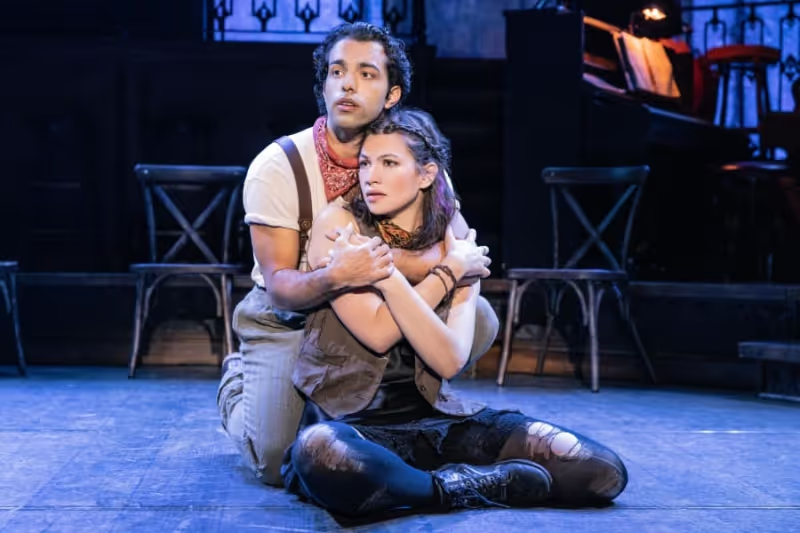
As the first song always reminds us “it’s a sad song, it’s a tragedy… but we’re gonna sing it again!” It doesn’t matter if this is the first or fiftieth time one revisits Hadestown. What matters is that lingering hope that comes with a revisit. That sense and that longing for a change. That maybe this time, it ends differently. It never does, of course. Part and parcel of the tragedy of Orpheus and Eurydice is its downer of an ending. Yet, even with that fateful turning point in the story, Hadestown still likes to bring the song to a close with the promise that someday, maybe, a new song could emerge.
During this particular viewing of the show, the character of Eurydice stood out to me differently than she had in previous productions. It dawned on me that, perhaps in some metaphysical way, Eurydice might always remember her role and her duty to the story. Those living a story cannot fully see or understand every nuance and beat happening around them. The only ones who’ve never seen the tragedy of Orpheus and Eurydice are the characters themselves as they must live through these beats ever time their story gets told. They live in a perpetual, fictional realm of storytelling that, for thousands of years, have relied on specific actions and dramatic plot points to guide their story along. And, last night, I began to wonder: what if Eurydice knew the ending every time this story was retold? What if, upon that narrative reset when a production ends and another begins, the character herself is aware that she’s done this story before? Or, perhaps, if all the characters are aware that all this has happened before and it shall all happen again?
So I began first observing Eurydice for signs of familiarity throughout the production. Not thinking about how the performer has played this role on a nightly basis with that same familiarity. Rather, how she imbued in the character any knowing nods or small acknowledgements that Eurydice herself has always been self-aware that Hadestown is on a constant loop, retelling her and Orpheus’ story for a new audience every night. Gradually, I noticed that not just Eurydice, but other characters seemed to convey a ”here we go again” approach at key points in the production. Perhaps everyone was “in” on it. Except, of course, for Orpheus himself. He seemed to be the outlier among the characters. The narrative reset seems to only occur for him, as he begins the story anew every time.
The mental gymnastics this took me throughout the evening felt worthwhile as it made me appreciate not just how this theory could be proven through the masterful performance of the cast, but also how the mere art of retelling stories allows for multiple interpretations of the same narrative to exist. In addition, the practicalities of a touring production – and one, also, on a second leg after the original 2021-2024 run concluded – shows how the company of players are continually changing and modifying this same story across different stages. Making compromises for what one city offers that another doesn’t, what one performer can do that another struggles with, and how regionally the audience might have their own pre-set experiences and expectations for what they’ll see unfold. Hadestown thrives not just on the same story being told and retold, but only ensuring that – like the best of live theatre – it’s a new and different experience every time.
This second national tour of Hadestown began in October of last year, set to conclude in June of next, and carries with it several modifications compared to that first tour and Broadway staging. Thus, it feels in some way like a new version of Hadestown. One that sits comfortably with my memory of the original tour, as well as what I’ve seen online of the Broadway production. Director Keenan Tyler Oliphant heads this production, drawing inspiration from Rachel Chavkin’s original directions. Oliphant also worked on the Broadway production before this tour, meaning he’s not coming in to re-invent the wheel. Rather, he's learning how to make that wheel adjust to different roads.
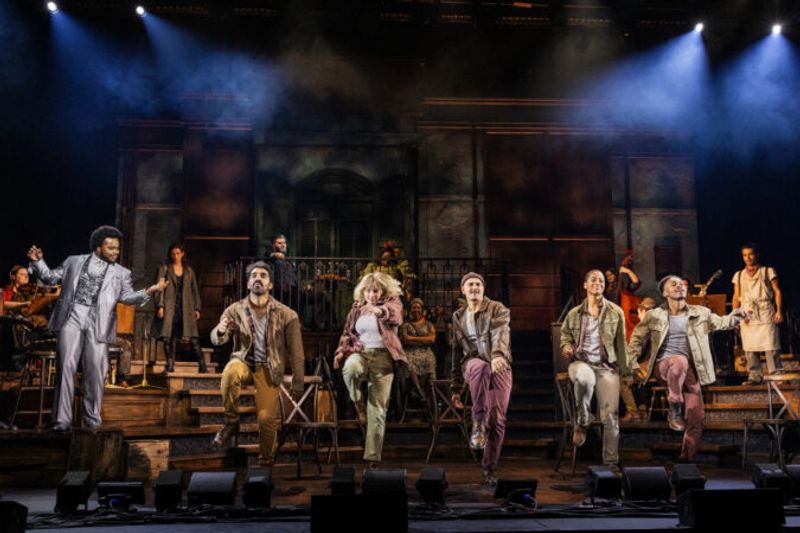
Let’s get the bad news out of the way first. We don’t have a turntable or lift in this staging. The turntable has been a staple in the Broadway production and put to similar use in the 2021-24 touring production. A majority of the dance numbers (notably “Wait For Me”) relies on that turntable as both an impressive choreography aesthetic as well as an enforcer for narrative theming. The compromise from losing the turntable and the lift means that choreography also has changed. While it does, occasionally, mimic that same turntable steps – sans, you know, the turning – it does allow for some original choreography unique to this touring production. Touring choreographer T. Oliver Reid had his work cut out for him, making sure that the movement of the Workers still felt kinetic and reactionary to Orpheus, even if it now requires different staging without that turntable. It works for anyone who’s never seen the original choreography before, but does come off slightly disappointing for those who loved the turntable to the point that they’ve imitated the Orpheus Walk on an airport’s moving walkway. (Guilty.)
That said, I still enjoyed how the new choreography found ways to suggest the turntable. During “Wait For Me,” for example, the Fates circle around Orpheus on foot and now get uncomfortably close as they taunt him. It makes for a new reading to their characters as well, as if they know the outcome and wish to send him away. Likewise, “Wait For Me” also re-instates the swinging lamps used in the Broadway. The original tour omitted those lamps during the number, but – perhaps because we lost the turntable – the new tour brings them back. Due to the different choreography, only three lamps swing while the other two are held by the Workers. And, again, it works in this new compromise. Having the Workers now manning a swinging lamp makes them active players, also trying to dissuade Orpheus from the futile quest that lays before him. And it further confirms my theory that everyone’s lived these lives before, except for Orpheus. He becomes, in a sense, a surrogate for the audience – themselves a mix of new-to-the-show first-timers and seasoned pros who know what’s coming. Orpheus is fated to fall in love with Eurydice and follow her into the underworld, only he will never remember his past attempts. He needs that motivation to try for the first time, even if he won’t learn from it.
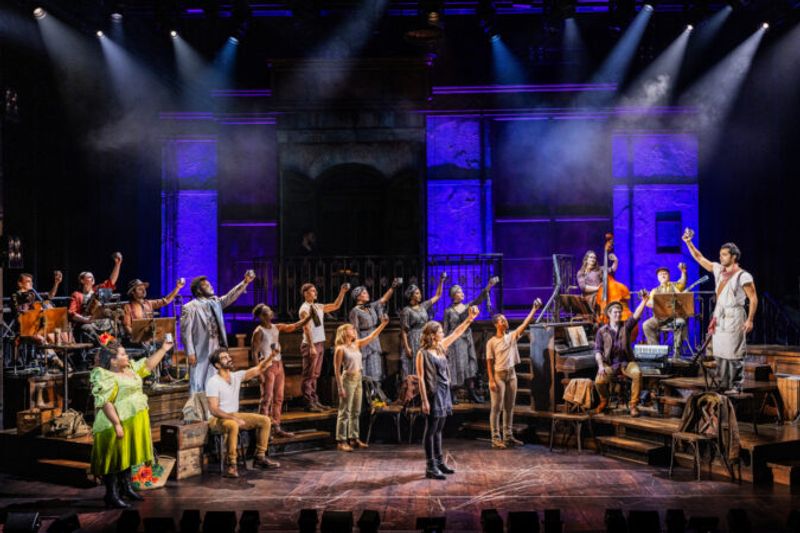
This new approach to the storytelling of Hadestown helped make me appreciate some of the compromises on the tour. And to further appreciate what they still maintained from the first tour and Broadway production. The set’s slightly modified (Hades’ door is more centered, for one), but we get to keep the band onstage. We get that dingy café feeling through the layout. We hold on to the iconic props – the rose, the candle, the guitar, the lamps – as well as the steampunk design of the costumes. The Workers are still a core five that inhabit both worlds and create their own, unspoken storylines through their movement and couplings. And the characters themselves are still the same, timeless figures that make Hadestown always feel like a new experience every time.
At the heart of Hadestown is Orpheus himself, played here by Jose Contreras. Contreras contributes a gentler portrayal of Orpheus compared to Chibueze Ihuomo (who played Orpheus on tour in 2022). I always remembered how Ihuomo portrayed Orpheus with a gusto and innocence, but then would belt and own the crowd-pleasing songs like “Wait For Me” and “If It’s True.” With Contreras, we have an Orpheus who is much more lovestruck with Eurydice to the point that he plays the character very much like a teenager in love. Thus, he gives Orpheus’ singing voice a sweetness and falsetto to highlight the youth of the character. The seven-note “Epic” melody that much of the plot’s B-story revolves around has a more honeyed sound to it, if it makes sense. Like Ihuomo before him, it’s a smoother delivery, opting not to mimic Reeve Carney’s “indie rock” intensity on the Original Broadway Cast Recording, but rather something more in the realm of a Michael Bublé or Frank Sinatra styling.
Pairing well with Contreras is Megan Colton as Eurydice. And likewise, her vocal choices here allow for the character of Eurydice to always have a hardened, “this ain’t my first time at the rodeo” approach. Colton’s voice is a raspy but endearing cadence, similar to Norah Jones, although she puts more energy into it compared to the more laid-back delivery Jones is famous for. And she makes sure to convey that knowing sense of my theory from earlier: Eurydice knows how her story will always end, but she lives through it again anyway. Colton adds a layer of helplessness to the character through a lot of subtle action, namely a tucking of the hair behind her ear. It felt, at least in my reading, as a way for her to claim at least one tiny bit of control in her (after)life. And that little ounce of power she has in the story becomes a lifeline for Eurydice, as well as a bit of appreciated nuance on Colton’s part.
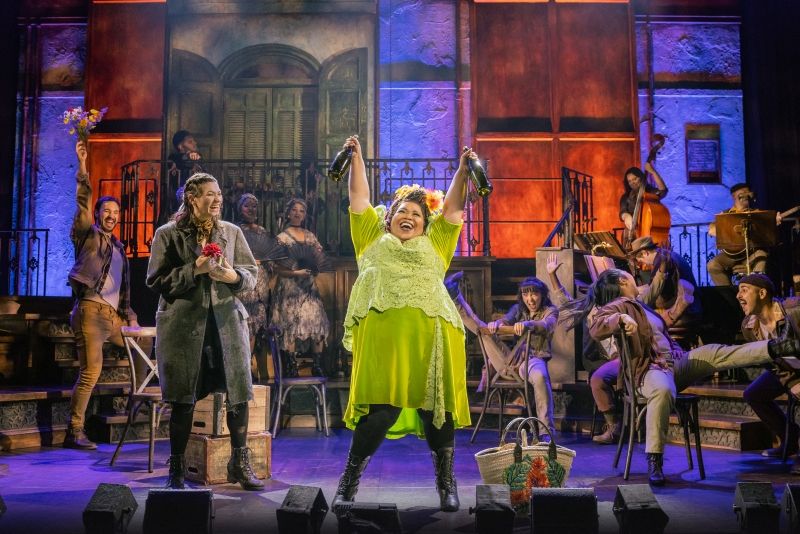
Hades as played by Nickolaus Colón feels like a business tycoon stepped out of the 1980s and into 2025. He dominates simply by his mere presence and deep, booming voice. It’s as if someone decided to turn Gordon Gekko (of 1987’s Wall Street) into a musical character and asked James Earl Jones to play him. Colón spends the first half of Act One literally just sitting on his little balcony, but once he gets a chance to act, he acts. And he holds his own opposite everyone: Contreras, Colton, and especially his on-stage wife Persephone as played by Namisa Mdlalose Bizana. Bizana gives Persephone a more comical approach compared to Lindsey Hailes (2022’s Persephone). She takes the same lines and stage directions and works it in her favor to give Persephone more levity than the material intended. It’s a welcome change, especially as her particular arc (a loveless marriage in which two partners forget why they are together) now turns the tired “I hate my spouse” trope into more poignant story of rediscovering why one fell in love in the first place.
Guiding these two couples along without any stakes in whether they live or die is the eternal chaos gremlin that is Hermes, as played now by Rudy Foster. Foster has the first and last line in Hadestown, so guides us all along full circle through the entire song. And he does so with, perhaps, the most self-aware “I know something you don’t know” depiction of Hermes. For a moment, I considered the possibility that all of Hadestown is unfolding as Hermes’ own, demented fan fiction of Greek mythology. But he’s having too much fun observing and commenting to be the actual puppetmaster on the stage. Rather, Hermes as portrayed by Rudy Foster runs around the stage like an NPC who’s snuck into the code and already saw the Final Boss level. He reacts not just to the characters, but specifically to the audience reaction as well – gleefully chipping away that fourth wall that separates us from them.
The ensemble of this production include the three Fates (Miriam Navarrete, Alli Sutton, and Jayna Wescoatt) and the five Workers (Jonice Bernard, Ricky Cardenas, Ryaan Farhadi, Erin McMillen, and Miracle Myles), all of whom serve as the entire world of Hadestown but never on that same meta-awareness as the primary five characters. The three Fates still feel like underwritten characters, at least within the grander sense of their responsibilities and power in Greek Mythology. Here, they still do little beyond sharing occasional criticisms of story beats through their songs. The Workers, too, are eternally twenty feet from stardom as they play around the characters without fully defining themselves. It works, narratively, as they represent the everyman, the people we pass on the street, the unknown names behind the labor that keep the world running. But they, too, find ways to keep – rather than lose – their identities. Some Workers like Cardenas and McMillen clearly created an unseen backstory between their two ensemble players. Although the choreography often will mix and match dance partners, Cardenas and McMillen found a way to imply that their Workers are already familiar with each other, already having lived their own love story and are now supporting that of Orpheus and Eurydice.

Little touches like that ensure that the same show will never truly be the same show whenever it comes back here. Performers will change. Staging will change. Who we are as an audience will change. I am not the same person today that I was in 2022. I shouldn’t expect a sameness to the show when I, myself, have different expectations to it now. What struck me most, leaving the theater last night, was how this production wholly now leans into the idea that stories only survive because we retell them – again and again and again, knowingly or not. If the characters of Hadestown (all but Orpheus, poor doomed optimist) truly remember the steps they’ve taken before, then each performance becomes a kind of ritual: a weary but determined march through a tale they already understand, undertaken for our sake as much as theirs. And strangely, that makes the compromises of this second tour feel not like losses, but like choices made in service of the larger cycle. This Hadestown may be a little different from the one you remember – simpler in some places, reinvented in others – but so are we. We arrive with new eyes every time. And that makes the familiar story hit just a little harder.
Which is why, even knowing exactly where the myth ends, I’m grateful we get to see it play out again here in Orlando, if only for a few days. There’s something quietly powerful about witnessing a tale that refuses to grow old, especially in a staging that embraces change as part of its identity. Hadestown will move on after the weekend, carrying its well-worn tragedy to the next city, ready to tell it all over again. But while it’s here right now, in this moment of time, it offers us the rare gift of seeing a story reborn in real time. And whether you’re a first-timer or returning traveler on this long road to hell, it’s worth taking the journey once more – even if you already know how it ends.
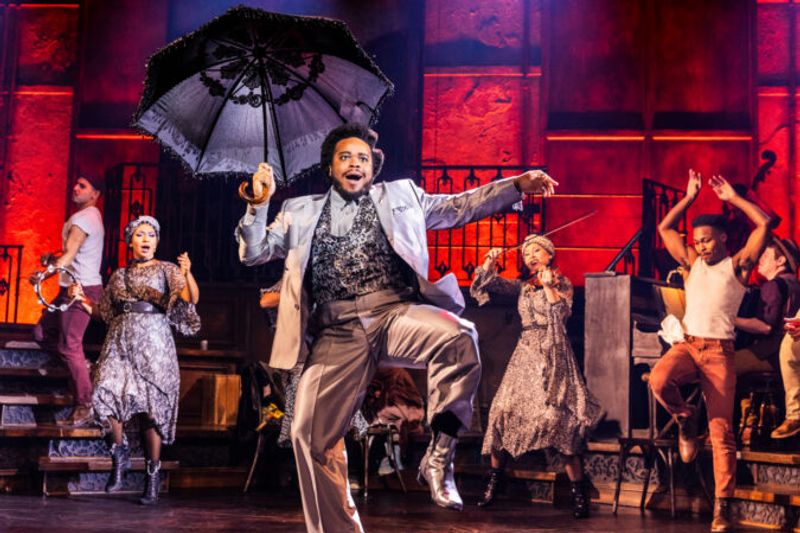
Hadestown plays at Dr. Phillips Center November 28 through 30. Tickets can be acquired online or at the box office, pending availability.



|
Havana Hop Orlando Family Stage (9/19-9/19) |
|
The Best Halloween Ever Orlando Family Stage (10/10-11/01) |

|
The Shark Is Broken Athenaeum Theatre One (10/15-11/08) |

|
Zayn at Kia Center Kia Center (11/09-11/09) |

|
On The Town Riverside Theatre (2/25-3/21) |

|
The Mouse & The Mustache Riverside Theatre (1/28-2/21) |
|
Hamilton (Angelica Company) Dr. Phillips Center for the Performing Arts (9/29-10/18) |
|
Ted Swindley’s Honky Tonk Angels Athens Theatre (2/26-3/21) |
|
The Light in The Piazza Riverside Theatre (3/14-4/11) |

|
Disney's Finding Nemo Athens Theatre (1/22-2/27) |
Reader Reviews
To post a comment, you must register and login.