


Review: Encore Performing Arts' THE HUNCHBACK OF NOTRE DAME
The Hunchback of Notre Dame asks its audience to lean back into the notion that compassion, in all its flawed and fractured forms, is still worth pursuing.
Great storytelling does not exist in a vacuum. When one puts pen to paper, they create a story based on the creativity within, but also influenced by the world around them. Victo Hugo’s 1831 novel Notre-Dame de Paris was written as a love letter to the Notre-Dame Cathedral. A veritable antique even in his time, the cathedral had been desecrated during the French Revolution, centuries of decay also leading it in danger of being destroyed. So popular was his novel however, one which turned the stone monument into a silent, living witness to an epic story set four hundred years in the past, that restoration efforts were mounted to save the cathedral, ultimately leading to the French government taking ownership and continually keeping the edifice preserved and intact. When a world is so willing to make way for tomorrow, relics of the past find new ways to stay relevance. Buildings, stories, ideas. They remain relevant so long as there are voices to champion their preservation. They remain timeless as new voices garner new meaning from the old stories.
Thus, the enduring story of Notre-Dame de Paris has led to countless adaptations in opera, theatrical films, television. The 1939 RKO film came out in a banner year for Hollywood, cementing its own “Classic” reputation. Although the film was not the definitive retelling, it became one from which all others in the modern world would be compared. Eventually, it led to Walt Disney Feature Animation (as it was then known), to adapt the sprawling novel into their own animated feature film. The 1996 version was, at the time and still today, decried by literary purists who loathed the Disneyfication of the source material. They criticized the dramatic licences placed on the characters and stories. They rolled their eyes at the Gargoyles coming to life and the revised ending. To be fair, it was based on an alternate ending Victor Hugo himself wrote for a later opera adaptation of his work. But, as I said earlier, great storytelling does not exist in a vacuum.
Disney’s The Hunchback of Notre Dame drew inspiration not just from the Victor Hugo novel, but the past successes of theirs and other’s work as well. The directors had previously adapted Beauty and the Beast into an Oscar-nominated Best Picture. The composer had written successive Academy Award winning scores and songs. The primary voice actor made a name for himself on stage and screen through a very contemporary take on Classical music. And Broadway itself had seen a revitalization thanks to the mega-popular, likewise Hugo-inspired musical Les Misérables. The Hunchback of Notre Dame became, in essence, a family-friendly cinematic Les Misérables from the same studio that gave audiences The Little Mermaid, Beauty and the Beast, Aladdin, and The Lion King. While not quite reaching The Lion King numbers at the box-office, The Hunchback of Notre Dame did finish as the fifth highest-grossing film of the year.
In the near-thirty years since The Hunchback of Notre Dame’s release, the film’s reputation has solidly remained “for mature audiences only,” albeit not in the lascivious sense. Rather than dilute the darker themes of The Hunchback of Notre Dame into a sanitized theme park attraction, The Walt Disney Company has instead leaned into the story’s deeper moral and emotional complexity through stage adaptations and more adult-minded projects. First appearing in Germany as Der Glöckner von Notre Dame, the 1999 stage musical restores elements from Victor Hugo’s novel and infuses them with the same haunting film score by Alan Menken and Stephen Schwartz. No longer shackled to the expectations of a G-rating for the cinema, this revised version of the tale also plays as more mature, raw, and emotionally resonant than its animated counterpart. In all respects, the stage musical deliberately improves upon its own film adaptation to honor the gravity of the source material and preserve its legacy not through merchandise or rides, but through art that respects its tragic beauty.
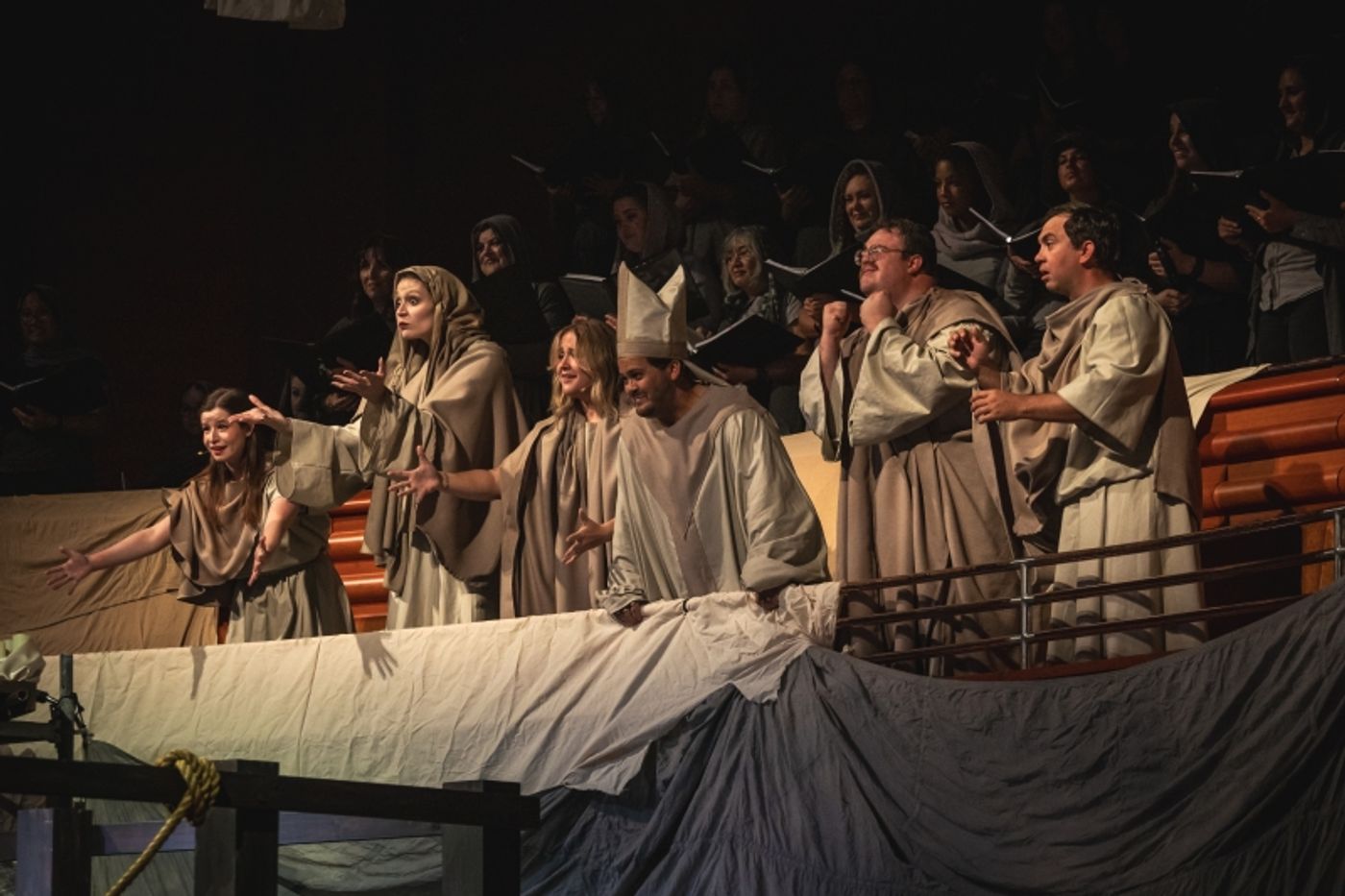
The musical opens with the ensemble retelling the origin of Quasimodo in "The Bells of Notre Dame." Archdeacon Claude Frollo (Arthur Rowan), a strict and pious man, is forced to raise his deformed nephew, Quasimodo (Dante Payne), after the death of his brother Jehan (Sean Powell) and a Romani woman Florika (Clarissa Moon) at the cathedral doors. Frollo hides Quasimodo away in the bell tower of Notre Dame for twenty years, warning him of the world’s cruelty and sin. Quasimodo’s loneliness leads him to imagine the cathedral statues (Andrew Campbell, Lauren Graber, Clarissa Moon, Sean Powell, Beth Ann Stripling, and Michael Anthony Rodriguez) into speaking to him, cheering him on and offering advice. Longing to escape his isolation, Quasimodo sings of his yearning to be part of life outside the cathedral ("Out There"). Meanwhile, the soldier Phoebus de Martin (Justyn Brown, understudy) returns to Paris from the front lines and is eager for a bit of pleasure and freedom ("Rest and Recreation"), unaware of the corruption he’s about to step into.
Quasimodo sneaks out of the cathedral to attend the Feast of Fools, a boisterous and chaotic street festival emceed by the chaotic Clopin Trouillefou (Ryan P. Blagg), where the Romani performer Esmeralda (Alexis DeLaRosa) dazzles the crowd with her dancing ("Rhythm of the Tambourine"). Quasimodo is crowned the King of Fools for his unusual appearance but is quickly mocked and abused by the crowd. Esmeralda intervenes, showing compassion and helping him back to the cathedral. Her defiance catches the attention of both Phoebus and Frollo. When Esmeralda later seeks refuge in Notre Dame to escape arrest, she is granted sanctuary ("Sanctuary"), and inside the church, she prays not for herself, but for the suffering and outcast ("God Help the Outcasts").
Quasimodo forms a quiet friendship with Esmeralda and shows her the bell tower, where they share a brief moment of connection and freedom ("Top of the World"). However, tensions grow as Frollo’s obsession with Esmeralda deepens. Phoebus, sent to track her down, begins to question his orders and motives after another encounter with her. The two find themselves in a rowdy tavern where Esmeralda blends into the crowd ("Tavern Song (Thai Moi Piyas)"), barely escaping capture. Quasimodo, watching Esmeralda from afar, realizes his feelings for her are romantic and pure, expressing this tenderly ("Heaven’s Light"). This contrasts immediately with Frollo’s dark and tortured confession of lust and damnation ("Hellfire"), revealing the depth of his internal conflict.
As the first act reaches its climax, Esmeralda finds herself hunted by both Frollo and the authorities. The ensemble sings the sweeping and ominous finale ("Esmeralda"), intertwining Quasimodo’s devotion, Phoebus’s growing love, and Frollo’s rageful desire. The stakes are raised as each man’s connection to Esmeralda sets the course for tragedy or salvation. With Esmeralda still under sanctuary but no longer safe, and Quasimodo caught between loyalty and love, Act One closes with the city of Paris on the verge of chaos.
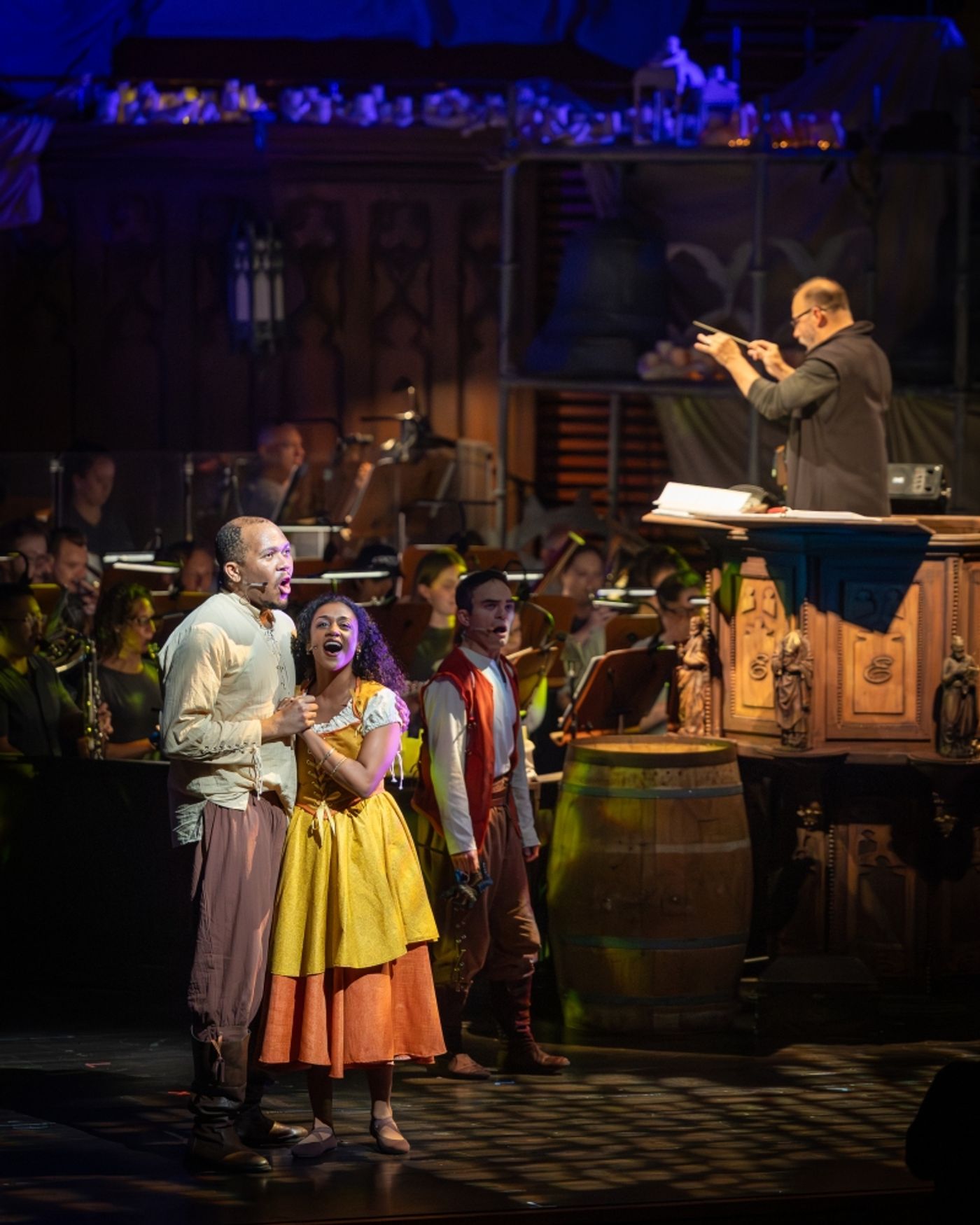
For anyone who’s seen Disney’s The Hunchback of Notre Dame, a lot of the familiar story beats remain here. However, this local production by Encore Performing Arts takes a unique approach to their mounting of this stage musical. The company has often selected projects that do more than entertain their audience in Central Florida. The stories told must have an impact, share a message, and provide hope for those in the darkness of a theatre. Last year’s production of Hello, Dolly! served a message about love. This year’s production of The Hunchback of Notre Dame pairs up that love with compassion. It is not enough simply to love thy neighbor, after all. Rather, there is a moral and social responsibility to show compassion, to empathize and help those less fortunate. It’s a driving theme within The Hunchback of Notre Dame as well as within Encore Performing Arts. Every production of theirs comes through 100% volunteer dedication of time and resources. Any money made from the shows get donated to worthwhile charitable causes.
This year’s cause, Miles To Go, was founded in 2018 by a 9-year-old Florida local who asked his mother how they could help the homeless and the panhandlers in the area. Rather than give money at a traffic stop, the family created Miles’ “To Go” bags that contained food and essentials for any homeless person in need. Over the last seven years, the foundation has donated over 12,000 bags to those in need, showing just how powerful compassion serves the community. To help with this cause, Encore Performing Arts has also selected a musical to bring that message forward. In an era where funding for the arts has seen record cutbacks, the fact that everything on this stage has been done through volunteer efforts only further drives the point home: compassion, not capital, is what makes a community.
That community has, for as long as I’ve lived in Central Florida and beyond, continued to provide Grade-A entertainment to audiences every year. Whether it be in their day-to-day jobs as performers, entertainment, and music, or within the purview of Encore Performing Arts, the entertainment in display on the Steinmetz Hall stage comes from years of dedication and compassion for both the arts and its audience.
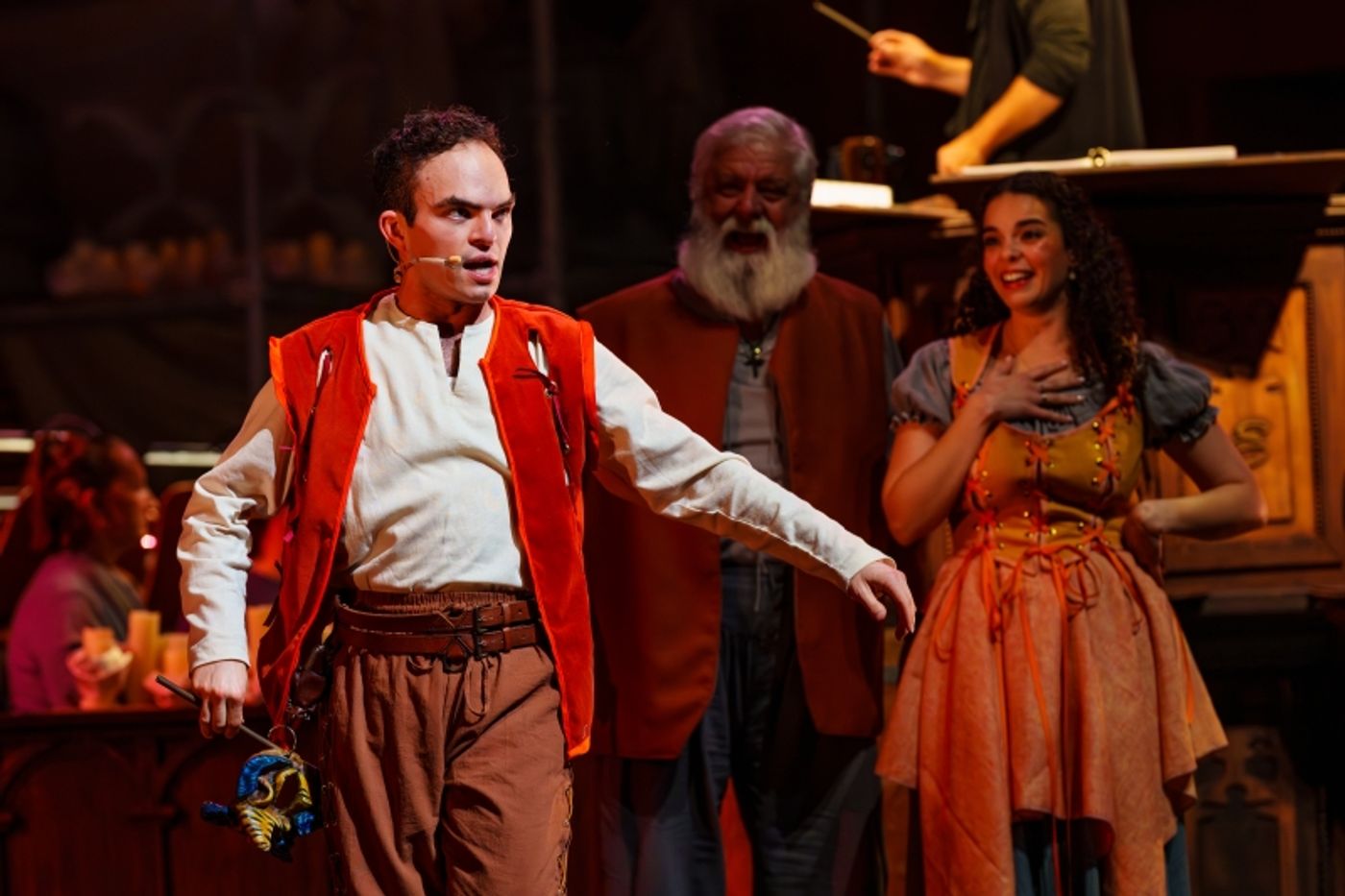
Heading up The Hunchback of Notre Dame are co-directors Ty Menard and Megan Stefanowicz, veterans of Encore that I’d seen in past productions. After two memorable turns as Leaf Coneybear in Encore’s 2018 and 2019 productions of 25th Annual Putnam County Spelling Bee, Menard has primarily contributed to backstage work and set design, making this a first-time director contribution for the company. Stefanowicz, likewise, wowed audiences five years ago as Sally Bowles in Encore’s production of Cabaret, continuing to work with Encore in the years since. Their first collaboration here with The Hunchback of Notre Dame comes with several creative influences not seen in the official stage musical.
Firstly, they frame the story rather ingeniously with the cathedral’s 2019 fire and reconstruction. In a pre-covid world, the fire to the cathedral shocked the world, inspiring hundreds of millions in donations to the 900-year-old structure. Thematically within the greater legacy of Notre-Dame de Paris, this creative choice by Menard and Stefanowicz also speaks to the resilience of the past. Within the immediacy of the 2019 fire and this 2025 production, we are pulled back through space and time to this particular version of this particular tale all without leaving the comfort of Dr. Phillips Center’s Steinmetz Hall. And the story comes to life not because of the building we are in, but because of the people within that cathedral. There is a timelessness to the eternal question at the heart of The Hunchback of Notre Dame: “What makes a monster and what makes a man?” that the audience is forced to address. It’s not completely black and white as the Disney film suggests – particularly painting Claude Frollo in a more sympathetic light than his animated counterpart.
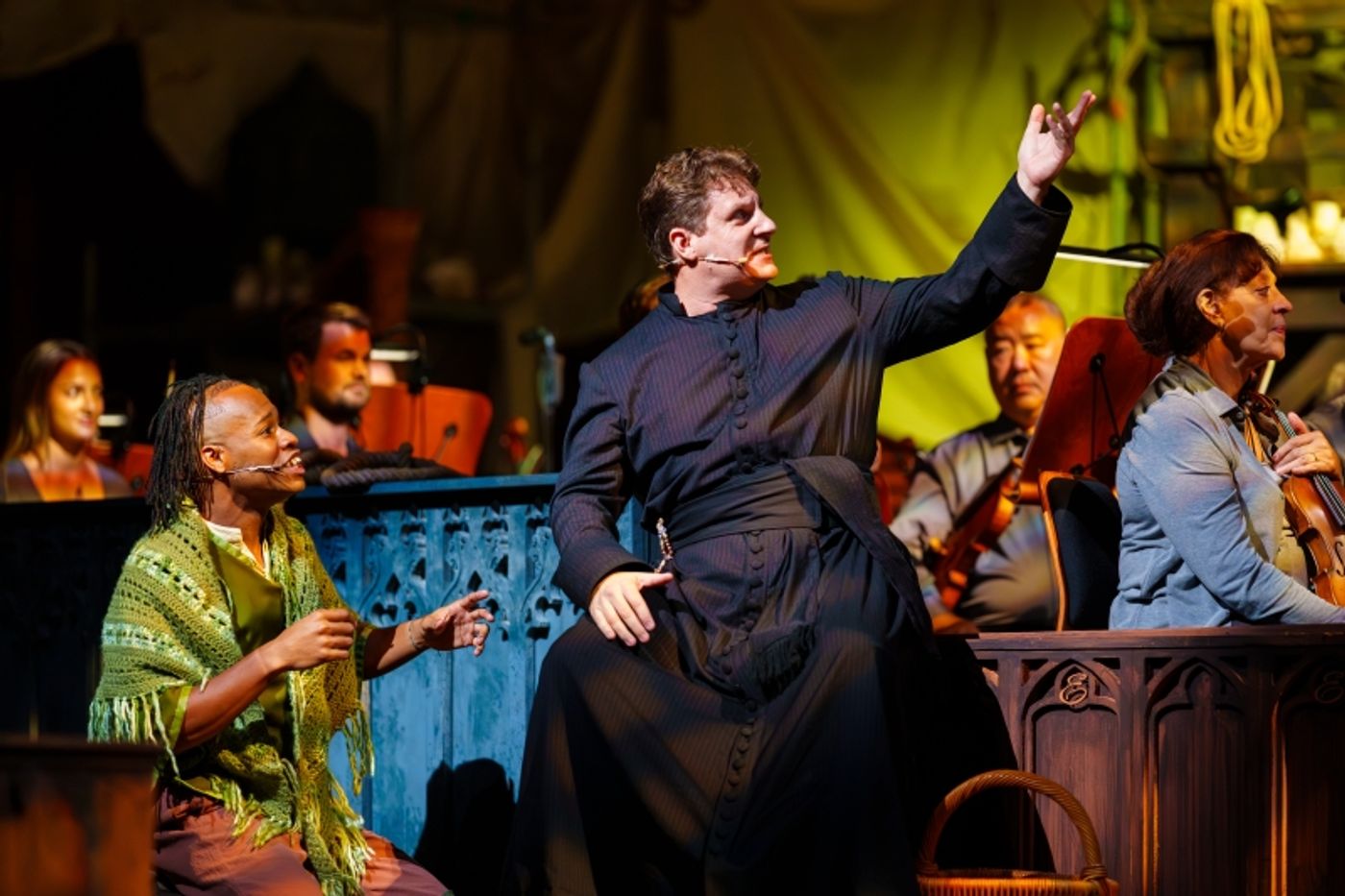
That’s not to say Frollo is no longer the villain of the piece. He still functions as the primary antagonist to those around him, but Arthur Rowan’s performance draws out a much more psychologically layered figure. Frollo’s villainy is not rooted in malice, but in a distorted sense of righteousness. His piety is understandable, but never admirable. His “compassion” is never freely given; it is always transactional, always bound in control. The most striking example of this is his relationship with Quasimodo. He cares for his nephew not out of warmth or love, but through holy obligation. He raises the boy not out of affection, but instead with a sense of divine duty, a burden he both resents and relies upon to sustain his image of himself as merciful. It is compassion forced into shape by religion. Rowan portrays Frollo as a tragic figure who continually gives other characters a moral performance rather than any sincere connection.
That same warped sense of mercy extends to Frollo’s obsession with Esmeralda. In Rowan’s hands, Frollo doesn’t see his lust as weakness; he recasts it as concern, convincing himself that to save her from her “sin” is an act of benevolence. His inner torment is not so much about love as it is about control cloaked in grace. Rowan plays this conflict with tremendous restraint, conveying the full weight of Catholic guilt, the slow corrosion of self-denial, and the way self-righteousness can weaponize compassion. This Frollo doesn’t twirl his metaphorical mustache; instead, he prays, pleads, and punishes in equal measure, always under the illusion of virtue. Rowan’s portrayal helps to form the dynamic tale of this production’s emotional thesis: how different approaches to compassion can still ultimately heal.
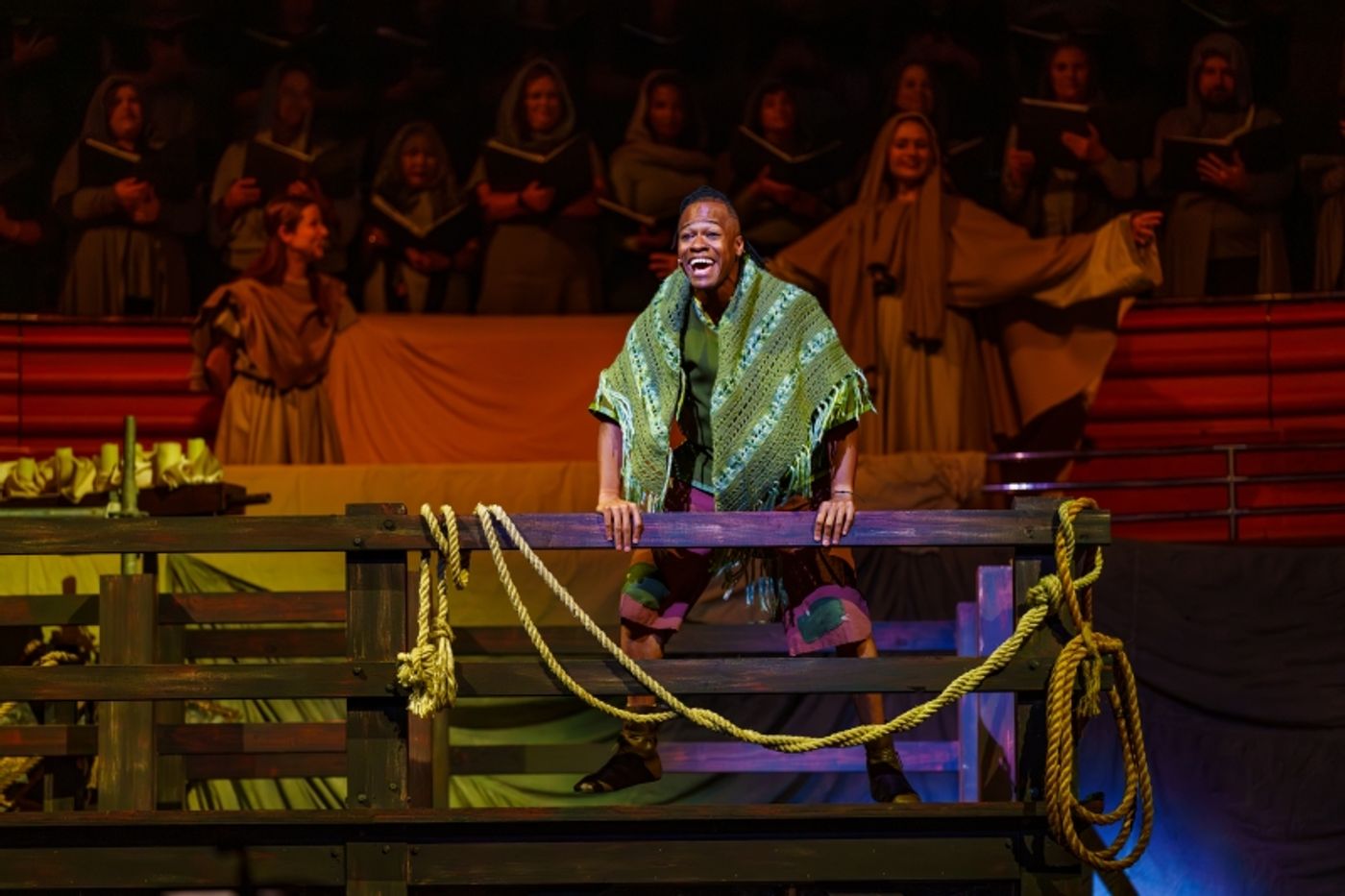
Chiefly among them is Quasimodo himself, as played masterfully by Encore newcomer Dante Payne. Payne plays Quasimodo with a gripping dynamism that transcends mere physical mimicry. Rather than relying on overt prosthetics or exaggerated costuming (a tasteful mask and an easily-movable sac serves as his disfigured face and hunchback), Payne’s performance draws from a theatrical tradition akin to The Elephant Man. Deformity becomes a performative choice rather than a visual reality as Payne only adopts Quasimodo’s hunched physicality and ugly face not as caricature, but as commentary. The mask and hunch are donned only when Quasimodo is made to believe he is monstrous, typically at the prompting of Frollo. It becomes a reflection of how society imposes its definition of ugliness and disability. In doing so, Payne folds his own ableism into the role with intentionality, making Quasimodo’s “hideousness” less about inherent traits and more about perception, shame, and the burden of being looked at.
Beyond the libretto’s emotional cues and eloquent lines, Payne also infuses Quasimodo with a striking depth that serves as part of this production’s treatise on compassion. It lingers and is prominent in every gesture. Whether it’s the tentative, reverent way he approaches Esmeralda or the conflicted devotion in scenes with Frollo, Payne layers the interaction with quiet longing and empathy. His choices in movement speak volumes: a hesitant touch here, a protective stance there, all convey Quasimodo’s emotional intelligence and instinctive kindness. There is a subtlety to the way his eyes follow a character, be it on the upper balcony as he stares at a loving couple below, or even the soft, hopeful curl of a smile. Gestures that translate wherever an audience member sits, because Payne makes sure to turn moments of silence into some of the most affecting in the show. Through Payne’s performance, Quasimodo is never pitied, but always felt, and always seen.
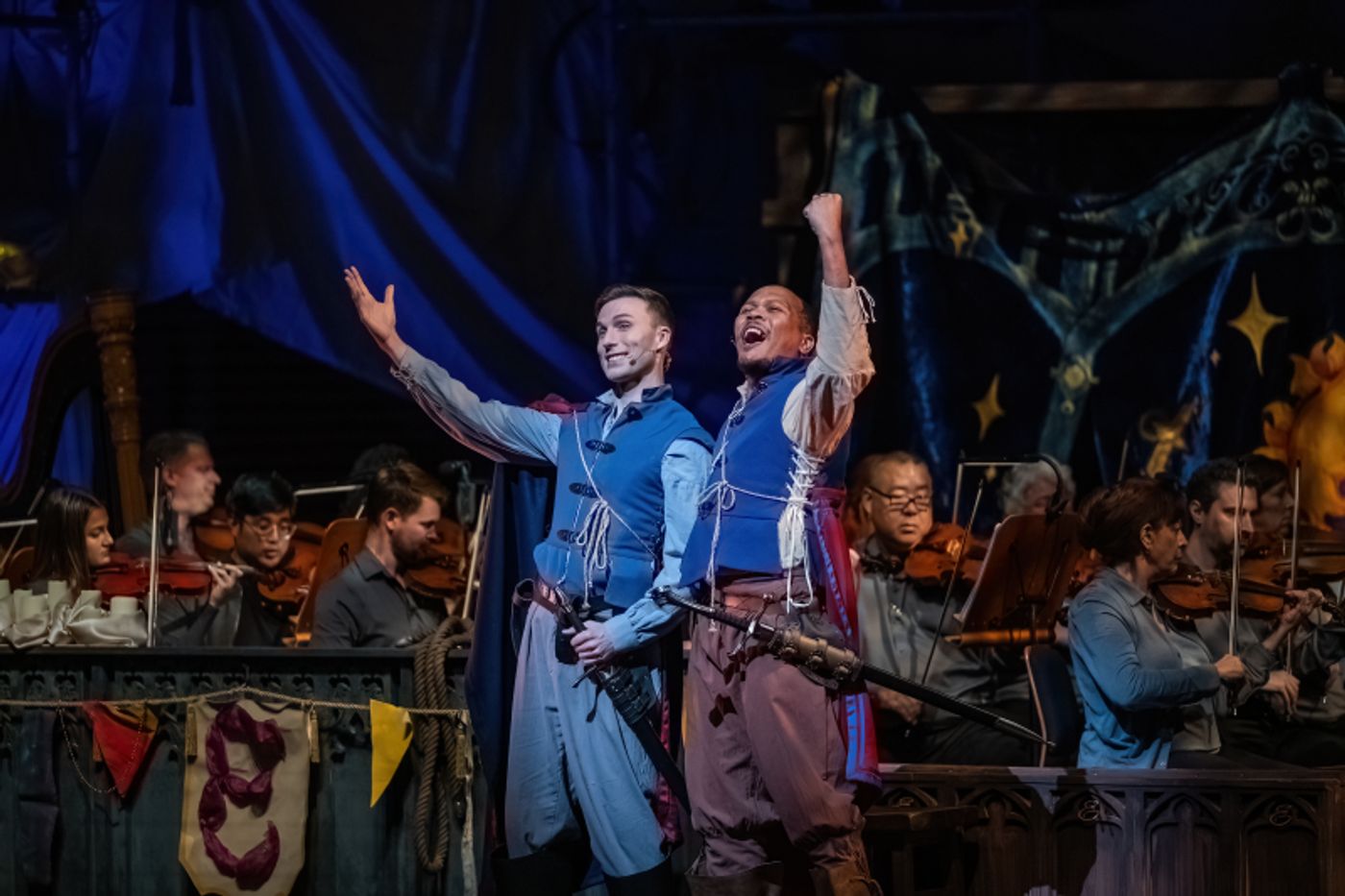
Justyn Brown (understudy on Encore’s final dress rehearsal, with Woodrow Jackson Helms performing for the weekend’s production) brings a compelling nuance to Phoebus, framing the character’s compassion not only as a virtue but as a byproduct of privilege. Unlike Quasimodo, whose love is pure and asks for nothing, or Frollo, whose twisted sense of duty masks control and repression, Phoebus offers a third perspective: conditional compassion. Brown plays him as a man who genuinely wants to do good, but whose ability to act morally is cushioned by his position. His social privilege lets him choose when to care. Thus, Phoebus’s compassion is sincere, but self-serving at times, allowing him to feel like a hero without always having to bear the cost. Brown leans into this with a performance that is idealistic but never naïve. His approach to Phoebus is charming, flawed, and achingly human. Through him, the show’s threefold view of love and mercy comes into focus: Frollo’s forced compassion born of guilt, Quasimodo’s unconditional compassion born of pain, and Phoebus’ chosen compassion born of comfort.
This layered reading comes through most clearly in the moment Phoebus refuses Frollo’s order to burn down a known Romani haven, Madame’s house of ill-repute, despite having previously turned a blind eye to his fellow soldier, Captain Frederic (Patrick Plucinsky), enjoying its more illicit pleasures the night before. Brown doesn’t let the audience forget that this is a man who’s benefited from the same institutions he’s now questioning. That tension between complicity and conscience makes his moral stand more complex and less convenient. His refusal to torch the building isn’t framed as a sudden act of bravery, but as a reckoning. It is only because Phoebus has seen compassion embodied in both Quasimodo and Esmeralda that he’s inspired to reevaluate his own values. His journey, then, is not from cruelty to kindness, but from passive detachment to active care. And it’s an arc that comes with a newfound understanding of privilege: doing the right thing is easy when you’ve never had to suffer for it. Brown’s performance reminds us that Phoebus’ goodness is real, but it is also a luxury. His pained look as he douses the flame brings with it the recognition of the truth that makes him more than just the pretty soldier with a conscience.
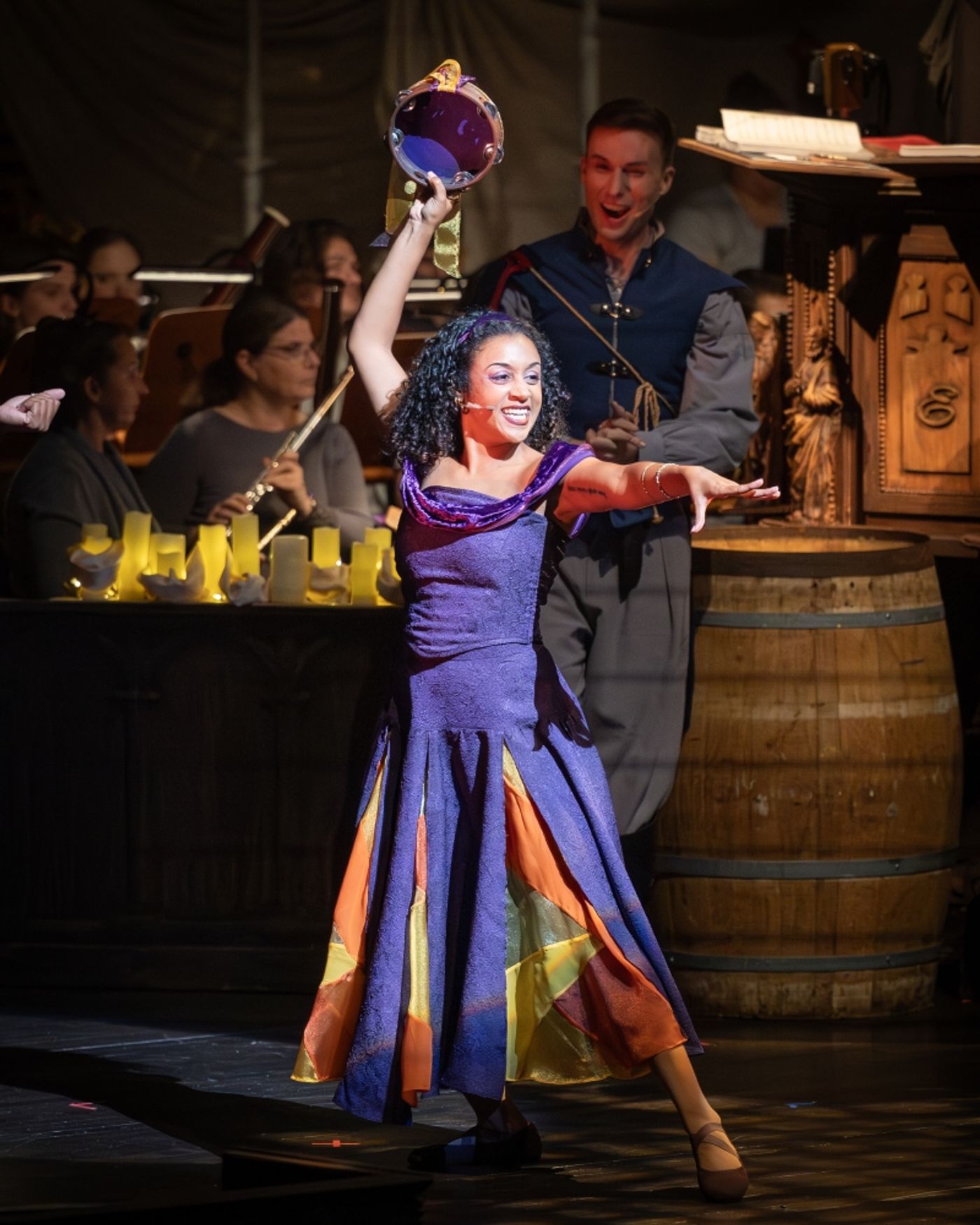
At the heart of the three men’s compassion is Alexis DeLaRosa’s portrayal of Esmeralda. She moves throughout this world as both muse and mirror: beloved by all, but truly seen by none. Each man who claims to love her sees in her a different version of salvation: Frollo, a temptation to be conquered; Phoebus, a cause to feel noble about; Quasimodo, a beacon of purity. DeLaRosa plays her with a knowing restraint, allowing Esmeralda’s warmth to glow around each man while never fully offering herself to any of them. She reads Frollo’s desire for what it is: not piety, but possession. She senses Phoebus’s chivalry as real, yet flecked with vanity. But perhaps most tragically, she never sees Quasimodo’s soul with the same clarity that he sees hers. In a production defined by the language of compassion, Esmeralda remains the one figure whose wants are seldom asked. Like Helen of Troy, she is a catalyst, a projection. Men will long, fight, and idolize her, but never truly understand her.
DeLaRosa captures this complexity with aching precision through her chemistry with all three leads: Arthur Rowan’s brooding Frollo, Dante Payne’s tender Quasimodo, and Justyn Brown’s conflicted Phoebus. With Rowan, there’s tension that simmers beneath every gaze. With Brown, there’s flirtation tinged with doubt. But most especially with Payne, there’s kindness that never quite crosses into love. In each dynamic, DeLaRosa adjusts her energy subtly. She keeps herself guarded within the role, never giving her heart to any character, though cleverly making at least one of them believe they have it. Her Esmeralda is not naïve or coy; she simply knows that the world often sees her as a symbol rather than a person. And in a show that asks what compassion really means, she becomes the ultimate question: can love still be love if it never truly listens? Her performance doesn’t offer an easy answer. Instead, it invites the audience to ask the question for themselves.
That is perhaps the greatest strength of Encore’s approach to The Hunchback of Notre Dame. It asks, in today’s political climate, if even compassion is enough. What good is empathy if it’s given to only certain causes, certain people? How can we still be morally good without excluding those who need compassion the most? Neither the narrative nor the production settle for sentimentality and easy redemption. Instead, it confronts the audience with a hard truth: that compassion, when filtered through bias, fear, or self-interest, can still cause harm. It forces us to reexamine what we consider kindness. Whether it’s Frollo’s twisted sense of moral salvation, Phoebus’s conditional idealism, or even Esmeralda’s inability to fully see Quasimodo. Encore’s staging invites us to reckon with the limits of our own empathy, and challenges us to ask whether we are brave enough to love the unlovable, listen to the unheard, and believe in the worth of those we overlook. And hopefully, it’s a lesson we all learn.
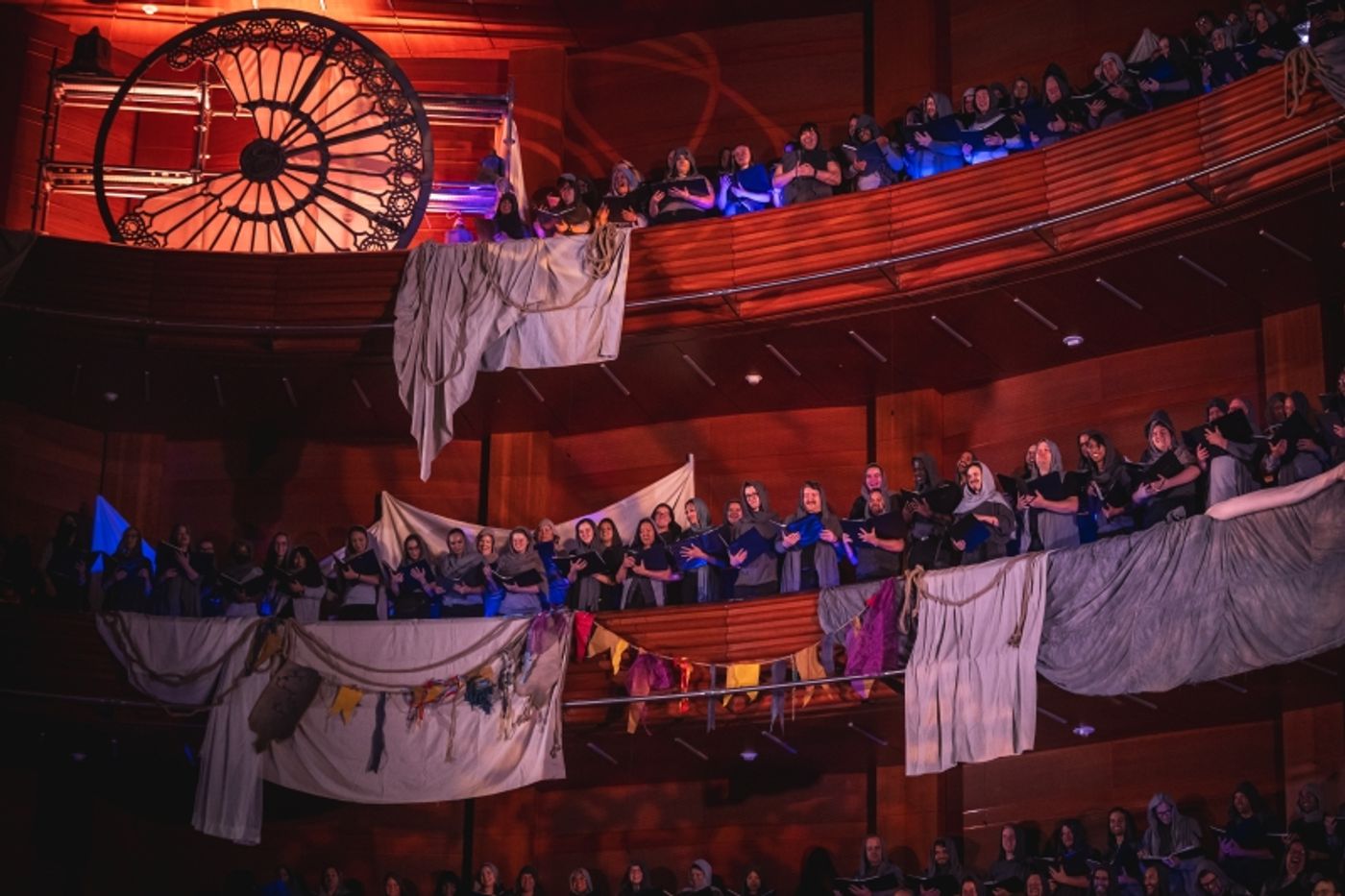
Cliff Price’s set design for Encore’s production makes remarkable use of suggestive architecture to evoke the spirit of Notre Dame Cathedral without attempting a literal reconstruction. Given the limitations of Steinmetz Hall, the design embraces minimalism as an emotional tool rather than a constraint. Trace elements such as the silhouette of gothic archways, cathedral stone textures, and the subtle suggestion of vaulting all gesture toward the grandeur of the real cathedral while allowing the space to transform fluidly between interior and exterior worlds. Chief among these is a single, stunning circular window at the highest level of the hall, resting gently at the top left of the cast choir. Though it stands in for the iconic rose windows of Notre Dame, it carries the symbolic weight of all three. Its broken, stained-glass glow becomes a visual anchor throughout the production, refracting light and casting color onto the characters as if to say that not only is an audience watching this story, but the history and legacy of the real Notre Dame is a viewer to this tale as well.
On the opposite side of the singular circular window, three archways serve as both structural and metaphorical devices, subtly embodying the show’s three representations of compassion: Frollo’s coercive “care,” Quasimodo’s selfless love, and Phoebus’s privileged idealism. I noticed that characters occasionally perform on a level that, at least in my reading, was assigned to those levels of compassion. At the highest level, of course, was Quasimodo. He sings “Heaven’s Light” from that vantage point, looking wistfully down at a romantic couple who – perhaps in an intentional casting metaphor – are played by the same actors who portrayed Quasimodo’s late parents Jehan and Florika.
As impressive as Price’s set design is on The Hunchback of Notre Dame, I was truly floored by lighting design by Vinnie Cross. It elevates this production from impressive to transcendent. Beyond simply illuminating the action, the lighting plan also helps to delineate emotional spaces. Different gradients serve to shift tone, memory, and power dynamics through the interplay of color and intensity. And it is in the shadows where the production becomes most poignant. These shadows do not signal absence, but rather presence just beyond reach. A shadow is cast only when light touches someone or something else. We, the audience sees the echo of that action. In this way, the show reminds us that compassion, too, can cast a shadow: the mark it leaves behind, the trace of a hand extended or withheld. The haunting beauty of these moments feels entirely in keeping with a story that has echoed for 190 years and continues to resonate still.

Particularly, the lighting scheme subtly reflects the moral topography of its characters, painting their emotional truths in color. Quasimodo is often bathed in softer hues, creating a visual shorthand for his earnestness and fundamental goodness, unmarred by the cruelty around him. In contrast, the Romani community and Phoebus are lit in more complex palettes. During the Festival of Fools and the Tavern Scenes, the lighting is erratic and intentional in who’s lit, as if reflecting the world’s moral ambiguity and Phoebus’s growing internal conflict. Frollo’s moments arrive in sharp contrast. The expected splashes of harsh red convey the expected rage and repression, but we also have a disturbingly pure white during “Hellfire,” a paradox that underscores the twisted righteousness of his lust disguised as salvation.
And it’s within the Act One finale that the lighting makes its most startling political gesture. The stage blooms into the unmistakable blue, white, and red of the French flag: a surge of national pride that feels both exhilarating and wistfully distant. In Victor Hugo’s world, that tricolor evokes revolution, belonging, and a hope worth fighting for. It makes everyone feel a little bit more French than they would American. In today’s political climate, this moment now reads as a memory of something we’ve lost: a bittersweet reminder of how it once felt to be truly proud of our country, and the aching hope that someday, when we are wiser, we will be again.

Of course, even with all the technical aspects of this production and the stunning performances of the leads, The Hunchback of Notre Dame simply would not work without the full ensemble on stage. We have a fifty-piece orchestra arranged on stage as if they were in church pews. Three levels of a Cast Choir help elevate every song with heavenly-choir vibes. And the ensemble players who interact with the main cast (Keondra Bowen, Solmarie Cruz Martinez, Danny Enriquez, Michael J. Glanzmann, Joel Lopez, Mark Gray Miller, and Joey Nelan) turn every Parisian citizen – be it soldiers or revelers or Romani – into distinct characters with personality. In a notable Menard/Stefanowicz addition to this production, two Gargoyle characters (Rachel Stanley, Gabriella Vultaggio) slink around on stage as a dark, evil influence over characters. They have no lines, they never directly address a character. But their presence often signifies that a character will be influenced by their malevolent force. They are, in essence, a Hamilton Bullet personified through the stone demons of the cathedral.
Encore’s The Hunchback of Notre Dame is more than just a musical. I’ve often championed how they select their projects based on the needs of the community as well as its inherent Disney connection (inescapable no matter where you live in Central Florida). While this production definitely has its own connection to Disney Theatrical Group’s The Hunchback of Notre Dame, it’s also serving as a timely parable, deeply rooted in the moral urgency of the present. In a world that today often feels fractured by fear, judgment, and indifference, this production dares to ask what true compassion looks like, and how it survives in the face of dogma and desire. Through its layered portrayals of Frollo, Quasimodo, and Phoebus, each embodying a different facet of compassion, the story feels not like a historical drama, but a mirror. It reflects the choices we make when confronted with injustice, and whether our empathy is reflexive or performative. The production doesn't offer easy answers, but it insists on the value of the question.
That message is magnified by Encore’s extraordinary use of Steinmetz Hall, in what may be their most effective use of the space to date. The natural acoustics of the hall lend reverence to the choral textures that surround the audience, with a live orchestra that breathes life into Alan Menken’s score in a way that feels sacred. The intimacy of the theatre space also draws us closer to these characters, closer to their inner contradictions and longings. From Dante Payne’s soulful, aching portrayal of Quasimodo to Alexis DeLaRosa’s grounded, watchful Esmeralda, every performance radiates a raw immediacy heightened by staging that uses space, shadow, and suggestion over spectacle. Steinmetz becomes a cathedral in its own right. Not by the architecture, not by the acoustics, but by the emotional connection it makes with the audience.
Ultimately, Encore’s two-night production is not just a revival of a beloved stage musical, it’s a revival of mindset. The Hunchback of Notre Dame asks its audience to lean back into the notion that compassion, in all its flawed and fractured forms, is still worth pursuing. It understands that stories like this endure not because of their fantasy, but because of their truth. With a cast that sees the humanity in every note, and a creative team that trusts the audience to feel the weight of what is unsaid, Encore has mounted a production that sings with purpose. It transports us into a story worth retelling and a world we may yet be able to rebuild, just like Notre Dame Cathedral, if we listen closely enough.
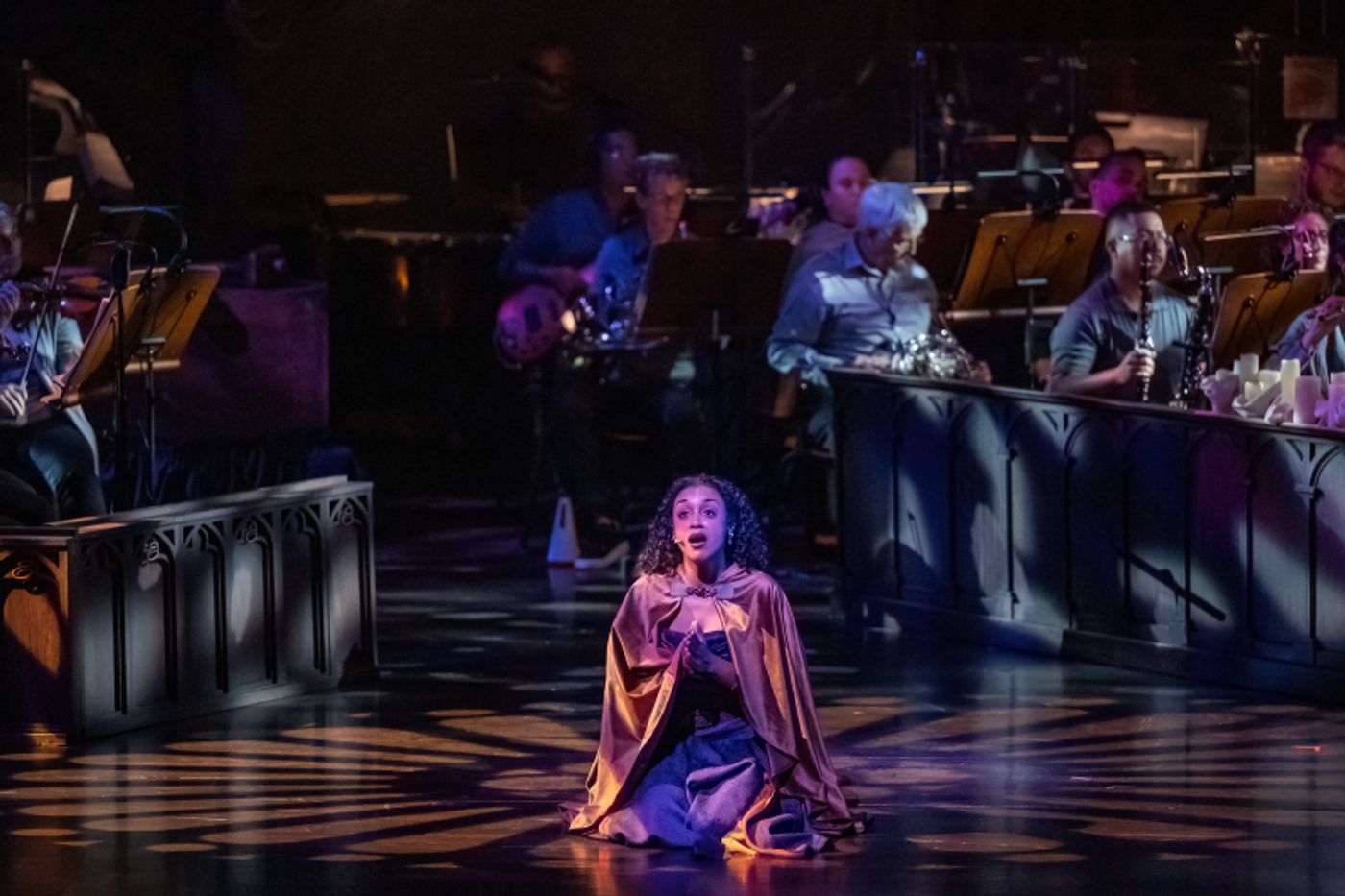
THE HUNCHBACK OF NOTRE DAME plays exclusively this weekend, July 25 and 26, at Dr. Phillips Center’s Steinmetz Hall. Tickets can be acquired online or at the box office, pending availability. Photography provided by Tiffany Bagwell, Bagwell Photography; Matthew Hiemenz, Black Hat Photography; Michael Huang Cukini Studio, and Howard Clifton. Used with permission.



|
Deer Tick Revolution Live (11/11-11/11) |

|
Songs for a New World Dr. Phillips Center for the Performing Arts (8/28-8/30) |
|
The Adams Family Musical Athens Theatre (9/18-10/11) |
|
Hadestown (Non-Equity) King Center for Performing Arts (4/20-4/21) |
|
Gothic Attitude Gothic Attitude (4/16-1/16) |

|
Disney's Finding Nemo Athens Theatre (1/22-2/27) |

|
Zayn at Kia Center Kia Center (11/09-11/09) |
|
Evil Dead: The Musical Dr. Phillips Center for the Performing Arts (10/02-10/04) |
|
Wicked Dr. Phillips Center for the Performing Arts (1/06-1/31) |

|
Ride The Cyclone Theatre South Playhouse (4/17-8/30) |
Reader Reviews
To post a comment, you must register and login.