


Review: SOWETO GOSPEL CHOIR'S PEACE TOUR at Southern Theatre
Music breaks the language barrier
Growing up, one of my best friends was first generation American after his parents migrated from Taiwan. I could always tell when my friend was in trouble because his mom would start talking to him in Chinese. Then in mid-sentence, she would ask me with a wink, “Isn’t that right, Paul?” in English as if I had understood everything she said.
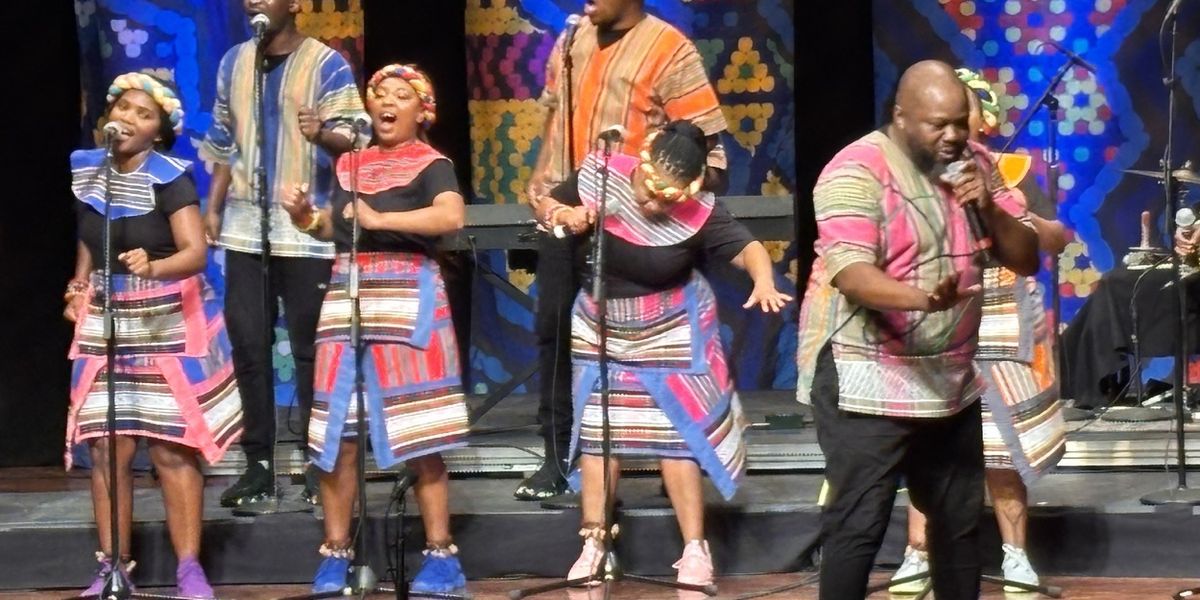
That experience didn’t prepare me enough for the Soweto Gospel Choir’s performance Oct. 29 at the Southern Theatre (21. E. Main Street in downtown Columbus). Through the first seven songs of their concert, the 20-member choir danced and created some of the most beautiful melodies I’ve ever heard at the Southern Theatre.
The lone drawback: these symphonic hymns were performed in six of the 12 official languages spoken in Soweto.
In the end, the choir’s music prevailed over any language barrier. The cavalcade of different voices kept the mostly full theatre dancing, raising their arms in agreement, and being moved by the power of things they couldn’t understand.
Choir Master and choreographer Shimmy Jiyane wasn’t surprised by the effect of his choir.
“Many of us on stage have suffered injustice and oppression,” said Jiyane, who packs a powerful tenor voice. “Ladies and gentlemen, you might not understand the words but you will understand the feeling. Later on in the show, we will be singing some well-known classics … and we’ll be singing them in English.”
Since 2001, the Soweto Gospel has built a strong fan base by following that simple formula. The three-time Grammy winners have performed for a host of dignitaries including former presidents (Bill Clinton and Barack Obama), at least one king (King Charles), world leaders (Nelson Mandela and Bishop Desmond Tutu), and other dignitaries (Oprah Winfrey). They have performed with superstars from across the musical spectrum, including Beyonce, Chance the Rapper, Jimmy Cliff, Celine Deion, Aretha Franklin, Peter Gabriel, Queen, Queen Latifa, Robert Plant, the Red Hot Chili Peppers, U2, and Stevie Wonder to name a few.
The Soweto Gospel Choir’s tour is simply titled “PEACE” and yet it opened with Choir Manager Mary Mulovhedzi leading a ground-shaking version of “Nkonyane Kandaba” (which translates to "spears will be shaken"). The number speaks of the defiance of a people who will not be silenced and who will not be stopped. Its lyrics translate to “when you touch us, you are touching those who won't die easily."
By the time they hit the Freedom Medley, a song about the power of Nelson Mandela, most of the audience was off its feet with fists punching the air.
However, not all the songs were about revolution. For example, “Mbai, Mbai” or "Umbayimbayi" roughly translates to “my beautiful or graceful one” and was a love song. Its chorus states, “you are the one I love” and later adds “I will be with you.”
In your average choir, there usually is one strong singer who stands out above the rest. Exceptional choirs have two or three robust vocalists.
The Soweto Choir has 20.
Every singer had his or her chance in the spotlight and overwhelmed the audience. If the voices of the choir is its lungs, the heartbeat of the choir is drummer Sipho Ngcamu, who kept a steady beat all night.
If the audience was caught up in the contagious energy of the Soweto Gospel Choir when they didn’t understand what they were singing, imagine what happened when the choir played the songs theatre goers were familiar with.
The choir offered a diverse cross section of songs in English, ranging from hymns (“Pass Me Not, Gentle Savior”), soul/pop (an arm hair raising version of Sam Cooke’s powerful “A Change Is Going To Come”), a Broadway musical/soccer anthem (“You’ll Never Walk Alone” from the musical CAROUSEL that became the anthem for the Liverpool Football Club), and R&B (The Staple Singers’ “I’ll Take You There”).
As the final notes of “You’ll Never Walk Alone” faded, Jiyane then toyed with the audience. He announced “Ladies and Gentlemen, we have reached the end of the show” invoking a round of booing from the onlookers.
Jiyane then turned to the choir and asked them, “What do you think? Can we do a couple more?” Various choir members held up fingers, ranging from one to eight before Mulovhedzi shook her head. “The big boss says two,” Jiyane said with a laugh.
The show closer was an odd and yet obvious choice, Leonard Cohen’s “Hallelujah.” The song that was initially rejected by Cohen’s label became a sensation after a John Cale’s cover appeared on the SHREK soundtrack. By 2008, over 300 covers of the song had been recorded.
None of those covers captured the sheer power, hope, and joy of the Soweto Gospel Choir’s show closer.
In an interview with BroadwayWorld, Mulovhedzi said, “We're singing, of course, in our language but when you come to watch our show, you’ll understand everything that goes on. Our movements also tell our stories. It has meaning for people, even though they don't know our language.”
When words fail, music speaks.
Photo Credit: Paul Batterson
|
The Dinner Detective Murder Mystery Dinner Show The Dinner Detective Columbus (8/22-8/22) |
|
Beetlejuice Ohio Theatre (4/16-4/18) |
|
The Lightning Thief - The Percy Jackson Musical Abbey Theater of Dublin (8/07-8/16) |
|
La Cage Aux Folles Hilliard Civic and Cultural Arts Center (11/06-11/15) |

|
Screamers: A Nightmare-Fueled Sketch Comedy and Music Experience Shadowbox Live (9/20-11/14) |
|
Dirty Talk Shadowbox Lice (4/12-8/15) |
|
Liverpool Legends "The Complete Beatles Experience!" Marathon Center for The Performing Arts (8/15-8/15) |
|
MTP Presents: Sister Act John, James and Clara Knight Stage (7/31-8/16) |
|
Wicked Ohio Theatre (7/28-8/15) |
|
Caamp Value City Arena at The Schottenstein Center (8/29-8/29) |
Reader Reviews
To post a comment, you must register and login.