


Review: SOME LIKE IT HOT at Ohio Theatre
Musical is as good as or in some parts better than the original film
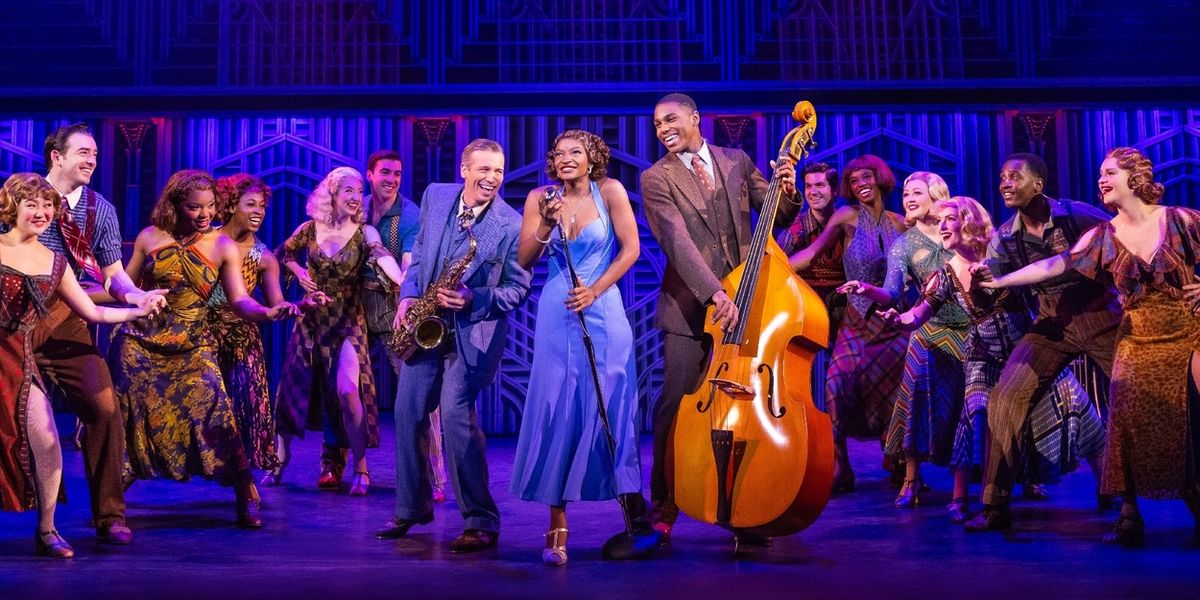
At first glance, SOME LIKE IT HOT might seem to fall into the “If it’s not broken, don’t try to fix it” category of entertainment. The traveling musical production runs Nov. 18-23 at the Ohio Theatre (39 E. State Street in downtown Columbus).
The show is an updated version of the 1959 movie, starring Tony Curtis, Jack Lemmon, and Marilyn Monroe. In 1989, the comedy was among the first 25 movies preserved by the Library of Congress for their cultural, aesthetic, and historical significance.
How could Marc Shaiman (lyrics and music), Scott Wittman (lyrics), Matthew Lopez (book) and Amber Ruffin (book) surpass that by making it into a musical? Or better yet, why would they try? The four didn’t rewrite SOME LIKE IT HOT … they reinvented it, elevating the motion picture into something a little more socially significant. When it first came out in 2022, the musical was nominated for 13 Tony Awards, winning four.
The tadaptation captures the over-the-top zaniness of the original film and stirs in breathtaking dancing and a tight jazzy score that might stick with its audiences for years to come. The premise is simple: Jazz artists Joe (Matt Loehr) and Jerry (Tavis Kordell) witness a gangland style slaying at a mafia-controlled hotel and decide to hide out from the mob by masquerading as women in a traveling all-female jazz band.
The friendship between the two is a study in opposites. Joe is a womanizer, a risk taker, short, and white; Jerry is quiet, cautious, tall, and black. When Joe suggests they disguise themselves, Jerry shoots down each idea in ascending disbelief:
Jerry: "You gotta be under twenty-five."
Joe: "We could pass for that."
Jerry: "You gotta be blonde."
Joe: "We could dye our hair."
Jerry: "And you gotta be girls."
Joe: "We could..."
Jerry: "No, we couldn't!"
As the two hide in the jazz band, both change names, genders, and personalities. Jerry becomes the boisterous, outgoing Daphne when he slips into drag. Joe’s qualities become more conservative and hesitant as he assumes his Josephine alter ego and later pretends to be Austrian screenwriter Kip von der Plotz.
Joe’s love interest is Sugar Kane (Lendra Ellis-Gaston), the passionate lead singer of the band. Kane develops a robust camaraderie with Josephine and confides to her what exactly she is looking for in a man. Joe then becomes a man playing a woman who pretends to be a man as he becomes Kane’s dream date.
The musical also puts an emphasis on racial balance and social commentary. Sugar is no longer the ditzy blonde Monroe played; Ellis-Gaston’s Sugar is a smart, seasoned performer on the brink of stardom. She acknowledges the racial injustices she survived growing up in the South—something a 1959 film never would have approached. In “At the Old Majestic Nickel Matinee,” she recalls sitting in a segregated theater watching movies that excluded people who looked like her:
“We could never sit with those who sat below us… Besides, I wasn’t thinking of ’em. I would rather be above ’em.”
While Candy Kane might be aptly named, Sweet Sue (DeQuina Moore) is far more salty and freewheeling as she dodges the Prohibition G Men trying to shut down the liquor-serving speakeasies she finds herself in. Moore is a raw throated belter delivering rousing and raucous numbers like “What Are You Thirsty For?” and “Let’s Be Bad.”
Another character that emerges from the movie’s stereotype is Osgood (a hilarious turn by Edward Juvier). In the movie version, Joe E. Brown’s Osgood Fielding III is a clueless millionaire who shakes his head as Lemmon rolls off reason after reason why Osgood shouldn’t get involved with Daphne: “I am not a natural blonde. I can’t have children. I have a troubled past.” Finally, Lemmon rips off his wig and shouts, “I’m a man!” Osgood shrugs it off with a nonchalant “Well, nobody’s perfect.” Late in the musical version, Juvier’s Osgood acknowledges he’s always known Daphne and Josephine are men, but he loves Daphne for whoever the bass player identifies as being.
While most of the show focuses on those five characters, SOME LIKE IT HOT offers strong smaller roles as well including bad guys Spats (Devon Goffman) and his henchmen and heroines Nellie (played by Devon Hadsell’s understudy Kelly Sheehan, on Nov. 18) and the rest of Sweet Sue’s band. The ensemble makes choreographer Casey Nicholaw’s high energy, mesmerizing visions come to life. The Keystone Cops-like dance sequence “Tip Tap Trouble” adds little to the story, but it still dazzles.
The show would have floundered without the tight jazzy score by Shaiman and Wittman with energetic romps like “What Are You Thirsty For” and “Dance The World Away” and Sugar Kane’s tender ballads, “Ride Out The Storm” and “Darker Shade of Blue.” Conductor/keyboardist Matt Binns does a masterful job of combining the touring musicians (keyboardist Nicholas Michael Johnson, trumpeter Rob Quallich, and drummer Chris Karabelas) with local musicians (trumpeter Matt Anklan, trombonists Ryan Hamilton and Jeremy Smith, reed players Tom Regouski, Pete Mills, Shawn Wallace, and Nancy Gamso, and bassist George Delancey).
SOME LIKE IT HOT succeeded where few have. It is a musical that is as good as or in some parts better than the original film. Let’s just hope Broadway can do just as good of a job with BACK TO THE FUTURE, which comes to Columbus Jan. 6-11.

|
The Dinner Detective Murder Mystery Dinner Show The Dinner Detective Columbus (9/12-9/12) |

|
Sombr Nationwide Arena (11/08-11/08) |

|
Caamp Value City Arena at The Schottenstein Center (8/29-8/29) |
|
The Fab Four: The Ultimate Tribute LIVE in Concert in Columbus, OH Hollywood Casino Columbus (8/21-8/21) |
|
The Lightning Thief - The Percy Jackson Musical Abbey Theater of Dublin (8/07-8/16) |

|
La Cage Aux Folles Hilliard Civic and Cultural Arts Center (11/06-11/15) |

|
Liverpool Legends "The Complete Beatles Experience!" Marathon Center for The Performing Arts (8/15-8/15) |

|
Dirty Talk Shadowbox Lice (4/12-8/15) |
|
Wicked Ohio Theatre (7/28-8/15) |

|
MTP Presents: Sister Act John, James and Clara Knight Stage (7/31-8/16) |
Reader Reviews
To post a comment, you must register and login.