


Review: THE BOOK OF WILL Fills the Bill at Elmwood Playhouse
An Ingenious Paean to the Bard, to Theater and to Storytelling
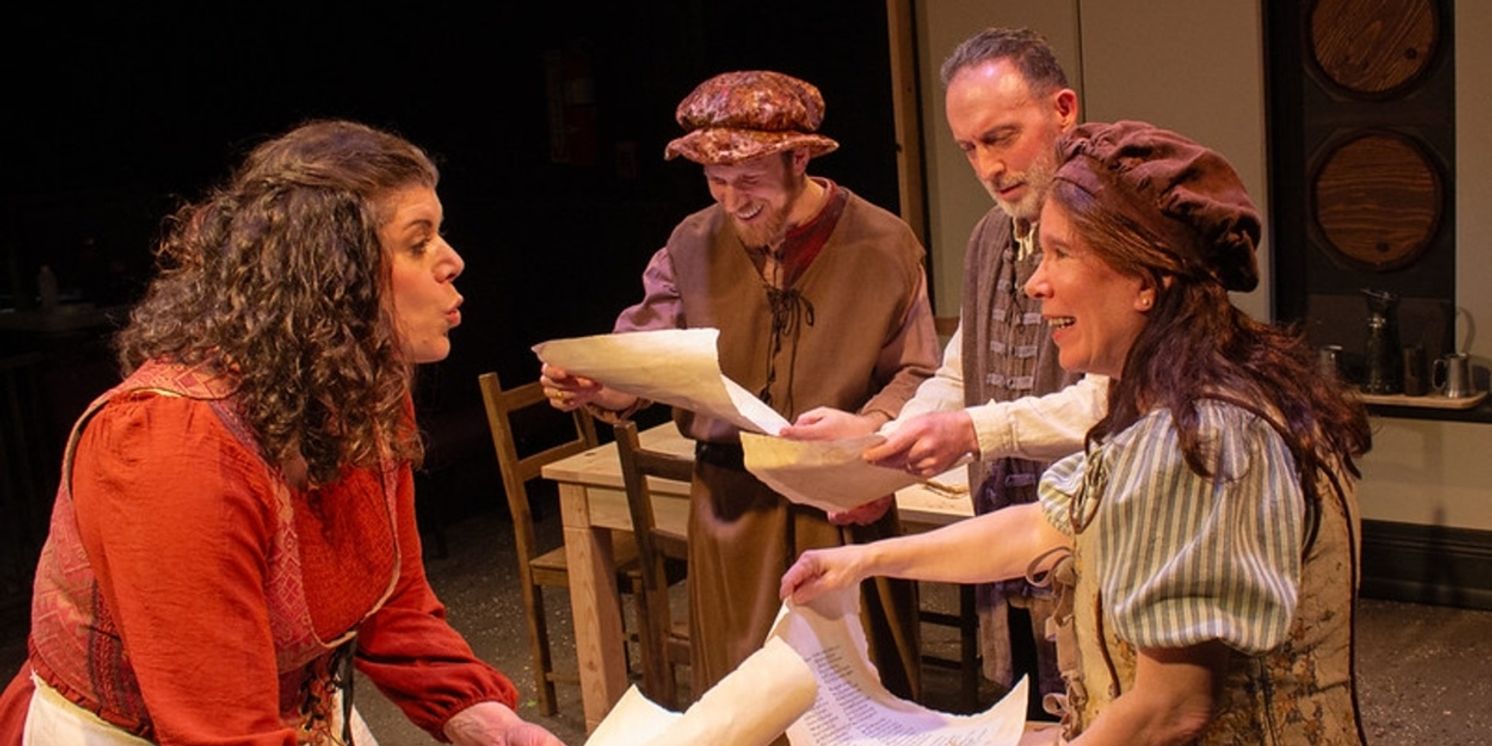
Imagine if fully half of William Shakespeare’s protean output of nearly 40 stage plays did not survive until today but went to the grave with him. We’re talking plays like Macbeth and Richard II and As You Like It. Imagine if, in 1619, three years after his death, two of the Bard’s staunchest thespians set about to avert that unthinkable void from robbing the world of what it has feasted on for 400 years.
Playwright Lauren Gunderson did not have to imagine that turn of events to write The Book of Will because the greatest rescue operation in the annals of English literature is a matter of fact, not fiction. Still, it takes no small sweep of imagination to flesh out the story’s granularity of relationships and vivid vignettes that inform and entertain in equal measure.
Ms. Gunderson’s ingenious play, directed by Lisa Spielman with her usual standard of excellence, is on stage through April 13 at Elmwood Playhouse (Nyack, N.Y.) The Book of Will is a marvelous creation, a paean not only to the Bard of Avon but a celebration of the magical potion, the curative powers, of live theater and, yea, of storytelling itself.
The characters in The Book of Will are as true to history as they are compelling in their stage personas, starting with Henry Condell and John Heminges. They are two of the anointed “King’s Men,” actors who specialize in – and worship – the Shakespeare of it all. Heminges also manages the troupe’s business affairs and, with wife Rebecca, runs The Globe Theater Tap House in Stratford-Upon-Avon. Think of him as chairman of the boards. Actor Michael Fleischer turns in solid work as the pragmatic Heiminges. He poignantly delivers a heart-rending soliloquy mourning a tragic loss.
In pointed contrast to the sober-minded Heminges is his boon buddy on stage and off, Henry Condell, joyfully played with infectious brio by Adam Bloom, who is in perpetual motion, driving the narrative forward. It takes Condell’s unbridled optimism to convince the skeptical Heminges that they can pull off the protean feat of compiling the master’s works into a single volume, which comes to be known as The First Folio.
The impetus for their daunting dream to create an authorized and accurate document is the extent to which Shakespeare’s works are being bowdlerized by bad actors (literally and figuratively). There also lurk in their midst unscrupulous fraudsters, such as William Jaggard, who cynically slap the Bard’s hallowed brand name on inferior works that the real McCoy did not author. Actor Ralph Bowers makes a convincingly jagged Jaggard. Crotchety and blind, he doesn’t let such inconveniences as ethical behavior get in the way of profiteering, though he ends up on the right side of these angels. It also has occurred to The King's Men that, as their number dwindles with age, many of the plays endure not on parchment but as ephemera, only in their heads.
Despite a short time upon The Book of Will stage, actor Ted Odell makes the most of it as celebrated Elizabethan actor Richard Burbage. His bellowing declamations are Shakesperean-size and just plain fun to watch.
That also speaks to Ms. Spielman’s sharp eye and ear for the alchemy of casting. Here, she gets it spot on in just about every role. This is a company of actors where each inhabits their character comfortably and convincingly, and where their camaraderie is palpable.
A big part of Ms. Spielman’s casting coup, in larger-than-life role of poet Ben Jonson, is larger-than-life actor Andrew Greenway. In Elmwood’s 2024 production of The Play That Goes Wrong, I was struck by his soul-chilling gaze, which he doubles down on in The Book of Will. Here, Mr. Greenway uses his laser look to, by turns, unnerving and humorous effect.
That baleful stare is there when he intimidates the men and, in a covetous mode, when he flirts with John’s daughter Alice, in a fine performance by Alison Costello. The indelible Greenway orbital effect inspired me to jot down in my reviewer’s notepad the apt nickname “King Leer.”
In other noteworthy roles, Amanda Bloom and Meg Sewell provide strong, supportive presences as spouses Elizabeth Condell and Rebecca Heminges, respectively. As Shakespeare’s loyal and fastidious editor Ralph Crane, Charlie Scatamacchia smoothly balances humility with workmanlike pride and fierce protection of the master’s works.
Filling out the sterling cast are the eminently engaging Todd Brown as William Jaggard’s earnest son Isaac, Hedieh Fidanza as Shakespeare paramour Emilia Bassano Lanier, Polly Corman as Will’s wife Anne Hathaway Shakespeare, Sierra Liden as their daughter Susannah, and Damon Fischetti as Boy Hamlet.
Director Spielman makes the most of very compact staging, taking her cue from the play’s structure of vignettes, creating a cinematic effect with constant scene transitions. A handful of tables and chairs are efficiently moved between vignettes by the actors to signify a new location where the scene takes place. It worked extremely well. The action is always on the move. The very efficient and functional set design is by Rob Ward.
For this show, Elmwood’s shape-shifting theater seating is arranged to create performance space between two galleries of seats facing each other, approximating The Globe Theater’s horseshoe design. It puts patrons satisfyingly close to the actors and the stage dynamics.
Kudos to Costume Designer Claudia Stefany for the eye-filling period wardrobe, with doublets, breeches, stockings capes, medallions for men, and smocks and such for the ladies. There are nods to modernity with Ralph Crane’s backwards baseball cap worn by Mr. Scatamacchia, plus a Grateful Dead t-shirt and a funky pair of what looked to me like white patent leather loafers. Ms. Spielman said every actor wore something current in keeping with modern touches sprinkled in the script. Interstitial music followed suit, with Queen’s “Somebody to Love,” for example, played Elizabethan style.
Ms. Gunderson has employed a supple love of language to weave a colorful tapestry that celebrates the iconography of Shakespeare through a choice sampling of actual dialogue from the classics, crafty humor (witness a funny riff on the whereabouts of a play called “Love’s Labour’s Won” -- and what about “Two Gentlemen of Antwerp”), and a helping of emulated Shakespearean dialogue that crackles with quicksilver wit.
She exhibits a general erudition about that era’s culture and society that lends this whole enterprise an undeniable verisimilitude. For a play set close to half a millennium ago, it feels intoxicatingly fresh.
The Book of Will is produced by Wendy Portney and Claudia Stefany. Lighting design is by Deanna Koski, technical direction by Sarah Kohout.
Pictured (from left) Alison Costello as Alice Heminges, Adam Bloom as Henry Cordell, Michael Fleischer as John Heminges, Meg Sewell as Rebecca Heminges. Photo by Omar Kozarsky
Reader Reviews
Videos