


Review: Handel’s Unfamiliar but Fine HERCULES with The English Concert and Bicket, at Carnegie Hall
There’s even a happy ending for the audience and opera, too, with a score filled with gems
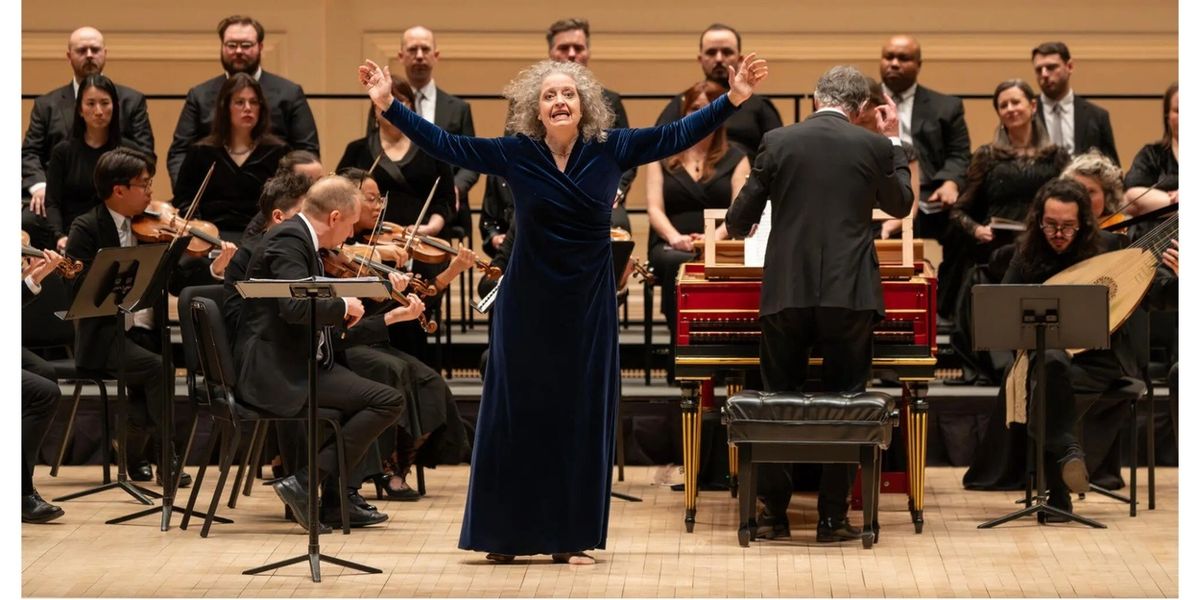
If you’re thinking of the muscle-bound hero of action films—or even Disney animation—boy, have you got the wrong HERCULES.
As soon as Harry Bicket and his early music ensemble, ‘The English Concert,’ played their first notes of the overture at Carnegie Hall the other afternoon, we knew we were definitely in Handel territory.
It was very elegantly, dramatically played by the small group, mostly strings (including theorbo) augmented by a couple of trumpets, oboes, percussion and harpsichord (conductor Bicket doubling on keyboard). There was embellishment galore, of course, reminding the audience what we miss at the Met when the music of this particular master isn’t in the repertoire.
There, we’re usually in the realm of Verdi, Wagner, Puccini and a few bel cantos, plus the contemporary composers that we’re beginning to hear. Not that there’s anything wrong with any of those. But there’s something about Handel that’s a special treat when done correctly, as these players, chorus and conductor decidedly do, and especially when it’s something we’re not likely to have heard before, as HERCULES certainly is.
The roles are as challenging as the Mount Olympus that all good Greeks aspire to, even when the characters are pretty standard: the mighty warrior, his fretful wife and faithful son, the mostly-sweet captured princess and the diligent messenger.
They run the gamut from the countertenor to bass-baritone, stopping off for a tenor, mezzo and soprano, mostly from singers unfamiliar to me but worthy performers. And let’s not forget the singers of the Clarion Choir, who made even the most challenging music sound easy.
The opera (or oratorio or musical drama or whatever you want to call it) may be titled HERCULES but the title character is an also-ran in the action of the piece; the music for William Guanbo Su seemed comparatively bland, even when he used his forceful voice suitably, but it livened up a bit by the time he got to his “rage aria” in the last act.
HERCULES could have been called DEJANIRA or IOLE or even HYLLUS (his wife, captive princess or son, respectively) because they all outshone him, role-wise, though none of those others has the name value of the current title. Whatever it’s called, so much of the music of this infrequently performed work was nothing short of wonderful.
Mezzo Ann Hallenberg, as the anxious wife, Dejanira, had a lovely, plaintive quality. That is, until she burst forth with a thrilling mad scene, thinking herself pursued by the Furies, her hair looking like she’d been electrified. She was also quite effective in the farcical confrontation with Hercules, who she suspected of mischief with his captive.
Soprano Hilary Cronin did some of the most rapturous singing in the performance as Iole (her “Why was I born a princess?” was very appealing), but could also stand up to the harpy-like Dejanira; she was also a good match for her husband to be. The music for tenor David Portillo as Hyllus—who was more familiar than the others—was some of the best in the score, showing great ardor and love, including the “happy ending” expected by audiences, in duet with Princess Iole, whom he gets to marry. (No “tragedy tonight” as Sophocles or Ovid might have demanded.)
Countertenor Alexander Chance as the messenger sang purely and with great enunciation, as was the general standard of the performance.
And, again, let’s not forget the chorus, because Handel’s hand was masterly in writing for them. “Jealousy! Internal pest” was in a word “marvelous.” As they intoned “Crown in festal pomp” the music sang of “Rapturous joy”—and that certainly was the case in their performance. (Two choristers, Jonathan Woody and Craig Phillips, had small, critical roles in the piece as well.)
The work is written in three acts but the intermission came halfway through Act II, which I found somewhat confusing, and unsettling, even if convenient. Oh well: a small complaint in an otherwise brilliant achievement on a fine afternoon.
Caption: Ann Hallenberg and Harry Bicket (back to audience)
Credit: Richard Termine
Prefer BroadwayWorld in Google Search?
Add us as a preferred source so our stories show up more often in Top Stories and Google’s AI answers — for you.
Sign up for all the news on the Fall season, discounts & more...

Reader Reviews
To post a comment, you must register and login.