


Review: ALL MY SONS Is Powerful As Ever at Elmwood Playhouse
Timeless Arthur Miller Classic Drama in Fine Staging Runs Through Oct. 4
Called “a landmark of 20th Century drama” by the New York Times in its 2005 obituary of playwright Arthur Miller, his masterwork Death of a Salesman arguably is even more vaunted than that rarefied description attests. It is an epochal cultural marker whose title rings familiar even to those with scant knowledge of classic plays. Likewise, its protagonist Willy Loman is recognized far beyond the proscenium as a universal everyman (or more tragically, a “low man,” as Miller would have it).
While Miller’s Salesman occupies a non-pareil perch in the pantheon of stage artistry, his All My Sons does not come so readily to mind for the casual theatergoer when considering the canon of the dramatist the Times’ obituary proclaimed “a giant of the American theater” (a status achieved at age 33).
Despite living in the shadow of Salesman, once it is experienced, All My Sons is unforgettable in its raw power and lyricism, fraught with an emotional fever not unlike that of Salesman. Both are laced with elegiac musings on the moral compromises that all too easily corrupt the so-called American dream.
The latest evidence of the gut-punch delivered by Miller is on stage now at Elmwood Playhouse in Nyack, N.Y., where All My Sons, beautifully directed by Elmwood president Derek Tarson, runs through Oct. 4.
The cast is anchored by the superb Michael Patrick Sullivan in a skillfully shaded and powerful performance as factory owner Joe Keller (whose surname, a la “low man,” sort of sounds like “killer.”)
Unlike chronic failure and embittered Willy Loman, this Miller creation is a successful, expansive factory owner brimming with bonhomie, an infectious glow Mr. Sullivan projects with disarming ease. Joe is so “on” all the time – whether playing “jail” with Bert, the boy next door, or mixing it up with son Chris – you’d almost think Joe is hiding something – and, boy, is he ever.
Where Salesman’s plot is fairly straightforward in its simplicity – after all, its outcome is staring right at us in the title – the layered narrative of All My Sons is akin to the proverbial onion that becomes more pungent as its skin is peeled away.
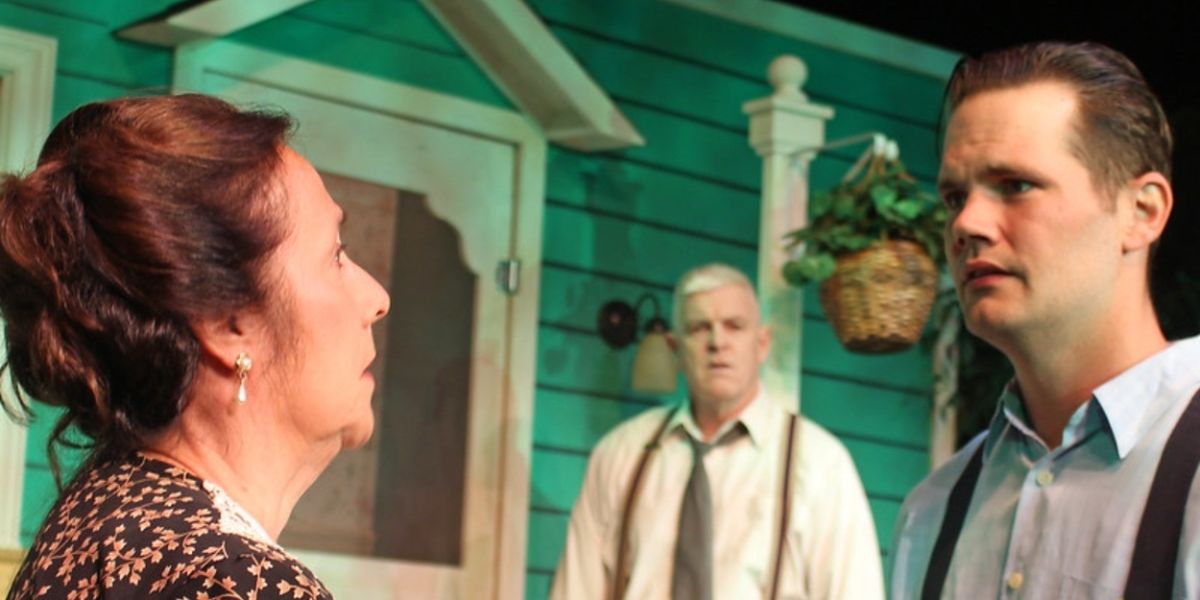
The entire play is set in the cozy suburban backyard of the Kellers’ heartland home in postwar 1940s. As ever at Elmwood, the set is picture perfect, designed by Eric Zoback. The A-frame house has bright, turquoise shingles, a white trellis and arbor, even a vintage rubber hose. It is appealingly homey, even if its denizens are less and less warm and fuzzy as the action proceeds.
Joe’s wife Kate is hanging by a thread on the notion that their son Larry, a fighter pilot who went missing in action during the war years prior, remains alive and eventually will find his way home. Kate clings to this desperate and improbable belief with a religious fanaticism that excellent actor Debbie Buchsbaum embodies with a conviction so complete and truthful it pierces your heart, even as your head concludes that this woman’s mental health is dangerously fragile.
Meanwhile, back in the backyard, younger son Chris Keller (Andrew Beadle) is courting his brother’s fiancee Ann Deever (Valentina Rodriguez), with both of the lovebirds resolutely refusing to share Kate’s addled illusions that Larry is coming back, and thus has first dibs on marrying Ann.
Mr. Beadle and Ms. Rodriguez are finely paired. Both must keep their footing solid while riding a roller-coaster of emotions, and they clearly are up to the formidable task. There’s a whirlwind of myriad relationships that swoop in and out – between Ann and Chris, between Chris and Joe, between Ann and Joe, between Ann and Kate, between Chris and Kate. That it flows as well as it does is a credit too to Mr. Tarson as director, who keeps a lot of plates spinning dramatically that combine to serve up a mounting tension for the audience to savor.
The layers of that onion start falling away fast and furious in Act II as Ann’s brother George Deever shows up. Ann and George’s father, Steve, had been Joe’s partner in a factory that manufactured cylinders for P-40 bombers during World War II. Steve was given a prison sentence for unconscionable actions that resulted in the deaths of 21 pilots. However, Joe escaped prison by lying at trial that he was home sick the day the cylinders were shipped, when in fact he authorized the shipment of the deadly cylinders. Joe has maintained the lie to this day, though he’s not fooling everybody.
While Chris and Steve’s own daughter Ann are convinced Steve got what he deserves, and have no use for him, Ann’s vengeful lawyer brother George (Sean Jordan) enters the picture with a different version of events that blows the lid off of the Keller family’s outwardly copacetic existence. Mr. Jordan’s dour countenance creates a stark counterpoint as soon as he comes into view, and he does a nice job of also showing a softer side, though that doesn’t last very long. He’s come to set the record straight, and will not be deterred.
While all that tense drama is unspooling, with the Kellers and Deevers teetering atop a powder keg of lies and recrimination, Miller contrasts that conflagration with the mundane lives of their next door neighbors, Dr. Jim Bayliss (Ryan McNeill) and wife Sue (Brielle Blood), and Lydia (Emily Gerges) and Frank Lubey (Paul Halley), plus son Bert (Demetrius Placido).
All the actors are solid in their critical supporting roles. Mr. McNeill, who always excels in his stage work, brings a dry resignation as an overworked, jaded spouse who escapes for some peace of mind to Joe’s backyard man cave. As Sue Bayliss, Ms. Blood makes a particularly strong impression locking horns in a fraught scene with Ms. Rodriguez’s Ann, where both give as good as they get.
Mr. Halley as astrology buff Frank Lubey and Ms. Gerges as wife Lydia are well cast, as is young Mr. Placido, presenting a happy, loving family with no drama, other than complaints of broken appliances.
For anyone who appreciates riveting theater robustly staged, All My Sons should be on your must-see list. Here’s something else to consider as to why we owe homage to this timeless work: As he embarked on writing All My Sons, young Arthur Miller still hadn’t tasted the success he sought in his career. He considered it his last-ditch effort to make a name for himself or he’d give up playwriting. The moral of the story is that were it not for the success in 1947 of the award-winning All My Sons, we might never have had, two years later, Death of a Salesman. Shudder the thought.
Other production credits: Assistant Director, Nick Nappo; Assistant to the Director, Jane Sebok; Technical Direction, Eric Zoback; Lighting Design, Mike Gnazzo; Costume Design, Janet Fenton; Stage Manager, Andrew Marcinak; Assistant Stage Manaer, Sarah Kohout; Producers, Carol Napier and Kandi Rosenbaum.
Prefer BroadwayWorld in Google Search?
|
Private Lives The Schoolhouse Theater (9/04-9/20) |

|
The Last Five Years Arc Stages (9/25-9/25) |
|
THE ANDERSON BROTHERS PLAY RICHARD RODGERS Jazz On Main (10/10-10/10) |

|
Songs Of the Valley Songs Of the Valley (9/24-9/24) |

|
It'll Be Fine Bethany Arts Community (9/25-9/27) PHOTOS |

|
Stan Ipcus & Friends Jazz On Main (10/16-10/16) |

|
Eugenie Jones Jazz On Main (10/24-10/24) |

|
Green Day’s American Idiot Theatre on Main Street, Inc. (11/13-11/15) |
|
Hey Rim Jeon & Friends Jazz On Main (10/17-10/17) |

|
Nick Chesnais Quartet Jazz On Main (9/10-9/10) |
Reader Reviews
To post a comment, you must register and login.