Interview: Greta Gertler Gold Unpacks the Mysteries of PICNIC AT HANGING ROCK
Gold talks stacked time, girlhood, and why you “can’t afford to miss this show” before it closes.
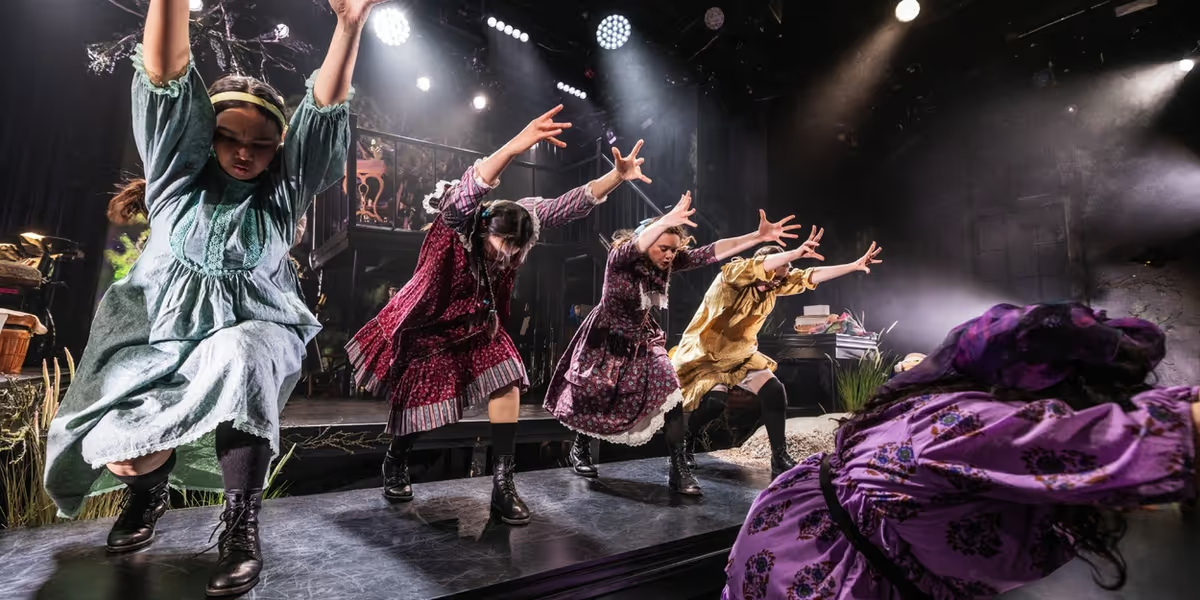
From the first moments of PICNIC AT HANGING ROCK: THE MUSICAL, Greta Gertler Gold’s score makes it clear that this is not a mystery you simply watch. It’s a mystery you enter. In the intimate Off-Broadway space at Greenwich House Theater, the music becomes a kind of weather system that circles, shifts, and pulls the audience along as Appleyard College gives way to the mysterious unknown of Hanging Rock (known as Ngannelong in Indigenous Australian tradition) in Victoria, Australia. Set in late summer 1900, the story’s disappearance at the rock is famously unresolved, and Gold brilliantly leans into that ambiguity with music that stretches rhythm and memory until they feel inseparable.
It’s impossible to discuss PICNIC AT HANGING ROCK without acknowledging the shadow of Peter Weir’s 1975 film, highly regarded as an iconic, singular work of Australian cinema. But Gold was determined not to treat the musical like a sonic echo of the film. “Everyone asked me if there were going to be panpipes in the score,” she remembers, and “very early on [I] decided that I didn’t want to use panpipes.” She admits they are “so powerful in the film,” but the musical came from a different root system. One that began with Joan Lindsay’s novel. “[Hilary Bell]’s been very devoted to adapting Joan Lindsay’s novel as the main source for this musical adaptation, not the film,” Gold says. “We’ve been very devoted the original source material.”
This intentional return to the novel wasn’t symbolic, it was physical. “We did a lot of research. We went to Joan Lindsay’s house outside Melbourne, and we went to Hanging Rock. We went to the library to look through Joan Lindsay’s archives, and we spoke to people that knew her,” Gold recalls. For her, that research wasn’t about building a museum replica of a beloved story. It was actually about reaching the dream-state Lindsay originally wrote from. “She dreamed the whole story,” Gold points out. “So it was very much from her subconscious.”
Gold knew the comparisons would come anyway. “I’m really conscious in this process because I knew I could never live up to the film,” she says. “It’s a masterpiece in itself, and this is a completely different form.”
That ‘different form’ becomes most apparent in the way Gold writes time in the score, and how she skillfully warps it, stacks it, and then lets it fracture into emotion. In the theater, the score can feel rigid at Appleyard College. It’s often tight, measured, and controlled, before loosening into something more circular and undulating as the girls near the rock. Gold traced that approach directly to the story’s relationship with time itself. “I was very conscious of the way Joan Lindsay and also Peter Weir played with time, and also the indigenous Australian approach to stacked time, which is very interesting to me and very musical,” she explains. “So I did want to have some freedom with time in terms of the songs.”
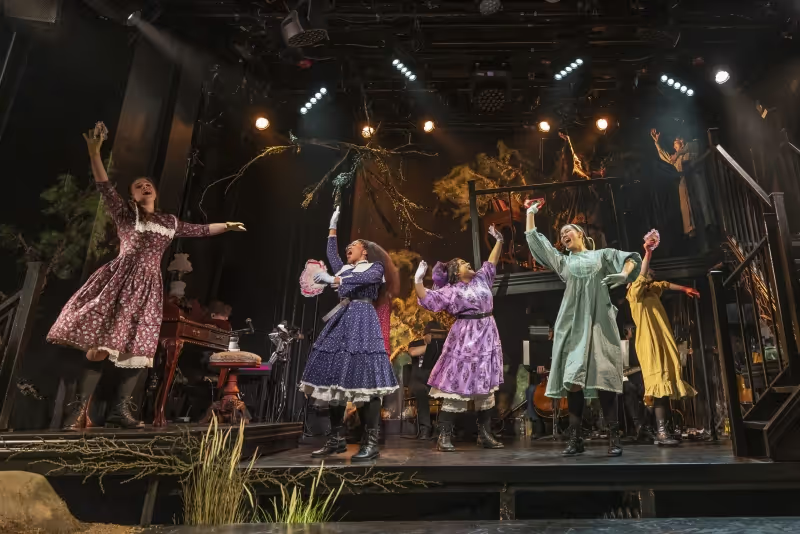
Photo by Matthew Murphy.
That freedom crystallizes in “Stopped Clock,” Irma’s ballad about forgetting. In the song she sings about losing the thread of what happened and realizes that the thread may never return. “In terms of the song ‘Stopped Clock,’ I wrote it in seven,” Gold says, adding that she “challenged myself” and chose to “follow my instincts with that.”
She also pushed that idea further in orchestration with her husband Adam Gold. His percussion background let them expand the score’s time-bending vocabulary. “He and I have worked together for many years, and he’s a drummer,” she notes. “And so we, in the orchestrations, could take it even further and layer in different time fields.”
For Gold, these rhythmic choices aren’t just compositional flexes. They’re character language that creates metaphors you can hear. “The metaphor of freedom for Miranda was something that I wanted to explore versus the constraint of Mrs. Appleyard,” she says. Then there’s Michael, whose music reflects certainty and then rupture. “With the character Michael, his path is very clear, but then he strays from the path,” Gold explains. “So there’s just so much juicy, fun stuff in the characters and the story that I felt that I had the chance to play with in the score.”
Gold’s affection for musical complexity extends beyond meter. She talked openly about the score as a living thing, and one that could keep evolving if the show’s future expands. “I’d love to put French Horn in it one day,” she adds, “and I do feel that there’s space for more instruments, eventually.”
As for what’s next currently, there’s interest abroad. “There is interest from a theater in Australia who wants to put on the Australian premiere,” she says. Though “there aren’t any specific plans as yet.”
If the score’s structure is stacked time, its emotional core is girlhood. How it aches, how it swells, and how it can feel like a ritual you barely survive. Gold didn’t treat that terrain like research. She treated it like home. “I feel like I’m still a teenage girl,” she says. “So that’s part of the joy, getting to really rediscover my own teenage feelings in this story.”
She described that teenage interior world as both empowering and brutal. “It’s all about teenagers and girls finding a new path into the future for themselves. And that’s very empowering,” she states. “But I also remember the heights of the highs and the lows of the lows of being a teenager, falling in love or feeling like you want to belong.”
In Gold’s case, music wasn’t just an artistic calling, it was survival. “I’ve held on to that phase of life in my work as a composer because music got me through it,” she says. “And I think that it’s like a circular thing. I’m putting it back into this show.”
She’s also watching that life stage approach again, but this time through motherhood. “Now that I’m a mother of two small children, I can see that they’ll grow into this phase pretty soon,” she says. “There’s just something really inspiring about that age.”
Her experience working with teens also shaped how she understands their power on the edge of adulthood. “I also taught songwriting to teenagers for a while,” she adds, and they “were so skilled, but they hadn’t yet been jaded by the world.” They were “so passionate,” and “they really loved music so much.”
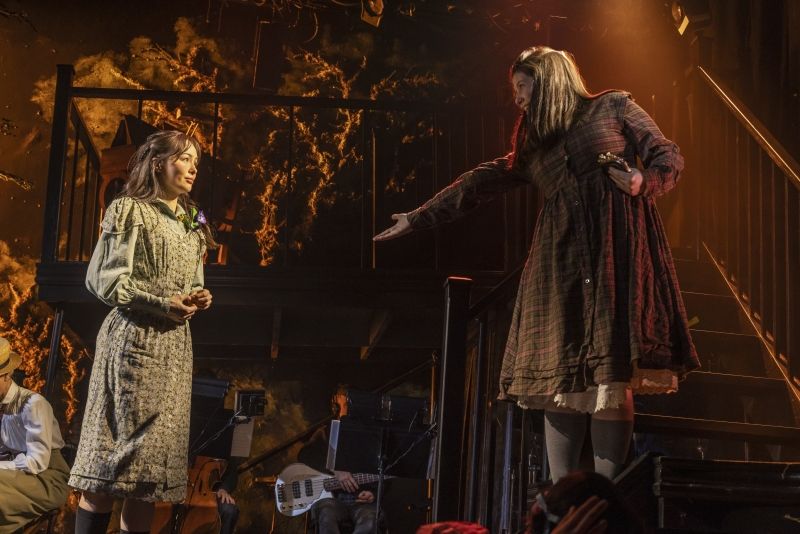
Photo by Matthew Murphy.
That lens sharpens PICNICs most intimate relationship, the one between Sara and Miranda, whose bond reads as devotion, desire, and aching dependence. Sometimes all at once. Gold speaks plainly about how her own experience made space for that yearning. “My having had a relationship with a woman was helpful in drawing on this experience,” she posits. “Identifying as bisexual and as a composer, I could feel liberated in just the sense of yearning that this girl, Sara, has for Miranda.”
She also widened the frame beyond sexuality into the social hierarchies of girlhood and the quiet forms of worship and envy that can look like love, and sometimes are. “There’s always this popular girl at school, and there’s always that feeling of a yearning to experience what it would be like to be that type of girl,” she says. “Any outpouring of love that’s potentially unrequited is something that I can easily tap into.”
Gold embraced a description she’d heard because it’s one that feels especially attuned to how the show lets the audience decide what they’re seeing. “Somebody described it as queer-lite,” she remembers. “I think that I like that because I like there being some ambiguity around it too, because maybe Sara’s not even aware of her feelings completely.”
In 2025, she noted, audiences bring their own lens to the story. “We, as the audience, can project our 2025 lens onto it and make it into that if we want to.”
But Sara’s yearning is also about survival. “She’s also an orphan and has no family,” Gold says, and Miranda becomes “the only person in the world that cares about her, which is really, really heartbreaking.”
Gold admits that Sara is her favorite character because “she weaves through the whole story” and “she’s also quite tough and strong.”
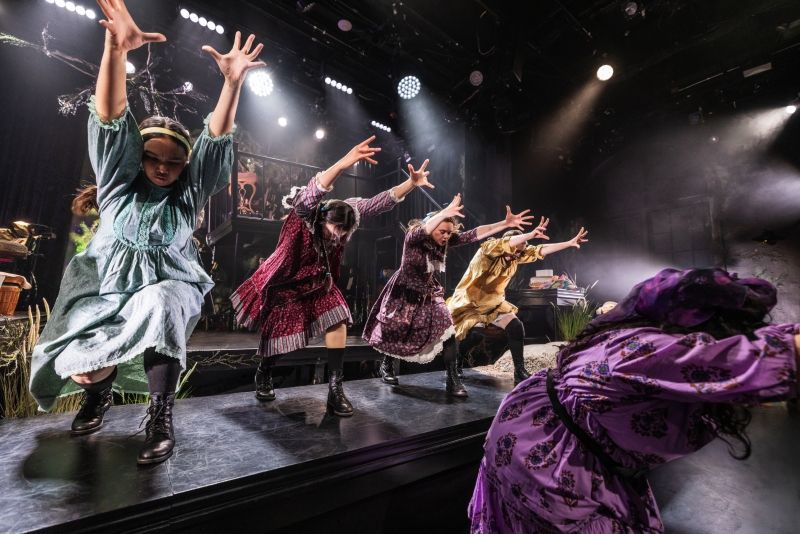
Photo by Matthew Murphy.
Sara’s musical arc also comes from conflict. She’s forced toward refinement under Mrs. Appleyard’s rigid authority, but learns to transform that pressure into her own voice. “When you see the character being forced to practice piano scales, there’s definitely this tension between her and Mrs. Appleyard,” Gold says. “Mrs. Appleyard is forcing her into this classical music model, and it’s very strict.” But Sarah “takes that and empowers herself to be able to write songs with that,” Gold adds. “I wanted to follow her through the finding of her own voice through music.”
For Gold, the sound world of PICNIC wasn’t built from a thesis statement about period authenticity versus modern language. It came from trusting her training, her instincts, and the way musical theater can hold contradictions. “I just followed my intuition,” she says, and “trusted all of the materials that I’d absorbed.”
At one point, while writing, she felt the weight of classical lineage arrive as something almost supernatural. “I felt like Schubert visited me,” she reveals.
She describes feeling “really grateful for this lineage of classical music” and how it fit a story that’s “a portal to the past that exists now.”
She also cited shows and artists who have widened what musical theater can sound like, particularly Dave Malloy. “I feel like there’s so much freedom in THE GREAT COMET,” she says.
That sense of stylistic freedom mattered because PICNIC’s story itself invites it. “The story is so mysterious and there’s so many versions of time that are explored in it,” she explains. This allows space for designers and performers to “play with [time] in all the different forms.”
As a composer, Gold was also clear-eyed about what it takes to bring new work into New York, especially without the usual out-of-town try-out process. “I just have never had the chance to have a production of a musical in New York,” she says, and she leaned into “a certain trust with all the other collaborators.”
“I’m also producing it myself. I just took the reins on that because someone had to do it,” she adds. “I’m really proud of getting it to this point.”
Gold also repeatedly returns to gratitude toward her collaborators, the cast, and the city that shaped her work. “I’m grateful to be able to see this show for the first time that I’m personally very proud of,” she says. “The actors are just astonishing.”
She recalls performers telling her the harmonies were difficult, but “they don’t make it seem difficult.”
She also credited early encouragement that helped her claim more authorship over the vocal architecture. “The former music supervisor, Amanda Morton, really encouraged me to do the vocal arrangements myself,” Gold points out. “I just didn’t have the confidence, but she gave me some confidence to try it.”
And if you leave the theater wanting to hear the score again and again, you’re not alone. Gold wants a cast recording, but she’s blunt about the economics. “At this stage, if somebody wants to invest $100,000, then yes,” the cast recording could happen, she explains. “I’d love to make a cast recording. I really just hope that there’ll be enough demand and interest to facilitate it.”
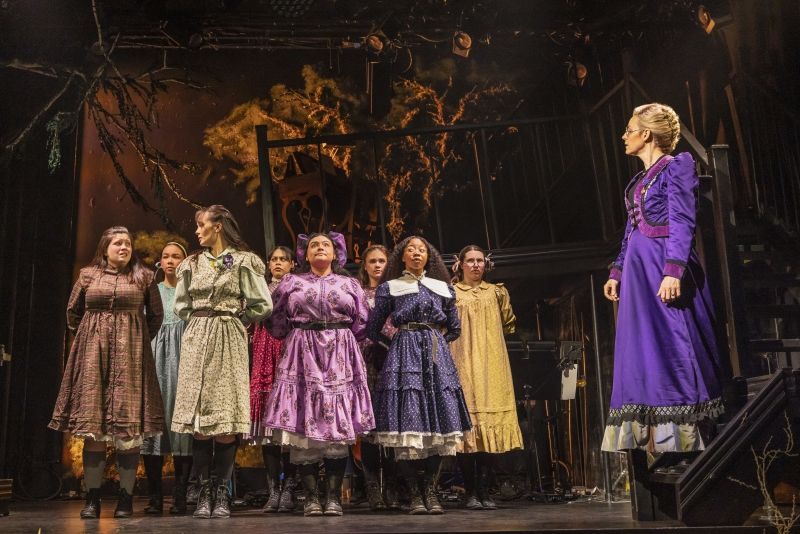
Photo by Matthew Murphy.
Until then, the music is something you have to catch while it’s alive and before the run ends on January 17, 2026. Gold’s pitch to audiences is direct, heartfelt, and ultimately rooted in what the story demands of us. “You can’t afford to miss this show,” she says. “It’s a very special show with an extremely incredible cast, band, and creative team.”
She also calls it “very uniquely Australian,” and “a really great break from America” that allows audiences a plunge into “another whole world and another whole time.”
But her most compelling argument isn’t about novelty. It’s about the shared discipline of sitting with what can’t be solved. “I hope that [PICNIC] provides a space to sit together in mystery,” she explains, because “the story is a mystery.”
In a world that demands clean answers, this show offers something much rarer. “Having a story that isn’t resolved is a good exercise for human beings to be able to deal with the reality of life, such as ambiguous loss,” she emphasizes. “We don’t find out why people go.”
In PICNIC AT HANGING ROCK: THE MUSICAL, Gold’s score doesn’t tidy up that truth. It sings it. It suspends it. It lets it hover over the audience like a beautiful, unsettling, and strangely cleansing mist.
As Gold put it, borrowing the show’s own language, “We’re here and we’re gone.” And, because this run is, too, “Get down there. Get down to Greenwich House Theater.”
PICNIC AT HANGING ROCK: THE MUSICAL must close on January 17, 2026.
Photo Credit: Matthew Murphy

|
Powered by

|

.jpg?format=auto&width=365)