Building 'The Stuff' That Dreams Are Made Of- How a Prop Shop Creates Broadway’s Most Magical Items
Bad Monkey Props has worked on such shows as Death Becomes Her, Moulin Rouge!, MJ, Stranger Things: The First Shadow, and more.
A week before their Tony performance, the candelabra that Amber Gray holds during the Rocky Horror set sat on a counter in Brooklyn for repair. You’ve seen the shimmering pink vial in the hands of Megan Hilty and plastered across Playbills and pole banners in the theater district, or maybe you’ve seen the light-up “Handbook For The Recently Deceased” on the Beetlejuice tour in Sarasota, Florida. Wherever they are now, those props were born in a small, unassuming workshop on the intersection of Meeker Ave. and Apollo Street.
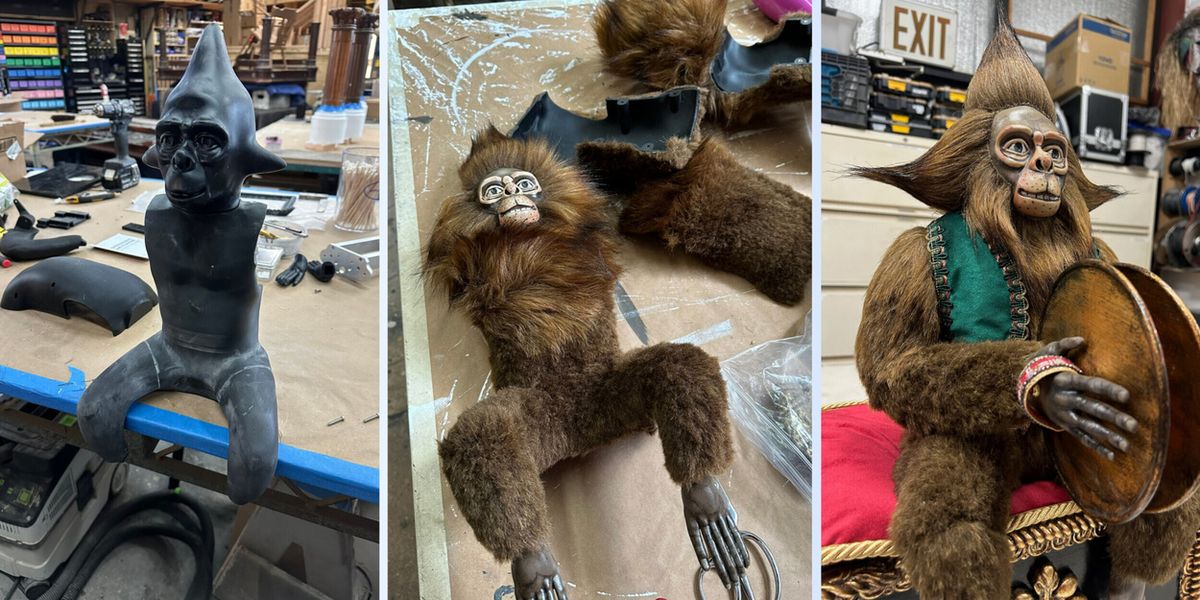
Bad Monkey Props is the brainchild of artisans Dan Brown and Austin Rodriguez, who met while working on the national tour of The Phantom of the Opera, with Rodriguez serving as head props and Brown as his assistant. “We would go above and beyond what normal road prop people would do,” says Rodriguez. “We basically remolded and cast all major parts of the chandelier and then spent two eight-hour calls re-gilding the entire thing. Like 5,000 sheets of gold leaf in eight hours.” In 2017, after a long stint on the road, the two decided to set up shop in New York, where they work with countless Broadway designers to bring their dreams to fruition. The namesake “Bad Monkey Props” refers to the music box monkey in Phantom, a prop that Rodriguez and Brown redesigned to maintain the original look while improving functionality.
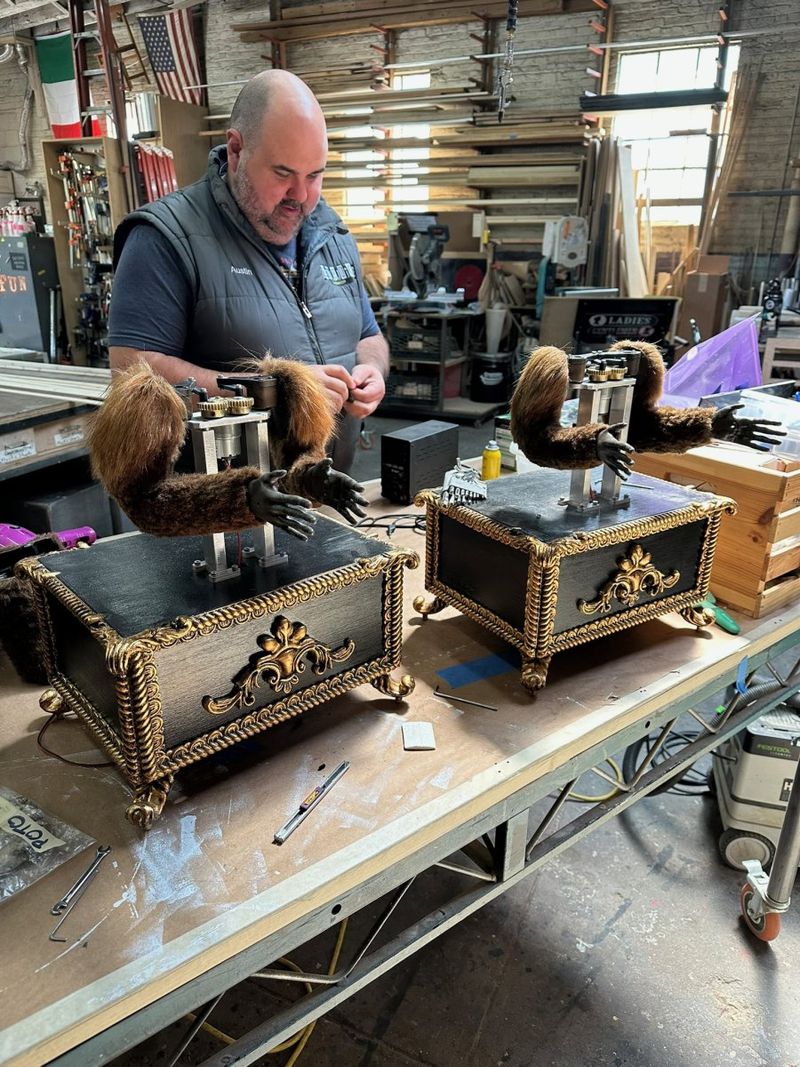
Audiences can likely conceive of how sets and costumes are made, or how lighting cues are programmed, but when it comes to a weird item, that’s where Bad Monkey Props shines. “A lot of people come to us for magic trick stuff, light-up stuff, things that have to have a high-quality finish,” explains Rodriguez. “We do a lot of custom LED stuff, wireless boards, stuff like that.”
“How often are you asked to build a sofa that is also a trampoline that also flies?” chimes in Brown. “I love that challenge of problem-solving, and so much of what we’re doing has never been done before. It’s a combination of elements that most people have never tried.”
The company itself is rather small for the ten to fifteen projects they could be working on during Broadway’s busy season. The core artists, besides Brown and Rodriguez, are project manager and designer Nellie Sanderson, lead fabricator Bridget Brooks, scenic artist and painter extraordinaire Lindsy Tortorice, and “prop dog” Korra, all of whom are in the shop on a typical workday (Korra is a real dog).
The process works like this: a production props supervisor comes to them with a dream, a budget, and a sketch, and they make it happen as efficiently as possible. Some projects could take three days, but some complicated pieces could take six months to a year. “Sometimes when shows are in previews or tech, and we’ll get a napkin sketch,” explains Rodriguez, “but sometimes it will be full-fledged, 3D drawings with sizes and reference photos, so that is where our job gets a little bit fun and tricky.”
.png?format=auto&width=800)
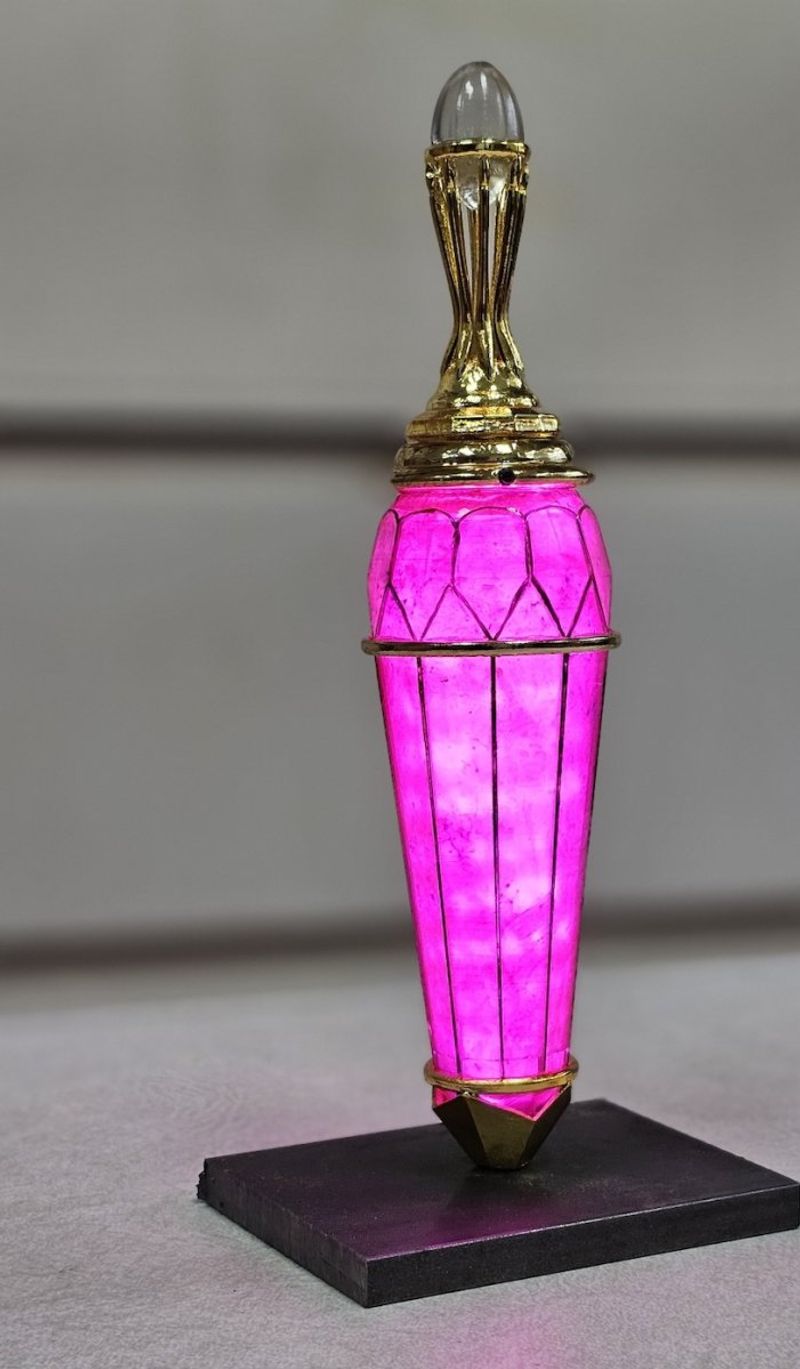
Let’s take something like the magical, youth-restoring elixir in Death Becomes Her. The team was tasked with building the box, the Fabergé egg, and the vial of elixir, which is, quite literally, the key art of the production. They begin by asking what the prop “needs” to do. In this case, it needs to light up; it must be lightweight so the actors can dance around with it onstage, yet large enough to be seen from the back of the house, as it serves as a pivotal plot point in the story. Phase one consists of them 3D-printing different versions of dummy props to take on stage and test their visual effects. Once they decided on a size, part two was figuring out how to pack the necessary technology inside the small vial so the end result would look the way they wanted. “Something that was really important to them was the movement of the light, and in order to get that kind of movement and variation, it requires programmed data,” says Brown. “We had to create that technology. We utilized a City Theatrical microchip and developed the PCB that’s inside of it. So we worked with a circuit board designer to create the tiniest switch and tiniest charge board that could fit in the vial, so it could be controlled wirelessly. It takes tens of thousands of dollars to get to that point before you’ve even started on the final piece.” Then, the next phase is to consider what the shell is made of. How durable is it? What are the paint finishes? How do we get it to look like real gold on stage? The vial itself is a combination of 3D printed steel, a custom electronics board and wireless receiver, a custom-sized battery, and custom LED tape. “When you see it on stage, you might think it’s just a piece of plastic,” says Rodriguez, “But no, it takes many people many hours and lots of dollars to make those things.”
 “After the first out of town, we learned that it was going to be dropped,” Brown continues. “That was a reality we had to grapple with, that this thing that was such a baby in our minds was going to be dropped and kicked across the stage.”
“Basically, our goal is to make every prop indestructible,” chimes Rodriguez. “But they will always find a way to break it.” Brown adds, “You have to plan for the worst case. It’s going to happen. Eight shows a week, however many years, whatever you imagine can happen to it, will happen to it. It will get dropped in the pit. It will hopefully narrowly miss a musician.”
Repairs and redesigns are another focus of their shop. (Spoilers) When I visited their facility, they were repairing a decaying cat corpse that gets dug out of the ground in Stranger Things: The First Shadow. Dan pulled out a bag of the cat’s silicone organs for me that spill out on stage. Their shop consists of a back office that houses an impressive 3D print studio, a space for smaller electrical work, and several computers for drafting. On his screen, Austin is working on drafting an air-powered mug launcher for the pub scene in Beauty and the Beast. The mugs have to be durable enough not to break if the actors miss a catch, and to test that, they quite literally throw them in the air and let them hit the concrete. “Korra, fetch!” shouts Dan as he chucks the prototype mug across the room (if a dog can’t break it, hopefully the actors won’t either!)
Outside the office, designer Lindsay paints a bunch of wooden stakes and crosses that will be used to kill the vampires in The Lost Boys. They have a CNC room to the right that can cut, carve, or shape wood, metal, and plastic. In the back, there is a metalworking area where lead fabricator Bridget is measuring out aluminum. Behind that area is an extremely organized rainbow wall of hardware and extra storage for materials, including a cotton candy machine that was meant to create faux dumplings for Bette Midler to stuff into her mouth in the 2017 Hello, Dolly! revival (they ended up not actually using real food in the production).
Above the CNC room is where many of the finished props are stored before they are sent out, and they are sectioned off by production. One of the coolest things they have is a Bible containing the exact paint swatches for every single item they create, so if Moulin Rouge needs another bottle of absinthe, they know exactly what shade of green to use.
(1).png?format=auto&width=800)
Over the past nine years, the team has accommodated a ton of unbelievable requests. They have built on almost every iteration of Beetlejuice, creating props like a stand-able bed that could transform into a coffin. “The hardest part of Beetlejuice is that there are no right angles,” says project manager Nellie Sanderson. “It’s just weird shapes.” For Suffs, they took a jazzy scooter and turned it into a stylized horse that an actress could drive across the stage. One of the more recent creations is Rocky’s 13-foot metal tank for the current Rocky Horror revival. “I think what we liked about it (the tank) so much is that it incorporated all the elements that we do. We had pneumatics on it, we had electronics on it, it was a big steel piece, the texturing, the paint, every element is something we take a lot of pride in,” says Sanderson.
For many props, a challenge even greater than creativity is the rising cost of materials that makes creativity possible. 3D printing for metal primarily comes from China because we don’t have as much of that capability in the US. “We don’t make aluminum here,” says Rodriguez, “so any tariff war affects our bottom line, which then goes back to producers. You used to pay $5 for a small 3D printed part; now you’re paying $70. There are a bunch of weird things that you don’t think about in theater or business that are completely affected by any war, any tariffs, and conflict with another country.” The team keeps a vast database of material prices on hand so that, when producers are budgeting, they can provide an answer on cost as quickly as possible. “We’ve seen those numbers change very drastically,” says Sanderson. “We recently gave a price for a project, assuming aluminum was gonna cost, let’s say, $86 per stick. When we went through the purchasing process, it ended up being closer to $105 per stick. And that’s just in the last couple of months.”
.png?format=auto&width=800)
Yet the little shop remains ever determined to create the best possible product for the good of the craft. “We obsess over our projects,” says Rodriguez, who, besides running the shop during the day, also runs props on Hamilton nightly. “Dan and I are thinking about it 24/7. I’m proud when we nail something, like from a designer drawing to physical reality. Or when we see one of our pieces in a show, like, ‘yeah, this was a pain in the butt, but so worth it.’”
“It’s really nice when people who have been in the business see what I do,” says Sanderson. “Like I have friends who are actors or dancers, or my mom, who grew up doing theater, told me she watches shows in a different way now knowing what I do.”
Sign up for all the news on the Fall season, discounts & more...
.jpg?format=auto&width=300)