


Review: LACRIMA, Barbican Theatre
Landmark theatre that speaks to past, present and future
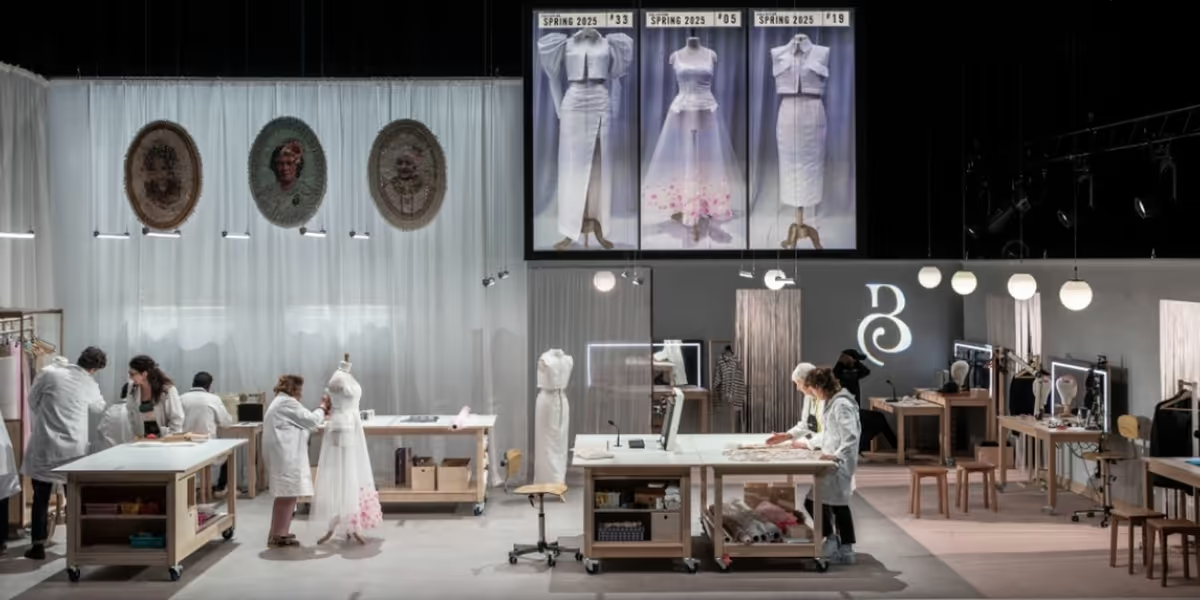
 It is a testament to the genius of Caroline Guiela Nguyen’s play (though ‘event’ suits Lacrima better) that I was transported back to two worlds that lie decades in my past. Stuff started bubbling up, some of it nostalgic, some of it… well, the word these days is triggering. For three hours with just a brief break for respite, I, like those around me, sat unable to move, at times barely able to breathe - a leitmotif that ran on both sides of the fourth wall - transfixed and terrified.
After a framing device that had echoes of Romeo and Juliet (and that wouldn’t be the last time Shakespearean tragedy was evoked), we’re no longer in an empty haute couture atelier, but a busy one, some months earlier. The workers wear white coats, the light is harshly bright and conversations are business-like, not social. The atmosphere is somewhere between a hospital and a church.
I recalled a private visit, 34 years ago, to the Maison de Lanvin, like the fictional house in the play located in Rue du Faubourg Saint-Honoré, and that was exactly how it felt. A place of work as much as art, of history to be honoured while always innovating, of confidence rendered fragile by the weight of the past and the unknowability of the future. I also felt the thrill of planning a new season’s collection well up from my time working in a buying office, the talk of colour, styling, silhouette, the regeneration of creativity, the envisioning of a world as yet only visible to us privileged few.
And, no longer with the sting such talk once carried, I remembered something I knew instinctively the moment I took time to think about it - fashion matters. I had to defend that assertion because my contemporaries from University College London’s Law Faculty were barristers, something or other in the just Big-Banged City or advertising execs making silly money and wearing silly braces. They asked me what the hell I was doing messing about with capri pants and jodhpurs all day. I told them that the modern world does not happen without fashion (The Silk Road was not as well known then) and that the psychological urgency of fashion was democratic and blind to ethnicity or history. The urge to dress up was and is universal, visible in cave paintings, never mind Egyptian pyramids. A world without lawyers, without stockbrokers, without advertisers is easily imagined (even desired) - a world without fashion designers is not.
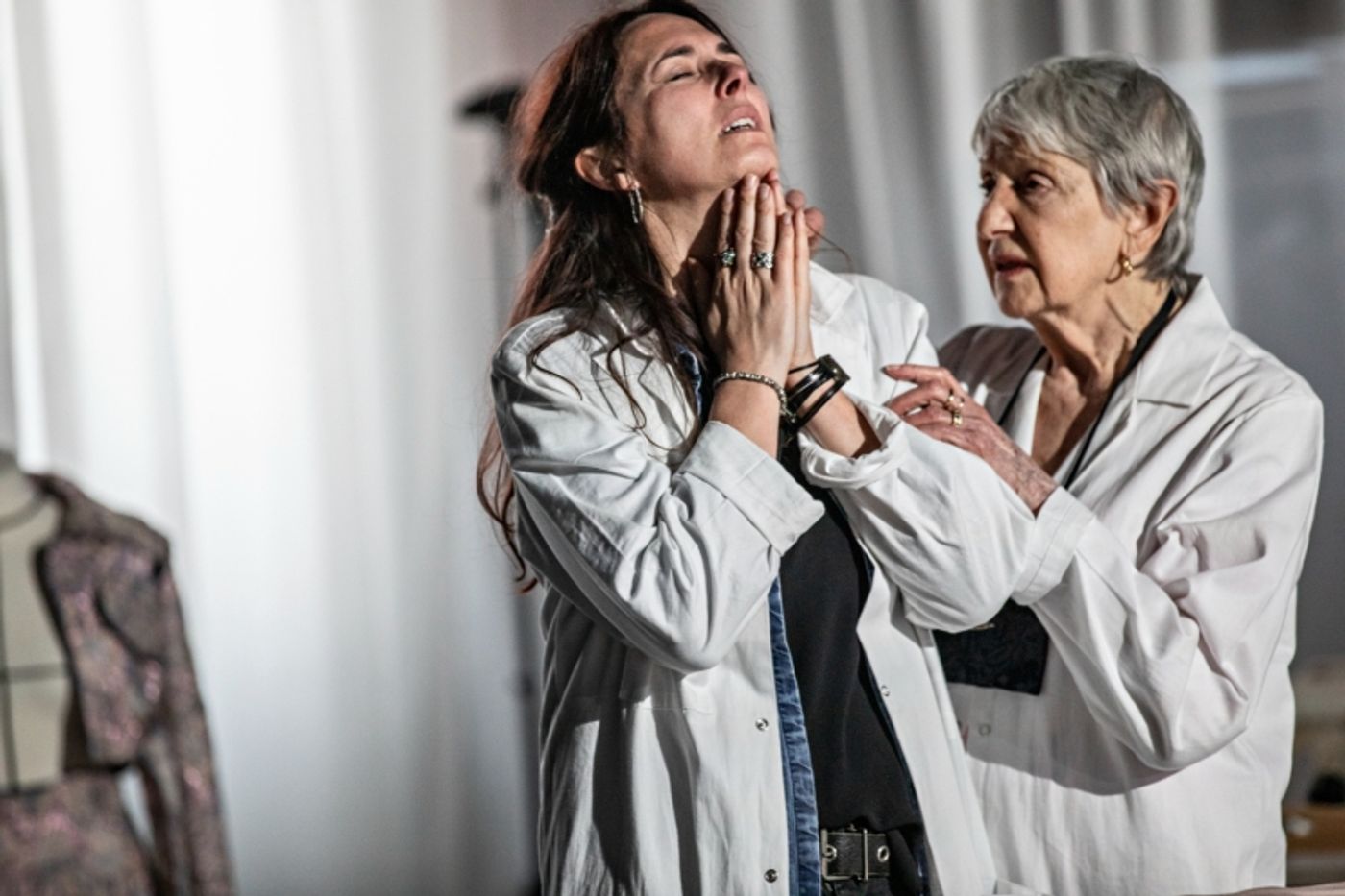
All that lands on the shoulders of the chef d’atelier, Marion (the devastating Maud Le Grevellec), when her maison’s designer wins the commission to produce the wedding dress for the Princess of England’s upcoming ceremony. That the play is in multiple languages and mainly surtitled into English, does not diminish the jarring impact of ‘Princess of England’, but the French did away with royals of course, if not the pomp and circumstance that surrounds them. It’s one of a surprising number of slyly humorous moments in a production that deals with one serious issue after another.
The artisan team swings into action, the near impossible demands of the princess and the designer (down the line on Zoom, one of many instances of superbly integrated video work by Jérémie Scheidler) to be met, as deadlines rush towards them. Soon, fissures emerge in the team - Marion is married to the chief pattern cutter FFS! - and her daughter is doing an internship on site. Everything is bottled up - the emotions, the tensions at home, even the dress itself, protected by a cast iron confidentiality agreement. It’s a Shakespearean court in the First Arrondissement and it’s not going to hold.
That’s just one of the three interlocking stories. In Alençon, traditional lacemaking is dying, its practitioners literally so, the craft surviving only with the women who learned at their mothers’ side, as they had learned from the nuns deeper still in the past. They’re charged with restoring a century old veil from the Victoria and Albert Museum, a critical accessory and the key to the dress design. We learn of their pride in their tradition, of the appalling toll on women’s health the intricate work exacted and, in brilliantly realised character writing and acting, the interior lives of the workers who give so much for so little in return.
The third story - running concurrently on a set, by Alice Duchange, that is both a delight for the eye and almost magically flexible (and don’t get me started on Benjamin Moreau’s costumes and couture pieces) - takes us to Mumbai for the embroidery of the dress. Over 200,000 pearls must be applied and there’s just one man who is trusted with the work.
Cue globalisation, something that’s been around for millennia in this industry, with Western principles of ethical business practice butting up against Indian tradition with its power relations more Dickensian than enlightened. The barbs cast at the Europeans’ high-minded rhetoric, embodied in protocols but insulated by the privacy of subcontracted terms and conditions hit home. Where is the long term funding to support structural change living from one contract to the next? Again, forty years ago, I wrestled with my conscience as I signed contracts that I knew were only deliverable through working conditions that would not comply with UK law.
As the big day approaches, tensions in the three workplaces become near unbearable. I knew that feeling too, having worked on university inspections, the regulator, QAA, not quite as ferocious as OFSTED, but with professional stakes just as high.
That buried guilt of neglecting oneself and one’s family, as all resources - time, emotion, health - go to the project, surfaced after two decades forgotten. And I also saw just how exciting it was to work later and later bound almost physically to a team doing good work, to live on a permanent adrenaline rush, to see progress in real time instead of endless discussion and prevarication. It was hell, but, my God, it was fun too. Few plays speak truths like this one.
Epic in scale, this is a production like no other, a monument of 21st Century Theatre. It makes considerable demands on its audience but repays that effort a thousandfold. It also leaves you with a gut-punch of an epilogue that is simultaneously shocking and entirely expected.
And perhaps more than anything else, it renews one’s faith in the extraordinary, unique, vast power of theatre.
Lacrima is at Barbican Theatre until 27 September
Photo images: Jean Louis Fernandez






Reader Reviews
To post a comment, you must register and login.