


Review: ANNA KARENINA starring Natalie Dormer, Chichester Festival Theatre
Magnificently opulent adaptation of Russian classic provides wonderful entertainment
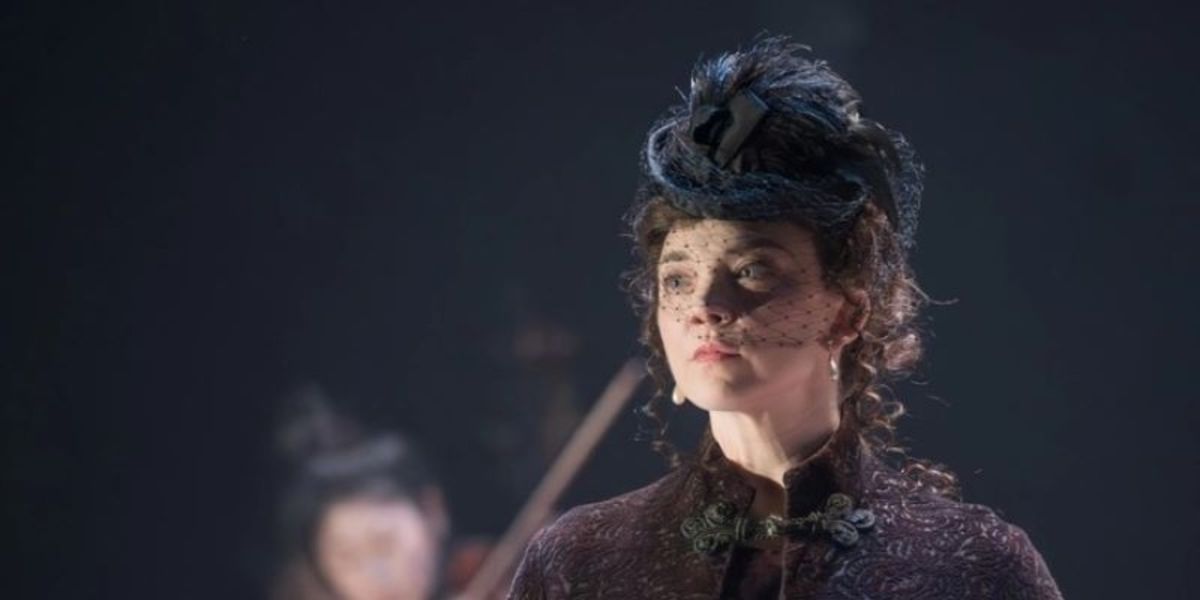
 How do you adapt a book that comes in at 38 hours in its Audible version for the stage? Of course, you don’t. You choose the characters to foreground, the narratives to develop and you use every device in the theatremaker’s toolkit to fill in whatever gaps start to emerge. Most of all, you make sure that the play stands alone as a work in its own right. Director/adaptor Phillip Breen has delivered that brief superbly at Chichester Festival Theatre with his Anna Karenina.
Tolstoy’s epic will not have been read from cover-to-cover by many filing in for over three hours of emotional intensity leavened by many laughs, so constructing the armature for the storytelling is crucial - a little exposition is more forgivable than would usually be the case. Conversely, the novel is such a monument of European culture that many will have seen a film or television adaptation or heard the title dropped into conversation as a kind of shorthand, and you don’t want them tapping their fingers. Finding a happy medium that works for everyone on a spectrum from superfans to newbies is always the adaptor’s conundrum.
Wisely, rather like the book itself with its famous quote about happy and unhappy families, things start with a bang. Everyone looks gorgeous, Ruth Hall’s costume work is as good as any I’ve seen at this venue (or anywhere else). Jonnie Broadbent gets laughs as the waster/philanderer Stiva, his longsuffering wife, Dolly (a fantastic Naomi Sheldon, channeling Joan Rivers) fires off plenty of barbs of her own in the crossfire and the ground is laid for the marriages that will be made, the marriages that will be maintained and the marriages that will be dismantled.
Two love affairs drive the action. The 18 year-old going on 12 year-old Kitty is devastated after being rejected by the dashing military man Count Vronsky and eventually settles for the decent, but dull, Levin. Vronsky has his eye on the eponymous Anna, but she’s married to the much older Karenin with only their young boy holding them together. Vronsky barely raises a sabre to win her so ill-suited is her match, but she loves her son and she can’t quite bury the shallow decency of her husband and commit to a new life - and the scandal that comes with it.
Natalie Dormer is another name-above-the-title screen star leading in a showcase play, but this is no mere stunt casting, as she delivers a tremendous performance, brokering her ethereal beauty and charisma into acting that I do not expect to see bettered this year. She is utterly compelling, not least in her tragic descent into morphine-addicted depression as the ruthless Karenin, played with ice-cold detachment by Tomiwa Edun, excavates her motherly guilt. She gets the lighter moments right too, vital to pull at us because this woman has so much to offer, but can’t find the stability she needs to live. Of course, there’s an element of self-sabotage, but Tolstoy shows us it’s the institution of marriage that is to blame, not those caught in its net.
Breen’s language has some of the formality of upper class conversation in the late 19th century, but he’s unafraid of interpolating 21st century elements, including a few swears that work surprisingly well. There’s a payoff too when the Greek Chorus of Moscow society scorn Anna and Vronsky at the opera and we’re instantly reminded of a present day social media pile-on. Judging women is nothing new.
Seamus Dillane doesn’t quite find Vronsky - too dashing and he’d simply whisk Anna away forever; too much of a milksop and you would wonder why this intelligent woman ever risked all for him. Maybe, to bastardise the famous families quote, he’s proof that all men are stupid in their own ways - at least those who aim for the likes of Anna are. You’ll have to trust me on that…
There’s subtlety and humour in the on-off relationship between Kitty and Levin. Shalisha James-Davis’s young bride somehow grows less and less immature without really becoming mature, but we’re never invited to treat her with contempt although she might be tricky company 24/7. David Oakes vests Levin with a bookish detachment and you do fear that, ten years down the line, Kitty will have her head turned too. But he’s a version of Karenin without the soft-spoken hypocrisy, a man who is at ease with being second choice, his life attached to animals and land as much as to people. They also get a lot of laughs, especially in a childbirth scene that is as terrifying as it is funny.
Roll in Russia’s aristocracy and peasantry, many of whom get some pretty good lines of their own and wonderful evocative music played on stage by Kotaro Hata’s Japanese three piece band, and the production gains an almost operatic scale - an event as much as a play!
But, despite all that visual splendour, despite all the baggage that comes with the title, the fundamentals established by Breen are so strong that we keep coming back to Anna and her tragedy. Some may quibble about the absence of the big finish, but do we really need to see it, as we see Puccini’s Tosca jump from the ramparts?
I’d say not - after all, that train had been a long time coming.
Anna Karenina at Chichester Festival Theatre until 28 June
Photo images: Marc Brenner






Reader Reviews
To post a comment, you must register and login.