


Review: THE MINUTES Exposes the Complicity of Silence
At Live Theatre Workshop, a town’s cheerful façade crumbles under scrutiny.
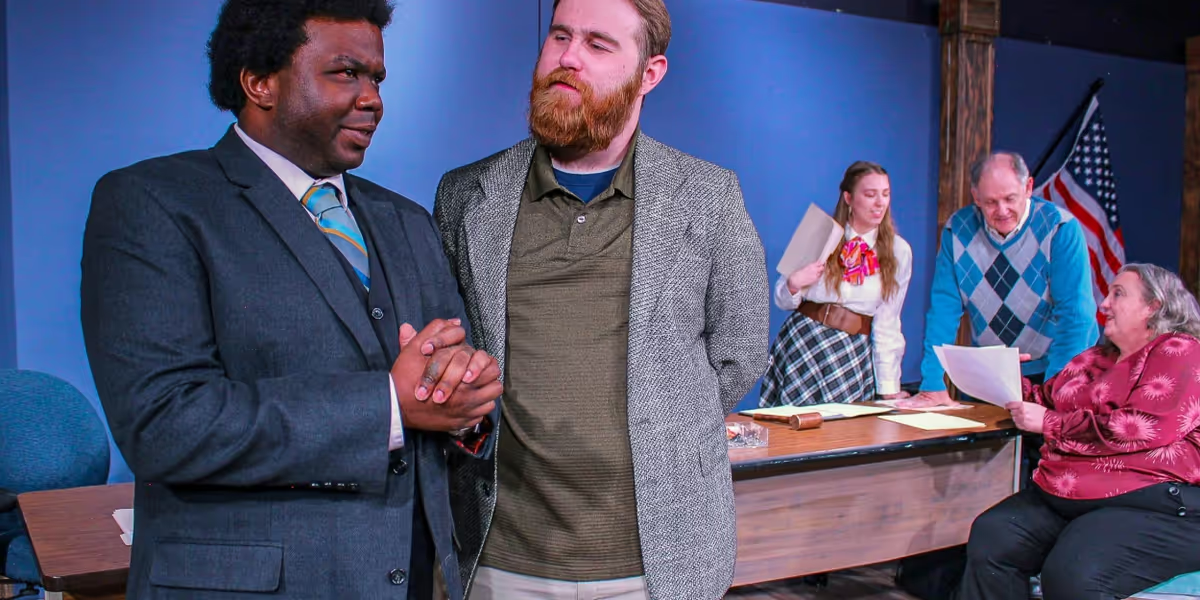
Big Cherry is a small fictional town that frames modern America's complex and divisive self-image. It's the setting for Tracy Letts' Pulitzer Prize-nominated play, THE MINUTES, which paints a microcosm of a proud nation's imperfect experiment—where tradition is prized, civic rituals are sacred, and discomfiting truths are carefully kept out of sight.
The playwright sets the stage with the humdrum mechanics of a council meeting, where the wheels of local government turn with all the excitement of drying paint. Council members bicker over bike racks and heritage festivals, clinging to the rituals of small-town pride and parochial decorum.
Yet, beneath the polite exchanges and procedural motions, a palpable sense of unease grips the room, subtle at first and almost easy to dismiss. The council's minor disputes and awkward camaraderie hint at deeper fractures, though no one dares to name them.
Director Rhonda Hallquist helms a stalwart 11-member ensemble, carefully teasing out the tension and gradually widening the cracks in Big Cherry's cheerful façade. The pacing is deliberate, the humor dry and edged with discomfort, causing the eventual shift in the atmosphere to feel both inevitable and deeply unsettling.
Though almost too large for the space, the cast works in remarkable sync, each actor capturing the faithfully curated normalcy of provincial life. Performances are restrained but layered, indicating hidden agendas and quiet desperation beneath the characters' jovial professionalism. As the meeting unfolds, subtle shifts in body language, tone, and timing deepen the sense of apprehension without ever feeling forced.
Staging a production of THE MINUTES in LTW's thrust setting presents significant challenges, particularly with an ensemble this large. The straight, upstage lineup of desks, from stage right to left, felt stodgy and drained some of the visual tension from the room. (I've never been a fan of straight lines.) I considered the obvious alternative: arranging the actors to engage the audience on all three sides. However, that would also pose challenges, given the static nature of a council meeting, where movement away from one's station would serve no purpose beyond the theatrical artifice of drawing an audience's attention. In a world of negotiated compromises, the company's preferred composition was the path of least resistance. Maintaining sightlines and coherence for all three sections of the audience required practical adjustments.
Among the ensemble, Mr. Peel (played with deferential persistence and mounting urgency by Dawson Woolridge) emerges as the unlikely disruptor. New to the council and still learning the unspoken rules of Big Cherry, Peel's genuine curiosity and polite but probing questions begin to unsettle the room's guarded equilibrium. Where others accept half-answers and evasions as part of the civic ritual, Peel refuses to let discomfort slide, jawboning his colleagues to confront the mystery beneath the town's polished surface.
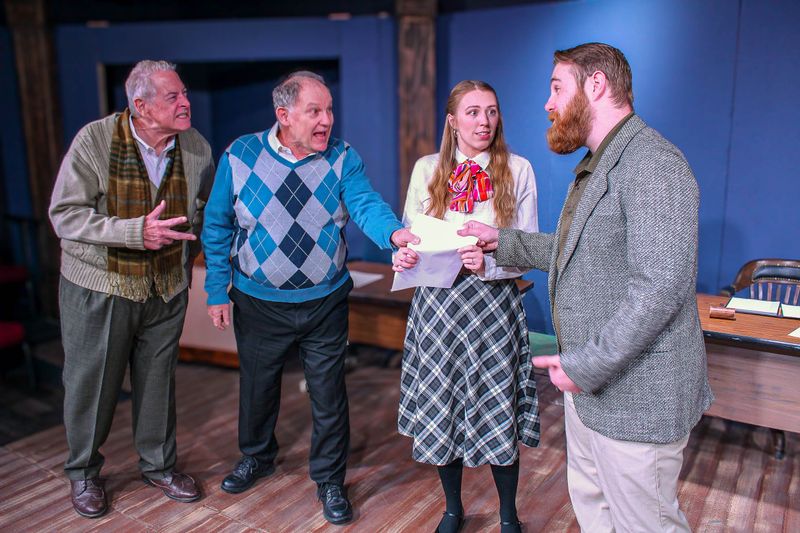
As Peel's questions grow more pointed, the room's genial atmosphere turns brittle. Long-simmering tensions surface, and the council members—once cordial, even bumbling—become defensive, evasive, and, at times, quietly menacing. What initially seemed like bureaucratic ineptitude begins to reveal itself as something far more troubling: a collective effort to preserve a safe and cherished narrative, no matter the cost.
Despite its small-town setting, The Minutes reflects a national conversation about fringe efforts to revise America's pluralistic history. Across the country, battles rage over how our collective past is taught, remembered, and sanitized—whether through rewriting school curricula, daring colleges to eliminate diversity programs, or pushing to promote a more "patriotic" version of history. Just as the citizens of Big Cherry cling to a comforting, made-up narrative, so does the nation grapple with the tension between myth and truth, pride and accountability.
At the heart of the play lies the bitter debate over the town's origin—a controversy surrounding a long-commemorated event that reveals troublesome contradictions under closer scrutiny. What begins as a procedural discussion about a public monument gradually evolves into a broader struggle over whose version of history will prevail and at what cost.
As the debate unfolds, it becomes increasingly clear that Big Cherry's very name—once worn as a badge of civic pride—has its roots in a brutal act of racial violence. Letts handles this revelation with chilling precision, forcing the town and the audience to confront the costs of preserving an insidious myth.
Throughout the meeting, certain council members reveal themselves as more than just civic functionaries; they become defenders of the town's collective myth.
Mayor Superba (played with affable authority by David Alexander Johnston) anchors the council, projecting an air of pragmatic leadership even as he steers discussions away from unsavory truths. Meanwhile, Mr. Oldfield (infused with cantankerous charm by Eric Rau) clings fiercely to traditional narratives, his defensiveness growing sharper with every probing question.
In contrast, Ms. Matz (the quirky and priceless Kat Basso) exhibits a quieter discomfort between loyalty to the town and a dawning recognition of the moral compromises it demands. Other standouts include Brian McElroy as Mr. Hanratty, whose piquant affectations and sudden flashes of defensiveness sharpen the play's tonal shifts; Leslie J. Miller as Ms. Innes, who brings a flinty pragmatism that quietly underscores the stakes of the debate; and Dave Sewell as Mr. Breeding, whose reactive bluster masks a deep-seated prejudice as questions aimed his way.
I'd be remiss if I didn't mention Jonathan Heras, who brings a sly watchfulness as Mr. Assalone, and Dante Crossroad, who gives Mr. Blake an earnestness that curdles into outright hostility. Completing the council ensemble is Kaylee Wilson, whose upbeat efficiency as the council clerk belies her inner conflict as the recorder of minutes and default keeper of the town's official story.
Each nuanced performance contributes to the creeping anxiety that steadily consumes the room. Together, these figures portray a community struggling not only with its past but with the limits of the stories it tells itself to survive.
The growing fracture in the room becomes undeniable with the eerie "return" of Mr. Carp (a hauntingly earnest showing by Cliff Madison), the council member whose unexplained absence has loomed over the meeting. His sudden reappearance—a spectral and unnerving flashback—casts a shadow across the proceedings, a living embodiment of the truths the council tried to erase.
A surreal ensemble ritual follows: a chilling communal act that strips away the last of Big Cherry's civic polish. In these moments, the production leans into horror, revealing the cost of collective denial not through grand confrontation but through deeply disturbing complicity. If I could nitpick, I might wish the ensemble had taken the ritual a fevered notch higher, committing fully to the frenzy of the cult-like fervor it suggests.
As the meeting barrels toward its final revelations, the genial façade of Big Cherry collapses. What once seemed like harmless civic posturing gives way to something far more chilling: a coordinated unwillingness to confront the truth, even as it festers in plain sight. LTW's production resists the temptation to sensationalize this turn, allowing the horror of complicity to emerge in slow, excruciating detail. The result is a devastating meditation on the price of comfort and the fragility of collective memory.
While battles over history and identity dominate our daily algorithms, THE MINUTES feels less like satire and more like an urgent reckoning. Big Cherry may be fictional, but its story is all too real, as we observe the minutes of our own civic life being (re)written.
Photo Credit: Stephen Frankenfeld
THE MINUTES continues through May 18. For tickets, call 520-327-4242 or visit

|
Proof Temple of Music and Art (9/27-10/17) |

|
Peter Hook And The Light The Van Buren (9/15-9/15) |
|
Nunsense Hale Centre Theatre Arizona (1/19-3/23) |

|
Annie Hale Centre Theatre Arizona (10/09-11/21) |

|
Bright Star Hale Centre Theatre Arizona (7/09-8/14) |
|
80’s New Wave Tribute: The Police, The Cars, Talking Heads and Elvis Costello and More Hale Centre Theatre Arizona (9/11-9/26) |
|
Catch Me If You Can: The Musical Hale Centre Theatre - Arizona (8/21-10/03) |
|
The Rocky Horror Show Marroney Theatre (10/11-10/25) |
|
Oklahoma! Hale Centre Theatre Arizona (2/11-3/27) |
|
Showcase: CINDERELLA Musical Theatre Alliance of Arizona (1/16-1/16) |
Reader Reviews
To post a comment, you must register and login.