


Review: THE BOOK OF MORMON at ASU Gammage
The production runs through January 11th at ASU Gammage in Tempe, AZ.
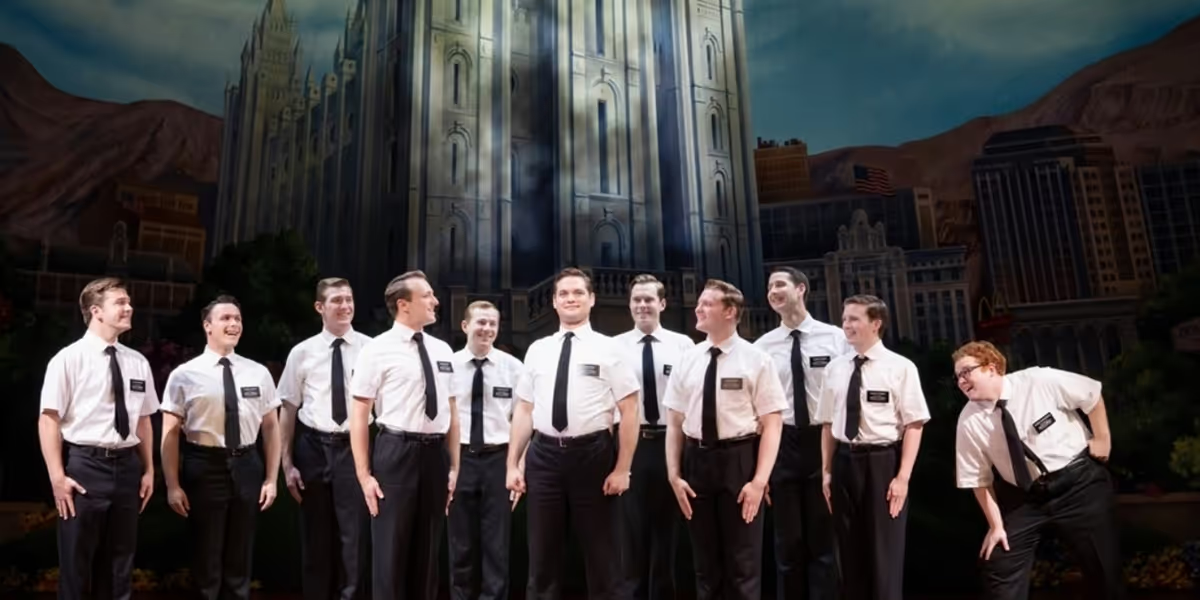
Guest contributor David Appleford gives a thumbs up to the North American tour production of THE BOOK OF MORMON at ASU Gammage.
In a theatrical era where standing ovations are dispensed like party favors, THE BOOK OF MORMON at ASU Gammage on its opening night elicited a reaction that felt less like polite approval and more like an arena rock concert. Audiences weren’t just clapping, they were erupting, unable to contain their sheer delight.
Back in 2011, writers Trey Parker and Matt Stone, the irreverent minds behind TV’s SOUTH PARK teamed up with AVENUE Q’s Robert Lopez and wrote a raucous musical revolving around the plights of two Mormon missionaries. What they created for Broadway was a full-throated, full-bodied lampoon that both eviscerated and adored its subject in equal measure, beginning with an over-the-top, broadly presented parody of the once famous Palmyra, New York outdoor pageant that dramatized Joseph Smith’s encounter with the angel Moroni. From there it launched headfirst into the ritual of young Mormon missionaries shipping out to spread the gospel.
The cast, now playing at ASU Gammage until January 11 and directed by Jennifer Werner, is young, vocally strong, and physically tireless, delivering Werner’s choreography with crisp, almost military precision. It’s a testament to how well this tour, launched in 2022, captures the show’s trademark blend of sweetness, irreverence, and politically incorrect glee. Scott Pask’s scenic design is now scaled down, moving from elaborate, automated set pieces to simpler versions, with a smaller Moroni perched on high like a golden exclamation mark, yet the sets still dazzle in key moments where Brain MacDevitt’s lighting and staging achieve Broadway-size spectacle within touring limitations.
Our two mismatched missionaries, bright-eyed golden boy Elder Price (Sam McLellan) and lovably schlubby Elder Cunningham (Jacob Aune), are packed off to Uganda, a setting that gleefully upends their meticulous doorbell ringing training.
The actors nail the chemistry; McLellan is all smug confidence until he’s left to flounder, and Aune, mercifully, doesn’t let the role sink too far into caricature. His slovenly, over-eager Cunningham remains a laugh-out-loud comedic creation. Price, who had prayed to be sent to Orlando (think Disney, SeaWorld, Putt-Putt), is scandalized with his new overseas mission. Those Ugandan villagers don’t even have doorbells to ring!
On the other hand, his partner, Cunningham, a compulsive fabulist with a penchant for sci-fi embellishment, takes to his new role with unchecked enthusiasm, weaving Star Wars and Lord of the Rings into his off-the-official-script, self-styled missionary work.
As for the book, you can just imagine writers Parker and Stone in fits of laughter when they came up with the idea of sending two whiter-than-white Mormon missionaries to Uganda. As Elder Price sings with unwavering conviction in the comically inspirational I Believe, it wasn’t until 1978 that God changed His mind about Black people. For the Mormon Church, Uganda was uncharted territory, and Parker and Stone milk that irony for every drop of comedy.
Those who have lived with the musical long enough to know where every punchline used to land may notice that the national tour has quietly adjusted its aim. The adjustments grew out of a 2020 letter from Black cast members who urged the creative team to reexamine moments that felt less like satire and more like inherited stereotype. Writers Parker, Stone, and Lopez responded with a two-week workshop that put the script under a microscope, line by line, joke by joke.
The musical is still gleefully profane, still powered by that familiar engine of bad taste deployed with unnerving precision, but the script has been fine-tuned in response to long-standing concerns about racial caricature and who, exactly, gets to steer the story. The good news is that these revisions don’t sand down the show’s edge so much as redirect it.
Most noticeably, the Ugandan characters are allowed more authority over their own fate. In a small but symbolically potent change, it is now the young daughter, Nabulungi (a radiant Charity Arianna), not a white missionary ‘savior’, who sends the warlord packing, a gesture that rebalances the moral weight of the scene. Plus, Price and Cunningham refer to the locals as “villagers,” a word that gestures toward humanity, while older authority figures like the Mission President and Price’s father persist in calling them simply “Africans.” The contrast is a deliberate generational tell, a reminder that the ugliest simplifications tend to harden with age and hierarchy. In the musical, ignorance isn’t evenly distributed, it’s inherited, institutionalized, and spoken most confidently by those who think they already know the world.
Elsewhere, the humor has been modernized. A once-broad joke about Nabulungi using a typewriter to send a text has been replaced with her wielding an iPad, shifting the target from her presumed naïveté now to the absurdities of social media. Plus, cringing misinformation mentioned in Hasa Diga Ebowai is now attributed to Facebook rather than ancient myths.
But as far as musical theater goes, Parker and Stone’s deep love of the genre is everywhere. After the conclusion of the Palmyra prologue, the first song, Hello!, opens with the infectious bounce of a golden-age show tune, meticulously structured to pull the audience in. The big, brassy finales of nearly every number feel less like polite requests for applause and more like Pavlovian triggers. Try not clapping to a big finish; it’s impossible.
For those uninitiated, let’s be clear: THE BOOK OF MORMON is not for the easily scandalized. It shocks, and it wants to shock, but always in service of the laugh. When it works, it’s a big, cathartic, uncontrollable kind of laugh, the kind that had Gammage audiences roaring with approval.
The show still walks a razor-thin line between parody and offense, and not every audience member will agree where that balance lands. And that has always been the paradox of this show. It’s a musical that skewers belief while celebrating the very joy of believing. Some jokes have aged less gracefully despite the new script tweaks, and the tour’s scale and polish don’t quite match Broadway’s. But its irrepressible spirit, its unapologetic exuberance, and its sheer musical craftsmanship still remain intact. And unlike the customary ovation-as-obligation seen in too many valley theaters, this one was definitely earned.
ASU Gammage -- https://www.asugammage.com/ -- 1200 S. Forest Avenue, Tempe, AZ -- 480-965-3434
Photo credit to Julieta Cervantes
Prefer BroadwayWorld in Google Search?
Add us as a preferred source so our stories show up more often in Top Stories and Google’s AI answers — for you.
Sign up for all the news on the Fall season, discounts & more...
|
Proof Temple of Music and Art (9/27-10/17) |
|
EUREKA DAY Stray Cat Theatre (10/09-10/17) |
|
MY MAN GODFREY Don Bluth Front Row Theatre (1/21-2/27) |

|
The Tempest Arizona Theatre Matters (10/05-12/31) |
|
A Room in the Castle Flagstaff Shakespeare Festival (9/19-10/03) |
|
The Comedy of Errors By William Shakespeare Adapted by Stephen Frankenfield Live Theatre Workshop (9/18-10/11) |
|
The Lightning Thief: The Percy Jackson Musical Valley Youth Theatre (10/09-10/25) |

|
Clue Hale Centre Theatre Arizona (12/31-2/06) |
|
THE MALTESE FALCON Don Bluth Front Row Theatre (5/20-6/26) |
|
The Taming Beaver Street Theatre (9/17-10/04) |

Reader Reviews
To post a comment, you must register and login.